Subscribe to Our Newsletter
Sargent in Spain

The landscapes and people of Spain were important subjects in the paintings of master artist John Singer Sargent.
By Sarah Bochicchio
In a 1908 painting from his time in Majorca, John Singer Sargent depicted yellow pomegranates clustered on a tree. Within the leafy embrace of its branches, several fruits split open, revealing the jewel-like seeds bursting from beneath the rinds. Without any visible sky or earth, the yawning green, orange and yellow are punctuated only by pockets of ruby; you can feel the warm breeze, inhale the tangy, citrus-like scent, see nothing but the depth of the vegetation. It is abstract and vivid, loving and sensual—an exceptional montage of the energy, color and natural beauty of the island. In many ways, the painting feels a moment of devotion to the nation that, at the moment of this work, Sargent had visited and revisited for the last three decades.
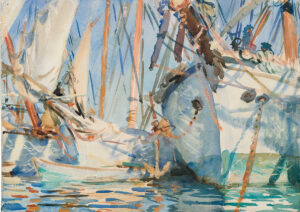
White Ships, 1908. Watercolor over graphite with gouache and wax resist on paper, 13 7⁄8 x 19 3⁄8 in.
Brooklyn Museum, Purchased by Special Subscription 09.846.
Sargent had made his first trip to Spain in 1879, marking the first of seven journeys that would animate his outlook and nourish his aesthetic imagination for the rest of his career. He was 23 years old, and he was following the example of more established artists such as Édouard Manet and Charles-Emile-Auguste Durand (also known as Carolus-Duran), who had come to revere Diego Velázquez as a prototype for the radical art toward which they were striving. Sargent’s voyages to Spain mark different periods of his own career, from the moments he spent in emulation of elders to developing his own relationship to the country and its artists.
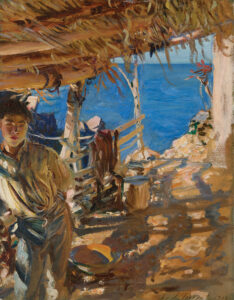
Majorcan Fisherman, 1908. Oil on canvas, 27 1⁄2 x 21 1⁄2 in.
Private Collection
The various images that Sargent produced during and in response to his time in Spain will be brought together through “Sargent and Spain” at the National Gallery of Art in Washington D.C. Coming up in October, the exhibition presents Sargent’s oil paintings, watercolors, drawings and photographs, curated by Sarah Cash, their associate curator of American and British paintings, and Sargent-experts Richard Ormond and Elaine Kilmurray. The curators explore Sargent’s travels and artwork, set against the country’s cultural and political landscape, as well as the Old Masters, religious themes, music and dance that inspired him. In the process, they draw out the styles and themes that earned Sargent the moniker, “Velázquez come to life again.”
Sargent was born in 1856 in Florence, to American parents. His parents, Fitzwilliam Sargent, a physician, and Mary Newbold Singer, an artist, had left Philadelphia for Europe in 1854, seeking a change of climate, but they ended up staying on the continent as expatriates. The young Sargent spent his childhood and adolescence in Italy, France, Switzerland and Germany, moving between the city and the countryside. Although he did not receive a formal education, his parents taught him various disciplines, from geography and mathematics to piano and drawing.
In the early 1870s, Sargent studied briefly at the Accademia di Belle Arti in Florence, and then in 1874, he entered the atelier of Carolus-Duran in Paris. Carolus-Duran was a painter best known for his fashionable society portraits. As a teacher, he encouraged his students to paint without preliminary sketches, pushing them to free and energize their brushstrokes. He had traveled to Spain before settling and Paris and had been completely enchanted by both the physical landscape and the paintings he had encountered. He reportedly told his students, “Velázquez, Velázquez, Velázquez, ceaselessly study Velázquez,” as he urged them to unite traditional and avant-garde techniques. Scholars have noted how closely Sargent followed his teacher; he worked with Carolus-Duran for the next four years, learning his style and eventually heeding his advice to study the Old Masters.
Sargent embarked on his first journey to Spain in 1879 with the specific intention of studying Velázquez. The curators describe 19th-century Spain as “a land that was economically poor but culturally rich and complex,” a waning power with extraordinary collections of artwork and architecture. They also suggest that by this time, there seems to have been a tourist route developed specifically for artists who were following the hispanophile vogue, indicating that Sargent was in merry company. He spent the trip doing research, collecting photographs and sketching what he saw, from the architectural colonnades in the Alhambra to museum holdings. The register at the Prado records that, while there, Sargent copied nine paintings by Velázquez and one painting by Ribera.
Following his trip to Spain, Sargent continued to Holland and Venice, but his visits to Madrid, Toledo, Seville and Granada had already made a lasting impression. Velázquez and Goya inspired the two paintings that he submitted to the 1882 Paris Salon. His full-length portrait of Charlotte Louise Burckhardt, Lady with the Rose, for example, depicts his cosmopolitan friend in with a tonal palette drawn directly from Velázquez. Standing against a shallow, beige backdrop Burckhardt recalls the master’s likenesses of the Spanish court. The subject also donned a black dress, ornamented with bows, tulle overlay, and a Renaissance-esque ruff reminiscent of Spanish fashions. The portrait was accepted to the Salon, and Henry James, the novelist and fellow expatriate, reported that the painting displayed, “the slightly ‘uncanny’ spectacle of a talent which on the very threshold of its career has nothing more to learn.”
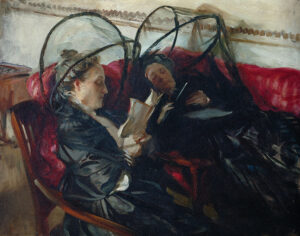
Mosquito Nets, 1908. Oil on canvas, 22 1⁄2 x 28 1⁄4 in.
Detroit Institute of Arts, Founders Society Purchase
The second submission, El Jaleo, even more overtly referred to Sargent’s travels. The monumental painting refers to an Andalusian dance, featuring a woman in the throes of a performance, twirling in front of the guitarists. In the spottily lit room, figures clap and snap their fingers to the music; the word olé is lightly but literally scribbled on the wall. Sargent captured the posture, emotion and musicality of both flamenco and its songs. But it is not only the subject that is heavily indebted to his trip—Sargent painted the scene with dark outlines, restless brushwork and melodrama that earned him the nickname “Goya Modernisé” (“Modernized Goya”).
The combination of expressive style and subject were quite radical—indeed, Sargent’s contemporaries lambasted and caricatured the work. In the catalogue, Ormond and Kilmurray explain how contemporaries might have interpreted it, writing, “The subject matter is at once nostalgic and transgressive—it is a painting not of modern life but of an underclass painted in terms of high art.”
It thus becomes worth noting again that as progressive as Sargent’s work was, he was engaging with an existing tradition. In music, literature and art, his contemporaries were already exoticizing and romanticizing Spanish culture, particularly in relation to the Roma population. The curators point to the example of Petra Camara, a Spanish dancer who premiered at the Théâtre du Gymnase in Paris in 1851. Author Théophile Gautier wrote a poem about Camara and the painter Théodore Chassériau commemorated her in oil, watercolor and pencil works that are reproduced in the exhibition catalogue.
The upward trajectory of Sargent’s career was momentarily plateaued by Madame X, his controversial painting of society woman Madame Pierre Gautreau. The full-length portrait, which he had submitted to the 1884 Paris Salon, scandalized conservative viewers with its daring pose and the dress’s seductively fallen strap. Between the revealing dress, the subject’s spectral pallor and her rumored reputation as an adulteress, both Gautreau and Sargent were effectively spurned from Parisian society. Sargent ended up leaving France altogether, moving on to London, which he would call home for the rest of his life.
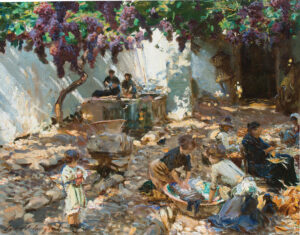
Women at Work, ca. 1912. Oil on canvas, 22 1⁄4 x 28 in.
Private Collection
During this period of notoriety, Sargent took professional trips to the U.S. and Egypt, but he did not return to Spain until 1892—whereupon he began traveling there quite regularly. His 1892 voyage was precipitated by a family visit to the town of Campródon; in 1895, he went again, this time to find inspiration for his mural for the Boston Public Library. By the 1890s, Sargent had recovered his reputation and was in high demand as a portraitist, sometimes painting three sitters a day, and he was elected to the Royal Academy in 1894.
Sargent was perhaps most productive in Spain in the 1900s; during his 1903, 1908 and 1912 visits, he produced over 100 new works. As enchanted as he had always been by the music, dance, religion and people of Spain, during his later trips, Sargent became increasingly focused on its architecture, landscape and decorative arts. When he visited in 1908, he was loath to paint more portraits (“No more paughtraits,” he had proclaimed to a friend) and instead drank in the vibrant colors of Majorca. During his last two trips, Sargent turned his attention away from society paintings, preferring to immerse himself in the daily life and the local, lush vegetation.
In Majorca, he wrote, “I am very content in this ravishing country,” and his attentions to the village and dazzling landscapes seem to prove it. In his painting from the same year, Majorcan Fisherman, the titular figure leans against the painting’s frame, drawing your eye toward the sketchy, sun-dappled path out to the azure sea. Unlike even his Madame X, the subject is unnamed and unknowable. In Granada, Sargent depicted women doing their household washing, workers, hospital patients, while observing the sun-filled spaces, palatial arcades and colorfully patterned tiles, all with a warm, impressionistic touch.
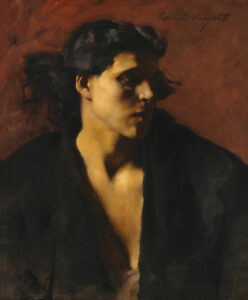
A Spanish Woman, 1879-80. Oil on canvas, 22 x 18 in.
Private Collection
As he moved away from portraits, Sargent remained on the avant-garde. In the catalogue, Cash highlights his close-ups of the natural world in particular; how he lingered on foliage and form, as in his pomegranate painting. Cash writes, “These are radical works of art that defy categorization, blurring the line between landscape and still life.” It feels as though, at this point, Sargent was most interested in producing works that reflected what he felt when he was in Spain—and the dynamics between the Spanish, their cities and their landscapes. When he was departing Spain after his last visit, Sargent expressed how hard it was to leave Granada, already anticipating a yearning he would feel until the end of his life.
Sargent died in 1925, leaving behind an enormous body of work representing an entire lifetime of travel and observation. Although he did not visit Spain again in the several years between his last visit and his death, the memories remained with him. On a visit to Miami in 1917, he reflected on “all that one is likely never to see again,” perhaps thinking of the sun-drenched facades in southern Spain, or the paintings that had moved him most at the Prado. He called the pang a “linger-longering,” a phrase suffused with nostalgia, but not with regret.

Subscribe to Art & Antiques for your Digital or Print copy