Subscribe to Our Newsletter
The Alchemist
With roots in the School of Paris, John Ferren helped define Abstract Expressionism, while finding his own reality
By William Corwin
Jimmy Stewart’s sleeping face turns blue, then flickers purple; he awakens and his eyes open; his face dissolves into a bouquet of roses, which in turn flutters away into a deconstructed assemblage of animated forms, while Bernard Herrmann’s pulsing score marks an anxious heartbeat.
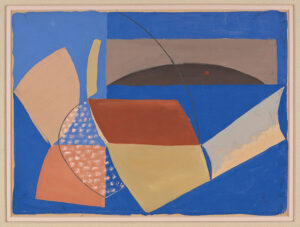
Mallorca, 1933, gouache on paper, 8 3⁄4 x 12 in.
Estate of John Ferren, Courtesy Findlay Galleries
How tempting it is to relate the surreal nightmare sequence described above in Alfred Hitchcock’s Vertigo (1958) to the series of flower and vase paintings that the painter John Ferren, who designed the film sequence for the great director, was creating just two years before the release of the film.
In The Bloom (1956), for example, Ferren offers the viewer a monumental parti-colored dahlia or chrysanthemum. Each petal is a single brushstroke, and the colors of the petals radiate or pulse from a hot fire-engine red at center, to purple, to green, to yellow, to ochre: a flower one could only see in a dream, or a nightmare. Around the main blossom are rhythmically fluttering white and brown petals. The correlation between oil on canvas and celluloid is the trademark of Ferren’s practice, a many-faceted use of media and various methods of execution, all correlating to a unified theme.
“Ferren was never bound by the shibboleths of style,”1 commented Dore Ashton fondly, over a decade after the artist’s death. He never followed one path too closely. He collaborated with Hitchcock on Vertigo and supplied the paintings for another Hitchcock film, The Trouble with Harry (1955), but he was not a film stylist or production designer.
Ferren immersed himself deeply in the Paris School for most of the 1930s and was close to Picasso and his circle, but he criticized Gorky for excessively imitating the master. And Ferren himself was called a traitor by Elaine de Kooning for rejecting the abstract in Abstract Expressionism—in the flower and vase paintings—yet, in 1955, he was director of The Club, the celebrated Manhattan-based assemblage of artists that was founded by abstract expressionist sculptor Philip Pavia in the late 1940s. These contradictions emerged partly from Ferren’s background, coming from the rugged Pacific Northwest, far from the cultural hotspots of the United States, and thus feeling like an outsider, first in Los Angeles, and later in New York and Paris. (One thinks of Pollock in the same vein.) The painter also pursued a lifelong odyssey of metaphysical discovery, initially through his familial Christian faith, but then investigating Taoism, Buddhism, and Sufism—all of which led him to the conclusion that artists needn’t tie themselves down to a particular method or medium.
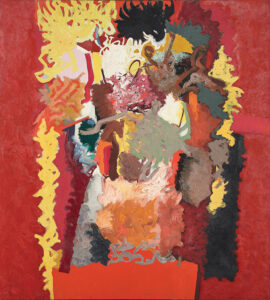
The Witch Doctor, 1963, oil on canvas, 65 x 59 in.
Private Collection, Courtesy of Jessica Jubelirer Design
John Ferren was born in 1905 in Pendleton, Oregon, the son of an army officer who moved his family around the West Coast until ultimately settling in Los Angeles. Ferren’s first love was acting, which he pursued briefly after high school. His performance skills served him well when he taught at the Cooper Union in the late 1940s and early 1950s, as well as at Queens College starting in 1952. Even though he eventually landed as an art teacher, his attempt to attend art school in 1925 quickly foundered and he instead chose an apprenticeship with a mason, where he learned the basics of stone carving. His art education followed that particularly casual trajectory emblematic of Paris in the early 20th century: Ferren took classes hither and yon in France, from 1929 into the early 1930s, at the Académie de la Grande Chaumière and the Académie Colarossi, as well as at Hans Hofmann’s school in St. Tropez.2
In Paris, the engaging American from the West Coast fit right in. He introduced Picasso to Dora Maar and assisted in stretching the canvas of Guernica.3 He spent time at Stanley William Hayter’s Atelier 17 and became good friends with Miro.4 Ferren’s friendships with Miro and Mondrian were particularly close, and from both artists we can see deep influences in his painting.
Especially in the case of Mondrian, more than two decades older than Ferren, we can imagine the philosophical influence emanating from the Dutch artist’s dedication to Theosophy, a religion (or “movement”) that draws influence from Hinduism and Buddhism, as well as Neoplatonic philosophy and the occult. Ferren, the painter, believed that abstract art held a sacred power—that rendering shapes and forms on canvas produced entities as viable as any in nature: “The forms of things were only the particular expression of an energy, or substance, which they all shared in common.”5 In Mallorca (1933), a work on paper, we see the artist playing with forms that hint at a corporeal existence, with shading and volume, but then lapse back into the purely two-dimensional, evaporating into simple black lines or a shimmering white filigree. Ferren was “a man who anticipated Abstract Expressionism and its aftermath.”6 In Mallorca, the solid forms never overlap, and they rest on a bed of various blues hues; however, they nestle in harmony and seem to evoke ruins or classical architecture.
Juxtapose Mallorca with The Desert and Flowers (1948), painted in New York when Ferren was firmly ensconced in the Abstract Expressionist movement, having moved into a studio on Greenwich Village’s 9th Street in 1946. He seems to have jettisoned his School of Paris thinking as well: “Comparing the classical concept of space which still haunts French painting to our [the Abstract Expressionists] space is like comparing a still photograph to a movie. A painting by Pollock ‘contains’ time in a way that is new.”7 Consequently we see less of the Braque and de Chirico of the earlier paintings, and more Rothko, Pollock, and Gottlieb. But there are, in fact, two paintings contained in The Desert and Flowers. In the background is a solid AbEx image—a yellow and orange circle embedded in the yellow and green rectangle of the canvas. Floating in some indeterminate space in the foreground is a selection of forms: a black, burnt sienna, and red ellipse at top, an off-white almost cloth-like apparition hanging down the right side of the canvas, a green rectangle, and a pair of dry-leaf-like forms slightly lower than center in sold black and red. Here are the seeds of what Elaine de Kooning eventually characterized as a “betrayal.” While not recognizable objects, they are forms existing in space, and the painter uses subtle gestures of shading and tone to imply physical presence.
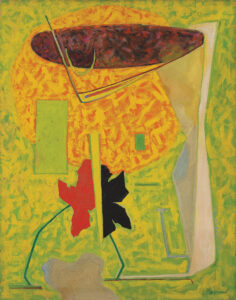
The Desert and Flowers, 1948, oil on canvas, 38 x 30 in.
Estate of John Ferren, Courtesy Findlay Galleries.
Between Mallorca and The Desert and Flowers much transpired, most notably World War II. Ferren advocated strenuously to be deployed and was assigned to the Office of War Information in the Psychological Warfare Division in 1942. In this capacity he wrote and edited radio broadcasts and texts to be disseminated to both allied and axis troops and civilians.8 Here again is another facet of the painter, that of eloquent ambassador for the cause of truth and justice. Ferren served throughout the theater of war in North Africa, Italy, and France (with distinction: receiving a Bronze Star and four Combat Stars)9. His most lasting reward, though, may have been exposure to the philosophies of the Middle East, which only further strengthened his resolve to paint (and sculpt) more expansively and independently.
Red (1952) sees a liberation of the carefully painted, hard-edged forms of the 1930s and 1940s. The painter has loosened his grip on the paint, and it expands riotously. Where there were carefully painted shapes and semi-regular patterns, there is bleeding and blurring. Neat lines have become the movements of a brush full of paint, expanding and contracting with the energy and pressure of the hand. And while Red has a certain cartographic layout, there is no sense of an arrangement of objects—simply patches of light transmogrified into oil.
While well reviewed and generally beloved by the art scene comprised of fellow artists and critics, lasting notoriety has obviously eluded Ferren, and this was because of his refusal to commit to a singular painting methodology. Taoist and Buddhist thought is represented in Ferren’s practice as oneness represented by diverse styles and media. It’s hard to argue with Ferren on his spiritual credo, but he did pay the price for hopping from Modernism to Abstract Expressionism to a more diaphanous symbolist painting style.
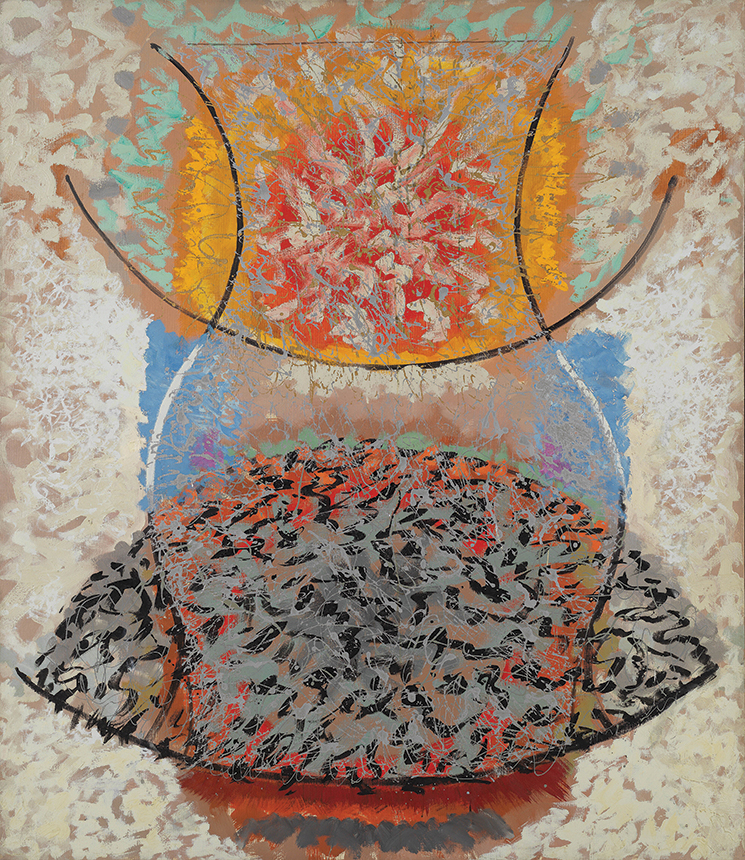
In trying to pin down the last phase of Ferren’s career, it seems expedient to view his whole life as one of experimentation: “Implicit within these paintings, however, is a similar dialectic that spread out across the whole career; control and chance, order and wildness, the geometric and the organic, are constantly held in suspended animation.”10 A painting such as The Vase (1956) was painted at the same time as Jasper Johns’s flags and targets, and is similarly postmodern. For Ferren, the vase is as much an investigation of a symbol, here a ubiquitous object, as Johns’s flags are an investigation of a practical and diagrammatic graphic image. The Vase is a complicated work. It refuses to let go of the painterly and expressionism of abstract expressionism, but it insists on delineating a recognizable form bluntly and without context. Laid over both the abstract/painterly and the symbolic (object) is a diagrammatic set of arcs which evoke a Hilma-esque mysticism without committing to an excessive didactic occultism (as in Hilma af Klint, Kandinsky, or Mondrian). While the painting is beautiful, it does confound and is less direct and blunt (and literary) than the path that Johns followed to express his interpretation of postmodernism.
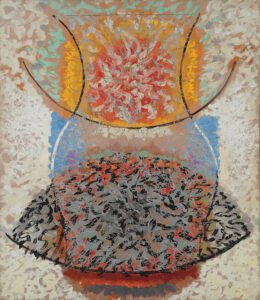
The Vase, 1956, oil on canvas, 73 x 64 in.
Estate of John Ferren, Courtesy Findlay Galleries.
Ferren, an old hand at actual propaganda from his army days, likely realized the limitations of the image to express specific philosophies. His late works are direct evocations of sublimity. In a painting such as Tierra Caliente (1961) he simply manipulates light, whereas in Shelly’s Choice (1968) he returns to hard-edge abstraction but with a very specific symbolic focus. In Tierra Caliente, a simple arrangement of a blurry, brushy yellow rectangle on a rose background encompassing the entire canvas is visually punctured by a burst of unruly strokes. This central form is a massive knot of color tendrils that cannot be untied; the black, blue, green, and orange lines form an inscrutable and heavy throbbing mass, and as if to ensure we understand that this seething form is the Subject—that it is life itself—Ferren underlines it with a thick blue dash.
Shelly’s Choice, painted two years before Ferren’s death, makes a bold and simple statement. The painter centers the form of a green and yellow mandorla, an allusion to the sacred lozenge that often accompanies the Virgin and Child in medieval painting, but the shape—flanked on either side by two hemispheres with stripes of color—also represents the portal through which life emerges. It is a hard-edged abstract painting that relies on the viewers to draw their own conclusions, and yet, it also seems a return to the French roots of his artistic education. In a sense, Ferren concludes by painting his own version of Courbet’s scandalously realistic L’Origine du monde (1866).
Ferren’s quest was to find the ineffable and fundamental in art, and he succinctly expressed his approach when speaking for the Abstract Expressionists (one of whom he proudly considered himself): “It was not a question of knocking over other Gods. It was a question of finding your own reality, your own answers, your own experience…We discovered a simple thing, yet far-reaching in its effects: the search is the discovery.”11
Notes
1.Ashton, Dore. Exhibition catalog essay in John Ferren. A.M. Sachs, 1982, p. 1.
2. All biographical information comes from Craig Bailey’s Ferren: A Retrospective. The Graduate Center of the City University of New York, 1979.
3. Ibid., p. 9.
4. Ashton, op. cit., p. 3.
5. Bailey, Craig. Ferren: A Retrospective. The Graduate Center of the City University of New York, 1979, pp. 6-7.
6. Cohen, David. Exhibition catalog essay in John Ferren, Major Paintings 1956-1964. Katharina Rich Perlow,
2003, p. 3.
7. Ferren, John. “Epitaph for an Avant-Garde,” ARTS (later Arts Magazine), November 1958, p. 26
8. Bailey, op. cit., p. 11.
9. Ibid.
10. Cohen, loc. cit.
11. Ferren, op. cit., p. 25.

Subscribe to Art & Antiques for your Digital or Print copy