Subscribe to Our Newsletter
Table for Two
The Met Considers the Intertwined Lives of Manet and Degas in an Exhibition Organized in Conjunction with the Musée d’Orsay
By Sarah Bochicchio
Édouard Manet (1832–1883) and Edgar Degas (1834–1917) met for the first time in the grand gallery of the Musée du Louvre. It was the early 1860s; both artists were in their late 20s and frequented the museum to copy Old Master paintings as part of their practices. As the story goes, on that day, Degas was copying Diego Velázquez’s Portrait of the Infanta Margarita (c.1660) directly on copper plate, when he was interrupted by Manet. Degas’s unconventional process shocked Manet, who (allegedly) declared, “How audacious of you to etch that way, without any preliminary drawing, I would not dare do the same!”
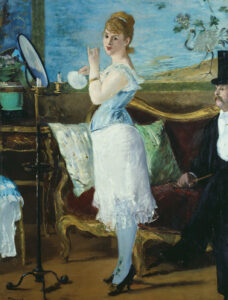
Édouard Manet, Nana, 1877, oil on canvas, 60 5⁄8 x 45 1⁄4 in.
Hamburger Kunsthalle, acquired 1924 (HK-2376), Image © bpk Bildagentur/Elke Walford/Art Resource, NY.
This first meeting was a coincidence, but, in retrospect, it also seemed slightly fated. Manet and Degas were born only two years apart; they both came from relatively affluent, bourgeois Parisian families; and they both would alter the tenor of modern painting. The Louvre incident was the first of many more meetings, eventually opening into a significant artistic dialogue, a friendship, and at times, a rivalry.
The caring, complicated, and competitive relationship between these two artists is now the focus of an extensive exhibition, “Manet/Degas,” co-organized by the Musée d’Orsay in Paris and the Metropolitan Museum of Art in New York—and on view at the Met from September 24th of this year through January 7, 2024.
The various curators specialize in different mediums, giving a wider breadth to the project and ensuring that less famous—though exceptional—works are included in the show. In the spirit of collaboration, in Paris, the exhibition was put together by Isolde Pludermacher, Chief Curator of Painting at the Musée d’Orsay; Stéphane Guégan, Scientific Advisor to the President of the Musée d’Orsay and the Musée de l’Orangerie; and Laurence des Cars, the President-Director of the Musée du Louvre. In New York, at the Met, exhibition principals included Stephan Wolohojian, the John Pope-Hennessy Curator in Charge of the Department of European Paintings, and Ashley E. Dunn, Associate Curator in the Department of Drawings and Prints.
Very few letters survive between the two artists, so the exhibition’s curators flesh out their relationship primarily through their artistic output and correspondence with other members of their circle. The curators enliven this process by focusing on their extraordinary paintings and works on paper, thinking about juxtapositions between preliminary and final artworks, as well as the wider world of the mid-to-late 19th century. The curatorial team is careful not to over-emphasize similarities, foregrounding the core political and personality differences between the two artists. In this vein, naturally, both artists’ copies of the Velázquez painting are featured in the exhibition.
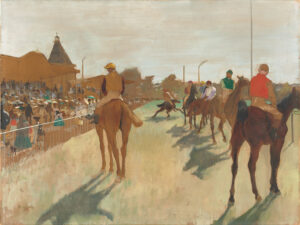
Edgar Degas, Racehorses before the Stands, 1866–1868, oil on paper mounted on canvas, 18 1⁄8 x 24 in.
Musée d’Orsay, Paris (RF 1981), Photo © RMN-Grand Palais/Hervé Lewandowski/Art Resource, NY.
This thoughtful methodology reveals how two artists who are so often grouped together within the same movement—and who did influence each other aesthetically—also represent inherent tensions at this key moment in modern art. Drawing out the relationship between the two artists also helps us to understand how the two painters conceived of their own work. Degas and Manet were constantly thinking of their individual approaches to the creative process. At one point, Degas complained, “Everything [Manet] does he always hits off straight away, while I take endless pains and never get it right.”
Before the pair met, they were already living quite parallel lives. As Wolohojian and Dunn explain in the exhibition catalogue, both artists had bypassed the traditional 19th-century artist’s path. Degas spent one semester at the prestigious École des Beaux-Arts before dropping out, and Manet studied under Thomas Couture, an artist who had explicitly positioned himself against l’École. In the 1850s, both Manet and Degas traveled to Italy to pursue their crafts. And, for both artists, the museum was an essential social and educational space. Museums were “a vibrant, new public space for discovery and pedagogy, outside the normative structures of the academy,” Wolohojian and Dunn explain in the catalogue. “In this charged and transitional moment, the museum as a site, studio, and stage provided a new model for artistic training and engagement with history and its reception.”
Still, at the time of their first meeting, Manet and Degas were at different points in their careers. Manet was already a key player in the Parisian art scene; in the early 1860s, Manet had riled the art world with Déjeuner sur l’herbe (1863) and Olympia (1865) in quick succession. In his early career, Degas was still mostly focused on “history painting”—the art historical term for classical, mythological, and historical subjects. Degas’s early paintings did not garner the same attention—and he was personally averse to scandal. However, in 1865, Degas began gravitating towards the subjects for which he is now known, including portraits with unconventional compositions and body language. Degas followed in the footsteps of Manet, thinking about how he could capture his social environment, the liveliness of their intellectual circle, and the fluidity of modern life.
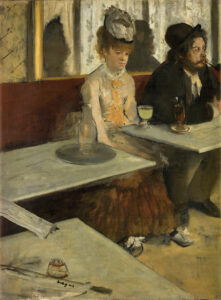
Edgar Degas, In a Café (The Absinthe Drinker), 1875–1876, oil on canvas, 36 1⁄4 x 26 15⁄16 in.
Musée d’Orsay, Paris (RF 1984), Photo © RMN-Grand Palais/Adrien Didierjean/Art Resource, NY.
The proximity between the two artists’ work is highlighted by several key juxtapositions—in a way that reflects their artistic interests, as well as their actual lives. Even as they had similar experiences, they had different reactions, motivations, and familial ties. As Wolohojian and Dunn write, “Manet and Degas worked less side by side than at a critical angle to one another.”
For example, both artists—with their opposing political views—thought about and engaged with warfare as it unfolded both in France and across the Atlantic, during the American Civil War. Both men were deeply connected to Paris, opting to stay in the city and join the artillery during the Franco-Prussian War (1870–1871). While Degas did not significantly address this difficult period in his work, Manet created a series of prints of the Siege and the Commune. Manet also wrote detailed letters filled with what Isolde Pludermacher calls “dramatic intensity.” Regarding the American Civil War, Manet famously painted The Battle of the USS “Kearsarge” and the CSS “Alabama” (1864) and submitted it to the Salon of 1872 in Paris. And, more broadly, he was against slavery and publicly celebrated Northern victories. Degas’s family, though, was deeply entangled in the Louisiana cotton industry and, by extension, slavery.
In A Cotton Office in New Orleans (1872), Degas’s close family ties to the American slave trade—and his belief in the system—come to life. Degas visited his uncle’s cotton firm in New Orleans during this period, and he painted several family members into the work. The painting depicts a seemingly candid moment running the family business: different men handle wool, read the paper, or pour over what looks like an account book. Degas wrote that he had been interested in “the contrast of the active and positively arranged offices with this immense black animal force.” His distance from slave labor and its graphic horrors is clear; it is a strikingly mundane image, transforming an extremely violent system into a bloodless, bureaucratic enterprise.
When he went back to Paris, Degas resumed his vibrant daily life there and returned to Parisian subject matter. Throughout their friendship, Manet and Degas frequented the same venues with a circle of writers, artists, and intellectuals that included Charles Baudelaire, Émile Zola, Félix Bracquemond, and Berthe and Edma Morisot. They could often be found at the Café de la Nouvelle-Athènes on Place Pigalle. They had two tables reserved in the corner, and as Degas later commented, there, the two artists “talked endlessly.”
The Café de la Nouvelle-Athènes underlies works by both artists. Degas’s In a Café (The Absinthe Drinker) (1875–1876) portrays the setting using an innovative cropped composition. In it, a couple sits together at a table, both visibly fatigued and lost in their own thoughts; the two sitters seem to share a certain distance, though they are seated next to each other. The man smokes a pipe, while the woman slouches over a still-full glass of absinthe. Knees together, feet apart, she seems world-weary. The two subjects sit at the corner, as Degas and Manet may have been seated, and Degas filled the foreground with an additional table, giving the viewer a seat in the composition. We seem to be actively people-watching, perhaps tapping our fingers on the table as we attempt to untangle what passed between them the night before. Ellen Andrée, the actress who modeled for the woman in this painting, was also a model for Manet in a painting called At the Café (1878), now in the Sammlung Oskar Reinhart Collection, “Am Römerholz,” in Switzerland.
In Plum Brandy (1877), Manet may have also based the setting on the Café de la Nouvelle-Athènes, though there are differences in his representation of the space. In his café scene, Manet depicts a young woman in a pink dress, leaning over her seemingly untouched plum brandy, with a cigarette between the fingers of her left hand. She rests her right cheek on her other hand; though alone, she seems less sad than Degas’s sitter. Her distant gaze suggests a dreamy haze rather than loneliness. She must be a working Parisian woman, but her exact profession is unclear.
Although both paintings closely focus on their sitters, neither is a portrait. Both Manet and Degas are, here, more interested in the ambiguous social dynamics of their Parisian milieu. They depicted a space that was familiar to them, infusing their compositions with a sense of reality, of what they may have witnessed in their café visits. The women—leaning over their full glasses—in both paintings seem to serve as barometers for how we should read the scenes. There is a clear dialogue happening between the two works; when observed together, they lend dimensionality to the physical spaces that these two painters inhabited together. Yet the closeness of the compositions may also hint at something competitive between the artists. Indeed, one must wonder what Manet and Degas said when they saw each other’s paintings.
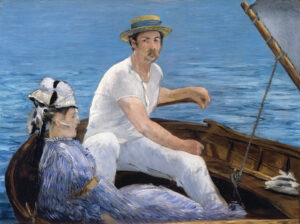
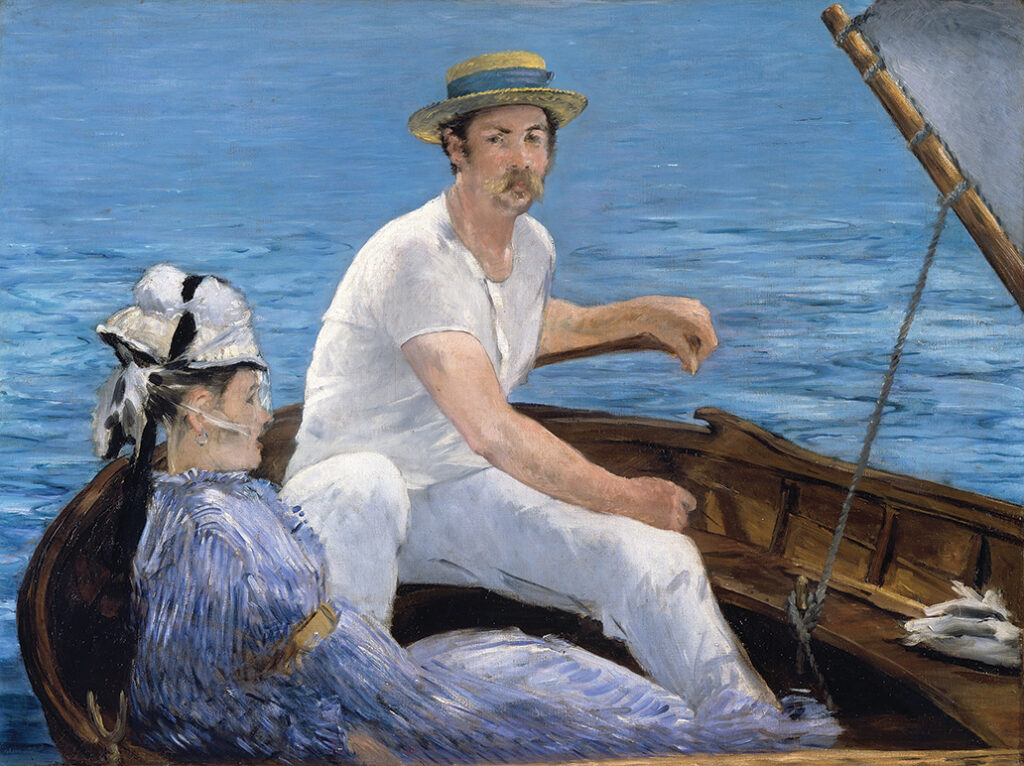
Édouard Manet, Boating, 1874, oil on canvas, 38 1⁄4 x 51 1⁄4 in.
The Metropolitan Museum of Art, New York, H.O. Havemeyer Collection, Bequest of Mrs. H.O. Havemeyer, 1929 (29.100.115), Image © The Metropolitan Museum of Art.
During the 1870s, Manet and Degas’s relationship became increasingly strained. Because their correspondence does not survive, it is impossible to know precisely what unfolded between them. There are moments about which we can speculate; they disagreed, for example, about Impressionism and how it related to Realism. There was an incident in which Manet slashed a portrait Degas had painted of Manet and his wife, angrily declaring that Degas had “deformed” her. Degas, for his part, wrote that Manet was “more vain than intelligent.”
Despite all their competitive creation, when Manet died in 1883, Degas continued to think about his friend. Much of his engagement with Manet’s legacy, as in their friendship, came through his artistic output. Degas acquired numerous paintings, prints, works on paper by Manet—and Gauguin’s large-scale copy of Olympia—for his personal collection. He also carefully sought out and reassembled the various fragments of Manet’s The Execution of Emperor Maximilian (1867–1869), which had been cut into pieces and sold off by Manet’s heirs.
In fact, Degas’s collection of Manet’s works now makes up a key part of “Manet/Degas.” The closest we can get to their friendship is in looking at their works and in thinking about the different lenses through which they saw each other. It is only right that these encounters will take place in the Musée d’Orsay and the Met, where their work is surrounded by that of their own contemporaries and the Old Masters that first brought them together.

Subscribe to Art & Antiques for your Digital or Print copy