Subscribe to Our Newsletter
Visions of Life
Pierre Bonnard produced compositions rooted in the places and spaces of his life that exist as a shimmering resonance of memory
By Ashley Busby
In an over five-decade career, artist Pierre Bonnard (1867–1947) reveled in the ordinary, painting the environs of his everyday life. Never without a sketchbook, the artist was known for his daily walks, often spent hastily scribbling in small pocket agendas. Life itself became the stuff of his paintings, opportunities to riff, to play, to compose. Interspersed among his sketches we also get a glimpse into his dedication to formal concerns. One note reads, “Drawing is feelings. Color is reasoning.” For Bonnard the sketch was but a reaction, while the canvas was a space for a more considered response that was subject to a self-imposed formalist logic. Another note confirms that for Bonnard painting was far more than simple observation; he writes, “One talks about surrendering to nature. There is also such as thing as surrendering to the picture.”
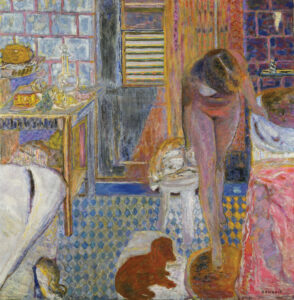
The Bathroom, 1932, oil on canvas.
The Museum of Modern Art, New York. Florence May Schoenborn Bequest, 1996 © 2023 Artists Rights Society (ARS), New York.
A new exhibition at the Kimbell Art Museum, “Bonnard’s Worlds” (November 5th–January 28, 2024), provides a means to examine the places and spaces that Bonnard inhabited and depicted over the course of his life. Presented as a retrospective with a “twist,” the exhibition proceeds from public to private, beginning with his striking panoramic landscapes, proceeding through his interiors, and concluding with his most reflective scenes, including his nudes (visions of his wife, Marthe, in the bath, in the bedroom, and at her toilette) and his self-portraits. In so doing, the exhibition offers an opportunity for viewers to recognize the artist’s long-running formal concerns regardless of date, scale, or subject matter. A Bonnard requires a kind of slow looking. In an appreciation of the artist, art historian John Rewald noted that the work “may not entirely get across to the visitor on a first viewing,” and might be best suited to “a living room where friendly eyes can return to them again and again.” Given the distinct impossibility that we might be able to hang a Bonnard in our own homes, the Kimbell offers a space, no longer beholden to chronology or other common exhibitionary tropes, in which to savor the artist’s work.
Bonnard first came to the attention of the art world in the 1890s as a member of the Nabis. This self-proscribed secret society of artistic “prophets” championed a subjective form of art-making wherein color and other formal elements had personal, expressive potential beyond their role in literal depiction. For Bonnard, this subjectivity was best found in his own life. And, over his long career, that connection to the ordinary remained constant even as his work pushed past the symbolist tactics favored by the Nabis.
For much of his career, Bonnard was recognized first and foremost as a colorist. As Elsa Smithgall has detailed in her account of the American reception of the artist’s work, critics in the early twentieth century positioned Bonnard as a bridge between Impressionism and Post-Impressionism—an artist who continued, in his own unique vein, the Impressionist emphasis on color as the primary concern of the artist. However, to recognize Bonnard’s work as solely connected to his artistic peers and predecessors does the artist a disservice. Beyond his interest in color, Bonnard’s work acts as a bricolage of experience. While the paintings draw our attention first with their shimmering, explosive palettes, a more considered encounter reveals a careful exploration of space—or an ultimately flattened lack thereof—and paintings filled with a compositional complexity that defies easy logic. His is a world built on observation but ultimately belabored and constructed in the studio. His working method confirms such an approach.
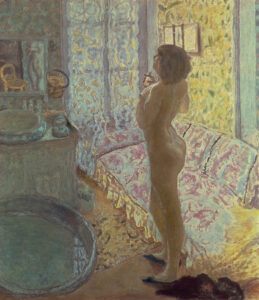
Nu à contre-jour (The Bathroom or The Dressing Room with Pink Sofa), 1908, oil on canvas.
Royal Museums of Fine Arts of Belgium, Brussels, Inv. 6519 © 2023 Artists Rights Society (ARS), New York.
For most of his career, Bonnard tacked several unstretched canvases across the walls of his studio. He found himself occupied by several works at once, often taking months or even years before finally deeming a canvas ready to be resolved. In such a process, observation no longer serves as the sole springboard for invention. Memory—never exact, always personal, ever-shifting—acts as the determiner. Each scene is neither an exact recording of what he saw in a particular moment nor is it solely imagined. Instead, the work references a place, a time, a feeling, all teased apart, prodded, or remixed to meet his formal aims.
Born in Fontenay-aux-Roses, just south of Paris, Bonnard began his career not as an artist but with training in the law. This course was encouraged by his father, a high-ranking official in the Ministry of War. In addition to his academic coursework, Bonnard attended classes at the École des Beaux-Arts, later transferring to the Académie Julian in 1889, where he first met the other young artists with whom he founded Les Nabis. In addition to his works on canvas, Bonnard took on projects in other media, illustrating texts, producing lithographs and posters, and collaborating with decorative artists and designers such as Louis Comfort Tiffany. Paintings and drawings from that era already set up a divide between the exterior—street scenes around the Place du Clichy often captured from a strange pavement-level view or from a dizzying bird’s eye perspective—and interior—early images of Marthe, always seemingly unposed, in the bedroom. Such work also reveals a strong reliance on the compositional strategies derived from Japanese woodblock prints, then very much en vogue in the city. The young Bonnard was so taken by ukiyo-e prints that he soon earned the nickname “le Nabi très Japonard” amongst his peers. And the work inspired a lifelong obsession with compositional tactics that mimicked and experimented with the flattened spaces and emphasis on patterning favored by Japanese artists.
While Bonnard traveled frequently in the early decades of his career, Paris remained his primary residence until he and Marthe left in 1910. Of his move away from the city, Bonnard once said, “I can’t work there: too much noise, too many distractions. For me it’s always been difficult.” Marthe’s ill-health, possibly tubercular, may have also provided an impetus to seek out a more rural environment. For the next several years, Bonnard spent the spring and summer months in Normandy, retreating to the warmer Mediterranean coast for the fall and winter. In Normandy, Bonnard took up residence in the hamlet of Verronet, near Vernon, in a small cottage, known as Ma Roulotte (“My Caravan”). The rustic, two-story structure overlooked a garden and the Seine; Bonnard’s studio, on the second floor, took advantage of this view. Here, Bonnard translated his early-career subjects and tactics to his new surroundings. Vernon, located approximately nine miles from Giverny, also afforded the younger artist an opportunity to connect with the by-then elder stateman of the avant-garde, Claude Monet. The two maintained a friendship, visiting each other frequently. Many scholars note that shifts in Bonnard’s work from these years—including a dappled, more painterly brushwork and brighter, effusive color palette—may be seen as a response to Monet’s own late-career compositions.
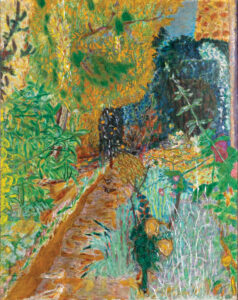
The Garden, 1937, oil on canvas.
Musée d’Art Moderne de Paris. Purchased from the artist in 1937 © 2023 Artists Rights Society (ARS), New York.
In 1926, the artist purchased a home, known affectionately as Le Bosquet (“The Bouquet”) in Le Cannet, a small village in the hills above Cannes in the south of France. He and Marthe would eventually abandon their Normandy abode in 1936, and the two remained on the Côte d’Azur until their deaths. In a letter to his mother from 1909, Bonnard first described his experiences along the Mediterranean coast: “The South was a very alluring idea, and when I got here it was like something out of the Arabian Nights. The sea, the yellow walls, the reflections as full of color as the light.” Drawn to that light and that landscape, Bonnard depicted Le Cannet and Le Bosquet in many of his most arresting canvases. Landscape at Le Cannet (1928) features a stunning panoramic vista of the artist’s new home, complete with a depiction of Le Bosquet, the small, red-roofed structure tucked in among the trees at the center of the canvas. Rich golden yellows, which Bonnard saw as the color of light itself, fill the foreground. These rich tones provide an intense counter to the cool blues and greens of the coastline in the background. The lack of sky and a perplexing, tilting sensation—that which is below, the coastline, appears literally above—leave the eye without an anchor, searching the canvas and in turn taking in each and every detail of the composition. Perhaps strangest of all is the reclining male nude figure in the right foreground, a likely self-portrait as Adam in his new Edenic environment.
Many of the interiors painted at Le Cannet quite literally invite us into Bonnard’s world but remain hauntingly aloof. Fruit and Fruit Dishes (c. 1930) presents as a typical still life, with an arrangement of fruits and blue and white serveware across a crisp, white tablecloth. The viewpoint here zooms in so close to the table, however, that we gain only glimpses of the colorful walls and nothing of the surrounding room.
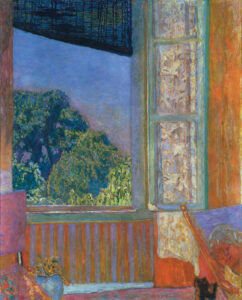
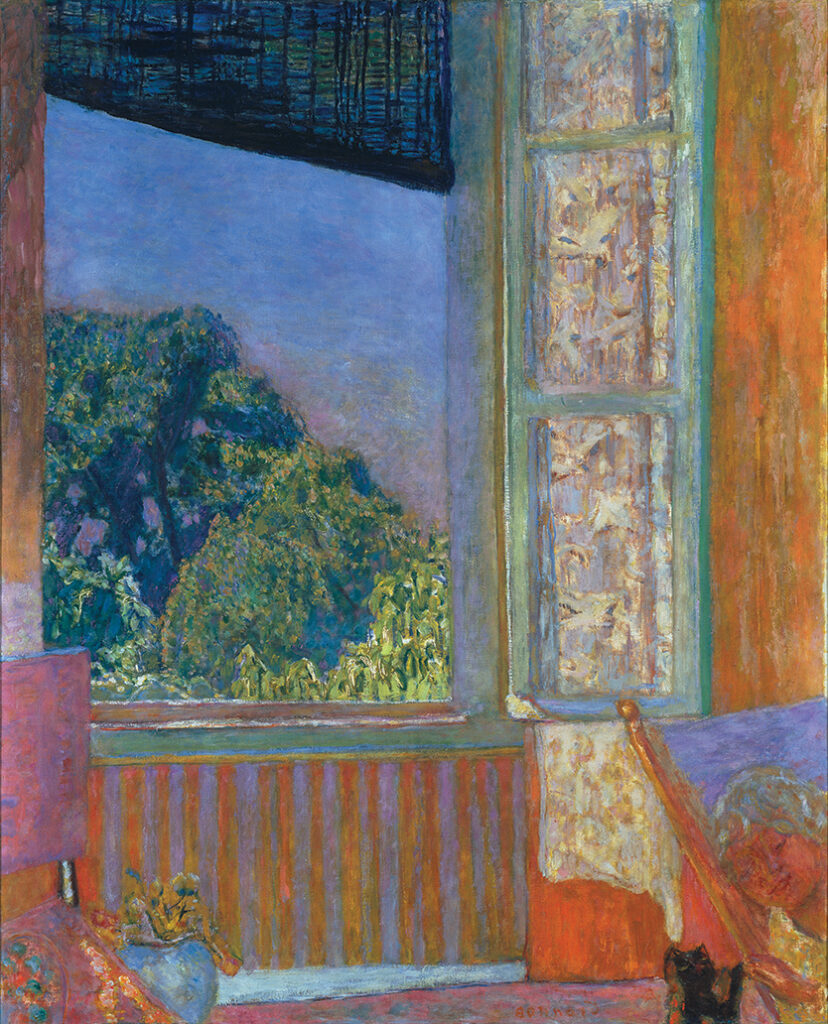
The Open Window, 1921, oil on canvas.
The Phillips Collection © 2023 Artists Rights Society (ARS), New York.
At a time when pure abstraction was seen to be the calling card of avant-gardism, Bonnard remained firmly attached to the objective. His work with the nude figure remains perhaps his most enigmatic and impressive. Bonnard painted a nude Marthe again and again. Known for taking near-ritualistic daily baths, Marthe is seen in her own private domain. While she is certainly the object to be gazed upon, her unidealized form and her mundane surroundings subvert the kind of eroticized vision common with depictions of the nude female. The Bathroom (1932) is a masterful study in complementary hues of orange and blue. Marthe leans over near the sink, her beloved dachshund, Poucette, resting at her feet. The scene suggests the kind of casual, non-sexual intimacy that one can only find in long-term partnership. In Nude in the Bath (1936) Bonnard provides one of his down-from-above, distorting viewpoints; Marthe lies, almost corpse-like, in the bath, more specter than erotic object. The space of the bathroom seems to dissolve and swirl around her in a riot of saturated colors.
Across his oeuvre, we are able to track the artist’s environs at each juncture of his life: the busy streets of Montmartre seen in work from an early career spent in Paris’s popular artist quarter; the dazzling landscapes of Verronet and Le Cannet, where he sought refuge from the demands of city-life; and the mundane yet haunting interiors where he made a life with his partner Marthe. In each canvas, Bonnard provides us with a glimpse into his world at that moment—no matter how large or small. Like paging through someone else’s diary, we attempt to connect with an individual life that no matter how hard we try is distant from our own.

Subscribe to Art & Antiques for your Digital or Print copy