Subscribe to Our Newsletter
The Power of Paper
A new exhibition explores Mark Rothko’s works on paper, revaluing an unappreciated medium
By Ashley Busby
Too often an artist becomes synonymous with that thing that cements their status, leaving a one-sided glimpse into an evolving career. For Mark Rothko (1903–1970), his expressive color field paintings, towering in presence and moodily centered in pure washes of color, have come to define him.
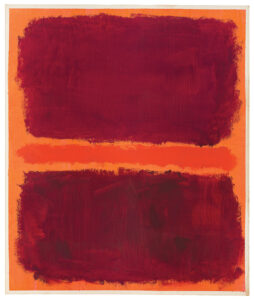
Untitled, 1969, acrylic and ink on wove paper; sheet: 50 x 42 1⁄8 in.
National Gallery of Art, Washington, Gift of The Mark Rothko Foundation, Inc. Copyright © 2023 Kate Rothko Prizel and Christopher Rothko.
A new show at the National Gallery of Art, “Mark Rothko: Paintings on Paper” (November 19, 2023–March 31, 2024), relishes his mature work from the last two decades of his career and also presents these as one chapter in a lifetime as a painter. With over 100 works on view, the exhibition showcases the NGA’s decades-long project to catalogue the artist’s works on paper. An online resource (rothko.nga.gov) and a forthcoming catalogue raisonné document almost 2600 known works by the artist. Both will provide scholars and enthusiasts alike with unprecedented access to view and better understand the artist’s oeuvre.
Museums and collectors often dismiss the value of works on paper. The term signals planning, and precedence is placed on the work that follows, typically on panel. Ephemeral by nature, paper does not have the same perceived value as a work on canvas. Over the course of his career, Rothko sketched and made preparatory studies in media such as graphite and ink. However, the NGA exhibition tracks four key periods when Rothko produced a large number of paintings on paper: the 1930s, 1944-49, 1958-59 and 1967-69. At such times, Rothko utilized watercolor, oils, and eventually acrylics to create fully realized works on paper. For Rothko, in the words of NGA curators, “paintings were paintings,” and he made no clear delineation or valuation of the work dependent on his choice of support.
Born in present-day Latvia, then part of the Russian Empire, Rothko’s family immigrated to the United States in 1913, eventually settling in Portland, Oregon. A voracious reader with a high academic acumen, Rothko showed little interest in art during his early life.
In 1921, he attended Yale on full scholarship, sampling courses, from biology to philosophy, with the vague intention of a career in engineering or law. Despite his love of learning, experiences with antisemitism, financial struggles, and a lack of social cachet left him at the bottom of the university caste system. At the end of his first year, Rothko lost the scholarship that had made enrollment possible. Before the end of his second year, he dropped out and moved to New York with no plan concerning how to proceed.
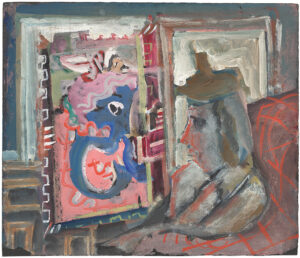
Untitled (seated figure in interior), c. 1938, watercolor on construction paper; sheet: 10 1⁄4 x 12 1⁄8 in.
National Gallery of Art, Washington, Gift of The Mark Rothko Foundation, Inc. Copyright © 2023 Kate Rothko Prizel and Christopher Rothko.
In late 1923, on a whim, Rothko attended a life drawing class with a friend enrolled at the Art Students League of New York. In that moment everything changed, and he dedicated himself to training as an artist. He pored over the city’s museum collections, in addition to taking classes with Arshile Gorky at the New School and Max Weber at the Art Students League. By the early 1930s, Rothko was exhibiting broadly expressionistic landscapes and figure studies in group shows at the city’s Contemporary Arts Gallery and had built friendships with other future Abstract Expressionists, such as Adolph Gottlieb.
Notably, Rothko’s first solo exhibition in 1933 at the Museum of Art, Portland, featured mostly works on paper including watercolor landscapes realized on cheap linen writing paper. While his selection of materials was almost certainly driven by his meager finances, Rothko felt comfortable exhibiting such work despite his lack of fine materials.
Other works from this period were executed on low-grade construction paper. From 1929 to 1946, Rothko taught children’s art classes at the Center Academy of the Brooklyn Jewish Center. He often utilized the same craft paper as his students. According to exhibition curators, Rothko’s use of the cheap paper was also encouraged by Milton Avery, with whom Rothko began a long friendship in the 1930s. Rothko’s work from these years shows traces of Avery’s simplification of the figure to flat planes of color.
Utilizing watercolors and painting wet on wet, compositions such as Untitled (seated woman in striped blouse), from 1933/1934, document Rothko’s early experiments with abstracted form and the play and manipulation of pigment. You can observe the ways in which the pigment feathers above the neckline of the woman’s blouse, a sort of controlled accident caused by the interaction of the watercolor medium with the pulpy surface of the paper. Also apparent is Rothko’s burgeoning move toward abstraction. He defines the planes of the woman’s face using muddy brown and mauve to render shadow and yellow to highlight across an otherwise creamy pallor. Stains of intense blue-green and burgundy suggest rather than define her lips and eyes. Even in this figural work, we see echoes of Rothko’s later approach to color and abstraction.
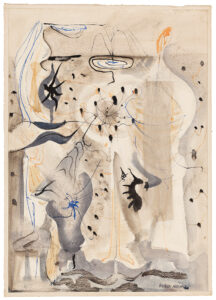
Baptismal Scene, 1945; watercolor, ink, and graphite on watercolor paper; sheet: 20 1⁄2 x 14 1⁄2 in.
Whitney Museum of American Art, New York, purchase, 46.12. Copyright © 2023 Kate Rothko Prizel and Christopher Rothko. Digital image Whitney Museum of American Art/Licensed by Scala/Art Resource, NY.
During the early 1930s, critics also recognized Rothko’s affinity for paper. A writer for The New York Times noted that the artists’ watercolors were “freest and most successful.” Another critic for The New York Sun commented that his watercolor landscapes “really score” while dismissing his oil on canvas offerings, work that a New York Evening Post critic described as “dry and brittle.” Perhaps taking this as a challenge to find a way to excel with works on canvas, Rothko left behind watercolor and focused his efforts on oils. He also stopped exhibiting the works on paper for almost a decade.
The NGA exhibition tracks a second period of intense production and exhibition of watercolor paintings on paper between 1944 and 1949. Such work was widely exhibited and critically praised, including a solo show at Peggy Guggenheim’s Art of This Century gallery in 1945. When Rothko submitted Baptismal Scene (1945) for inclusion in the Whitney’s 1946 annual contemporary exhibition, the institution acquired the work, his first to be included in a museum collection.
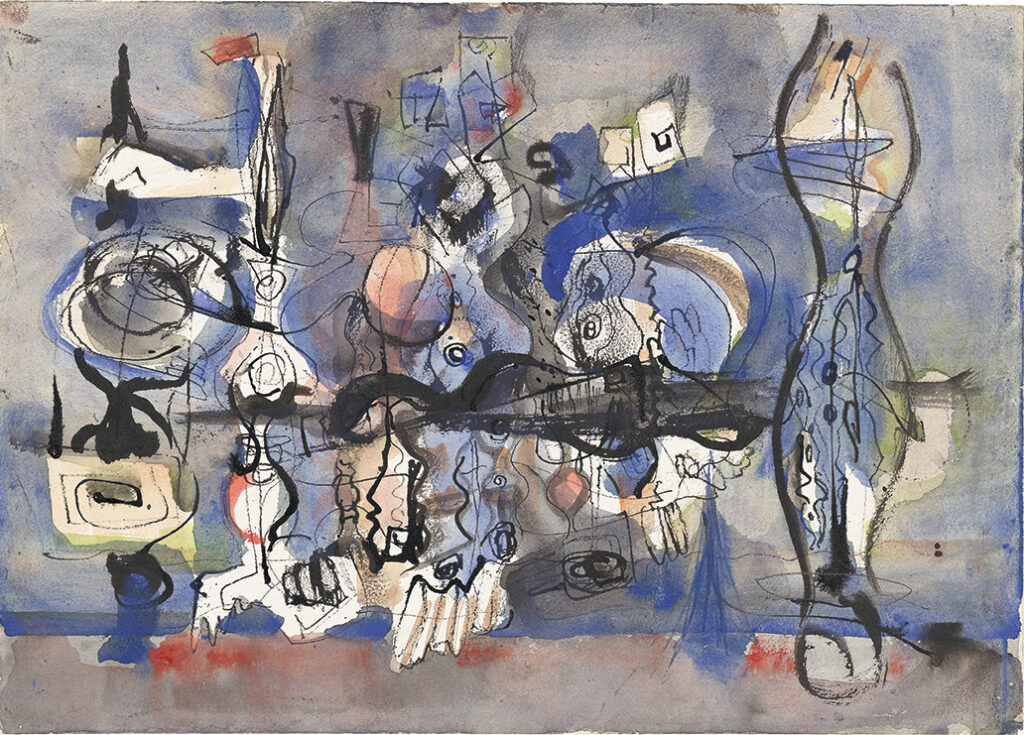
Work from the late 1940s verged ever closer toward total abstraction. Rothko’s compositions, rendered in pale, almost ghostly hues, emulated the style of biomorphic Surrealist painters, such as Joan Miró and Yves Tanguy. He would have likely first encountered their work at Alfred Barr’s 1936 exhibition “Fantastic Art, Dada, Surrealism” at the Museum of Modern Art. Tanguy was also among the many Surrealist artists that immigrated to New York during World War II and with whom Rothko and other New York School painters connected during the early 1940s.
In Untitled (c. 1944), Rothko maintains a connection to his early preference for landscape. Soft washes of blues and gray greens create the visual impression of a thin strip of ground plane and a vast, mottled sky. Populating the space, at once expansive and exceedingly flat, he includes a new language of form and shape rendered in quick painterly strokes of watercolor, ink, and graphite. This new iconography suggests the biological, almost like an abstracted vision of the microscopic or unicellular. Such a tendency would have certainly been drawn from the artist’s natural science coursework during his time at Yale.
This move away from identifiable subject matter was also entrenched in the collective terror that pervaded the world during the war. Atrocities on the battlefield, a growing awareness of the horrors of the holocaust, and fears surrounding the potential development of an atomic bomb shattered Rothko’s perception of the world. The artist felt powerless to depict such an appalling reality. Instead, he depicts a kind of primal space of origin, perhaps the envisioned terrain of what might remain in the wake of an atomic event. Drawing both on the philosophy of Friedrich Nietzsche and Carl Jung’s concept of a collective unconscious, Rothko believed his abstracted forms and expressive color could communicate a sense of universal human tragedy.
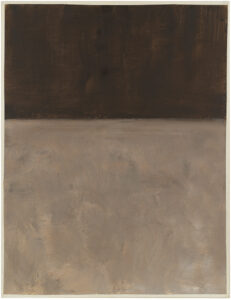
Untitled, 1969, acrylic on wove paper; overall: 62 5⁄16 x 48 1⁄16 in.
Private collection. Copyright © 2023 Kate Rothko Prizel and Christopher Rothko.
By 1948, Rothko left behind the biomorphic. We see such a shift in Untitled (c. 1948). Gone are the symbolic shapes rendered in ink and graphite. Instead, Rothko returned to watercolor as his sole medium and selected a larger (40 x 27 1/16 inch) paper support. In its play with space, color, and scale, the work echoes contemporary oil on canvas compositions that critics termed his “multiforms,” a sort of stepping stone toward the later color field work.
At the end of the decade, Rothko would again turn away from works on paper and focus his output on oil on canvas. Between 1949 and his death in 1970, the artist would only return to paintings on paper in two short bursts of exploration at the end of the 1950s and again at the end of the 1960s.
Rothko’s first return to paper coincided with a 1958 commission for the Four Seasons restaurant in New York’s Seagram Building. NGA curators argue that paintings on paper completed during the commission should not be read as one-to-one preparatory studies but rather as parallel exploration. Subsequent work from 1959 continued to investigate expressive space and color. Rothko often capitalized on his early mastery of watercolor, exploring oil’s potential to bleed into and across the paper, such as the intense blue and red tones in Untitled (1959).
In 1968, during Rothko’s recovery from an aortic dissection that vastly compromised his health, doctors forbade the artist from working at large scale. Given his physical limitations, he produced small works on paper, which document his recovery and his insistence on continuing to paint. That same year, Rothko prepared his will, naming the new Mark Rothko Foundation as primary beneficiary of the estate. An inventory of work, created as a part of this process, made no distinction between paintings on paper or canvas, further emphasizing the perceived value of the works on paper.
In 1969, one year before his death, Rothko worked almost solely on paper completing 120 acrylic paintings. By then ignoring his physical limitations, his scale again swelled with some works as large as 84 x 60 inches—comparable to his oil on canvas work from the previous two decades. He continued to produce work on paper until just before his death by suicide in February 1970.
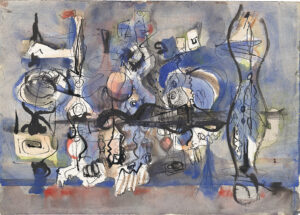
Untitled, c. 1944; watercolor, ink, and graphite on watercolor paper; sheet: 15 x 21 in.
National Gallery of Art, Washington, Gift of The Mark Rothko Foundation, Inc. Copyright © 2023 Kate Rothko Prizel and Christopher Rothko.
While Rothko was often critically panned for producing a body of work that might be read as repetitive, the artist dismissed this notion. His work was never simply a formal exercise. His central goal was to evoke emotion, once arguing that anyone solely interested in his work’s color interactions had “miss(ed) the point.” Over the course of 1969, Rothko explored multiple color palettes. Soft, shimmering pastels exist in a space of emotional tension, at times quietly sad or deeply hopeful. Work featuring black, gray, and brown has too often been misread as a tragic foreshadowing of his death; however, on closer inspection, the work—while somber—is also startlingly frank. The paintings encourage a kind of meditative calm and create space for spiritual reflection. Through it all, whether on paper or canvas, whether figural, abstracted, or somewhere in between, Rothko makes us feel.

Subscribe to Art & Antiques for your Digital or Print copy