Subscribe to Our Newsletter
Paint as Experience
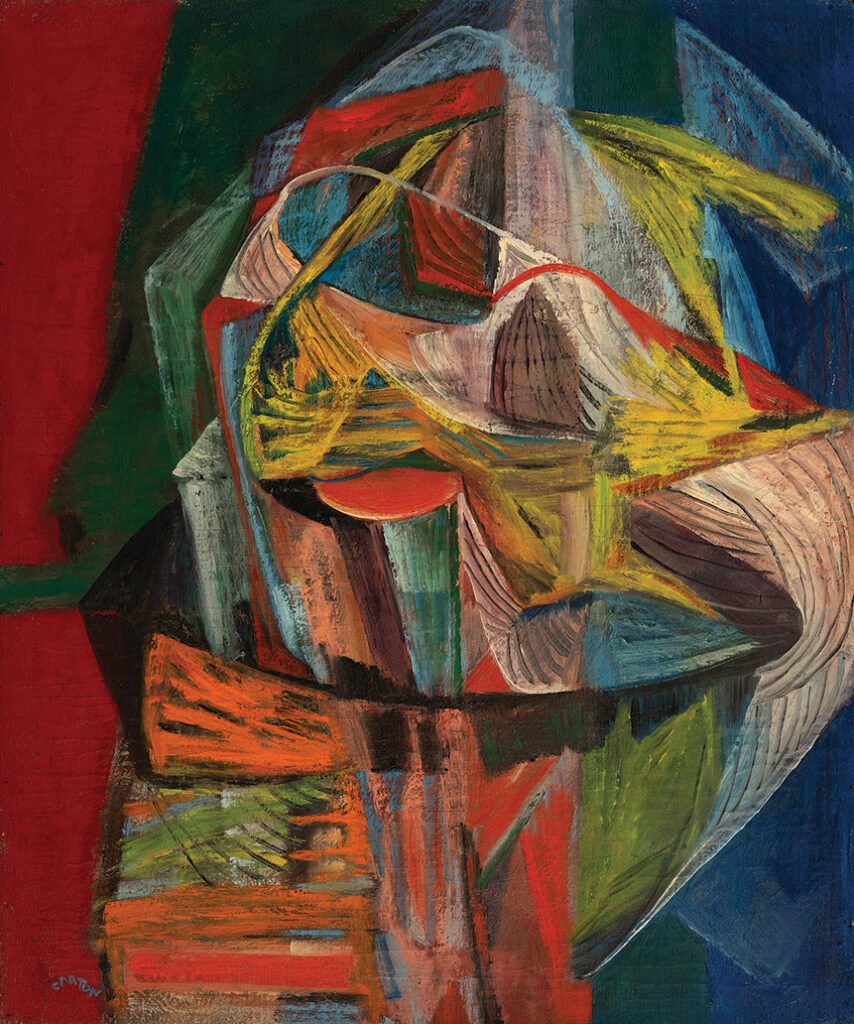
Norman Carton: from Ukraine to Philadelphia to New York, bridging Impressionism and Abstract Expressionism
by William Corwin
At age 10, in 1918, Norman Carton and his mother were in hiding during pogroms unleashed by the Russian revolution; six years later the same boy found himself safe and sound in Philadelphia, rescued from Eastern Europe by the intervention of his older brother, who had already relocated to the States. The pogroms in Ukraine during the Russian civil war resulted in the murder of up to 250,000 Jews. Carton had escaped with his family through Romania and immigrated to the U.S. in 1922.
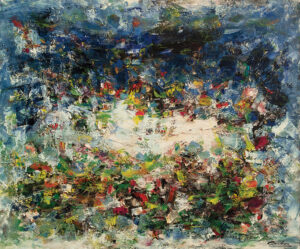
Summer Meadow #758, circa 1955, oil on canvas, 44 x 52 in.
Private collection, California. Courtesy of The Estate of Norman Carton and Hollis Taggart, New York.
Carton began his art studies in Philadelphia in the late ‘20s, and it is hard to imagine the transformational power of art, and stability, on a young refugee who had experienced so much suffering. As a young art student, Carton was introduced to the works of the Impressionists, Post-Impressionists, and Fauves. In later life, Carton’s style would eventually come to rest in the Abstract Expressionist school, but what distinguishes him from his contemporaries is his passion for rich liberatory color. Color was an obsession for Carton, both in painting and photography, as well as the textile design company he founded. Carton has re-emerged with other overlooked painters from his generation, along with painters such as Michael (Corinne) West, and Janice Biala, and most of the biographical information in this article is greatly indebted to the research and writing of Jillian Russo.
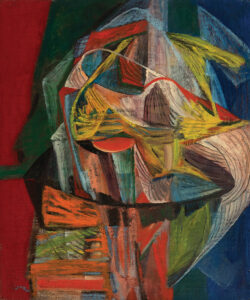
Mummer #3129, 1948, oil on canvas, 30 x 25 in.
Courtesy of The Estate of Norman Carton and Hollis Taggart, New York.
Carton began studying with Henry Bainbridge McCarter (1864–1942) at the Pennsylvania Academy of the Fine Arts (PAFA) in 1930. He received a fellowship to travel in Europe in 1934, where he became even more familiar with the legacies of Fauvism, Cubism, Surrealism, and perhaps most important to the development of his own personal style of painting, Soutine. In 1924, soon after Carton’s arrival in the U.S., a serendipitous collaboration took place in Philadelphia. In addition to founding the Barnes Foundation, Dr. Albert C. Barnes invited the philosopher John Dewey to organize classes for students at the institution. As a philosopher of pragmatism, Dewey saw art as a means to instigate a visceral response in the viewer, as opposed to purely appreciating a finished work on a wall or a plinth (as expounded in his book Art as Experience). Dewey was also heavily invested theoretically in childhood education. Barnes wanted his institution to be a site of democratic interaction with contemporary art, such as Impressionism, Post-Impressionism, and Cubism, as well as indigenous works of art from Africa, so there was a meeting of the minds between the two men. Into this mix came the young Norman Carton.
For the full story click on the preferred link below
for your Print or Digital subscription:

Subscribe to Art & Antiques for your Digital or Print copy