Subscribe to Our Newsletter
A Life in Collage

Eileen Agar’s Surrealism and Storytelling
by Sarah Bochicchio
“My life is a collage,” writes Eileen Agar (1899–1991) in the first chapter of her autobiography, A Look at My Life. The metaphor is particularly apt for the surrealist artist—and not just because collage was a key medium in her oeuvre. In her writings, Agar lays out her biography as a series of proximate experiences. She writes about people who were adjacent to her, who came and went, who stuck with her. Her worlds overlapped. People and places seem to be cut and pasted repeatedly; personal and professional lines were constantly blurred.
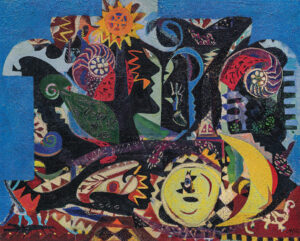
Abundance, 1942, oil on canvas.
Private collection. Eileen Agar © Estate of Eileen Agar. All rights reserved 2024/Bridgeman Images. Reproduced with permission of the Estate of Eileen Agar.
A Look at My Life was originally published in 1988, fell out of print, and Thames & Hudson reissued the autobiography this year, with dozens of glorious illustrations. The new edition offers an opportunity to reexamine Agar’s work, as well as to think about history as a kind of assemblage. Although Agar’s significance is now well established in the art world, she is not a household name, unlike many of her friends and colleagues. Her autobiography provides a written record to elaborate on her prolific artistic oeuvre, showing us how significant her work was in its own time, even if it has not adhered to our collective memory.
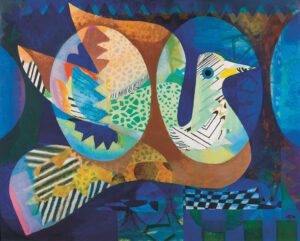
The Bird, 1969, acrylic on canvas, 12 1⁄2 x 20 1⁄8 in.
Private collection. Eileen Agar © Estate of Eileen Agar. All rights reserved 2024/Bridgeman Images. Reproduced with permission of the Estate of Eileen Agar.
Moreover, the book serves both as an autobiography and as an account of the art world in the early and mid-twentieth century. Co-written by the writer and curator Andrew Lambirth, the text covers Agar’s birth up to the then-present, all of which adds up to a vibrant, adventurous, and, at times, complicated life. Agar’s itinerant lifestyle brought her into contact with cultural giants, including Pablo Picasso, Lee Miller, Henry Moore, André Breton, Man Ray, W.B. Yeats, Evelyn Waugh, Dylan Thomas, Ezra Pound, and even Issey Miyake. In some ways, fame almost haunts her work; she even lived in Virginia Woolf’s former residence.
To read her writing is to view prominent artists and writers from the vantage point of someone who knew them intimately—and who was their true peer. Her writing is peppered with outrageous anecdotes (including a poorly planned performance in which Dalí almost suffocated in a diver’s helmet that was meant to represent “the unconscious, the proper death of experience.”). Her voice is strikingly matter of fact—inured to the opinions of others—as she details salacious and, at times, ungenerous stories.
For the full story click on the preferred link below
for your Print or Digital subscription:

Subscribe to Art & Antiques for your Digital or Print copy