Subscribe to Our Newsletter
Positively Porter
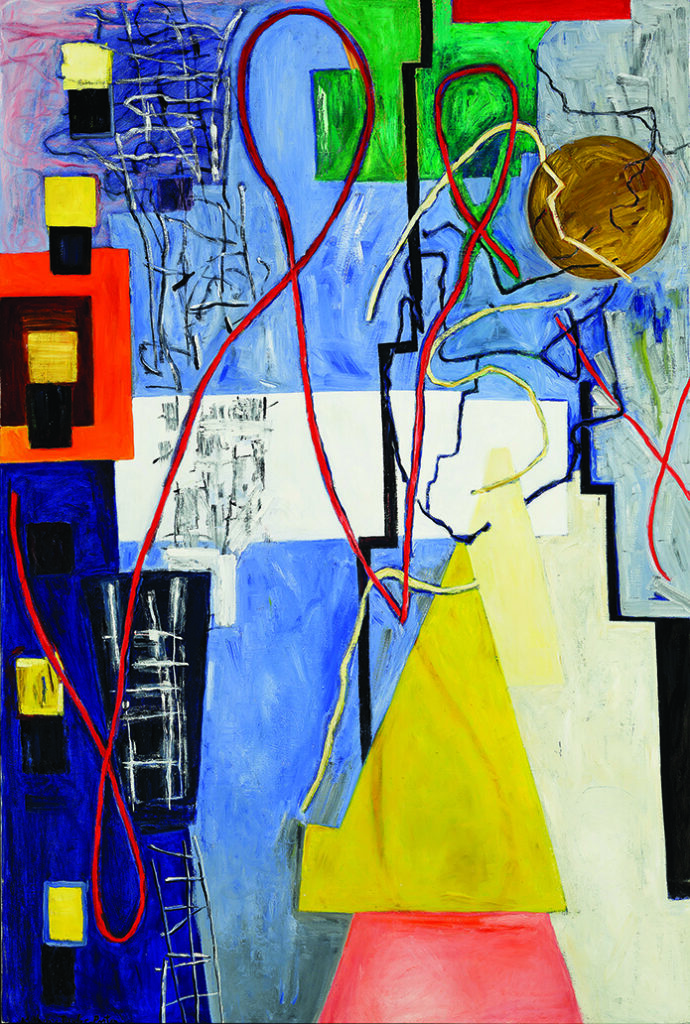
The late Expressionist painter shows us how geometry can be as spirited as gesture
by Lilly Wei
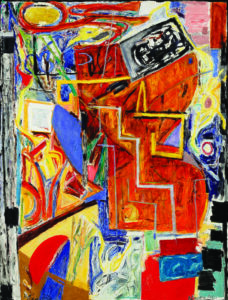
Begin Again, 2019-2020, oil on canvas, 66 x 50 in.
© Estate of Katherine Porter, all images courtesy of LewAllen Galleries
Katherine Porter died this past April at the age of 82 in Santa Fe, New Mexico. A month before, the unflaggingly productive painter had an exhibition in Santa Fe at the LewAllen Galleries aptly titled “Brilliance of Spontaneity Untamed.” It was the first major showing of her work in three decades, boosted by the resurgence of interest in geometric abstraction in recent years and in the women of the 1960s, ‘70s and ‘80s who painted them. In an interview in Art in America in 1982, she said that she tries “to put everything into a picture,” her work studies of chaos and change.
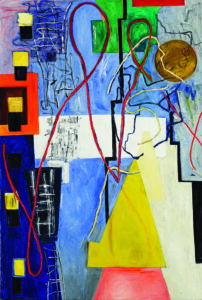
Sailing, 1997, oil on canvas, 74 x 50 in.
© Estate of Katherine Porter, all images courtesy of LewAllen Galleries
Porter came of age with a generation of pioneering women artists that deserves far more credit than it has generally been given, its numbers far exceeding the handful or so that are usually mentioned (although that count has been steadily rising). Porter’s work, a sassy, brassy meld of the geometric and the expressive, was singled out almost immediately for its audacity and rawness, its full-throttle physical presence and ambitious scale, but the reviews—usually by male critics—were often mixed, and what might be considered positive now, such as her spontaneity and willingness to trust, to flaunt, her instincts, were then considered flaws: too jarring, too rough-and-tumbled, too lacking in sophistication and aesthetic rigor. While it is said that abstract art is not gendered, artists (and critics) are and, inevitably, that has some bearing on their perspectives and judgments. Even in those iconoclastic years, when former standards were being toppled as excluding, the promulgation of new ones, curiously, was still left up to a cadre of white male artists and critics, Greenbergian and otherwise. In hindsight, it seems Porter’s greatest failing was that her vision was her own, her formal vocabulary, although drawn from a familiar modernist lexicon, nonetheless forged resolutions that were often considered unacceptably, irreverently independent.
Born in Cedar Rapids, Iowa in 1941, Porter’s artistic talent was noted early and encouraged by her family and instructors. She attended Colorado College where she was introduced to Abstract Expressionism and Pop Art and taught to revere creative “freedom.” She graduated in 1963 and went east to study at Boston University where she signed up for a series of technically stringent courses that advocated the opposite, including one that focused for the entire semester on the correct way to draw an egg. “Chaos” and “structure,” words she often used to describe her work, were both critical to her creative impulse, providing contrast and tension to compositions that were often divided into quadrants or otherwise gridded, as each played off the other.
For the full story click on the preferred link below
for your Print or Digital subscription:

Subscribe to Art & Antiques for your Digital or Print copy