Subscribe to Our Newsletter
Resonant Success

Never a household name, Herman Cherry produced abstractions featuring gestural color on par with his New York School peers.
By Ashely Busby
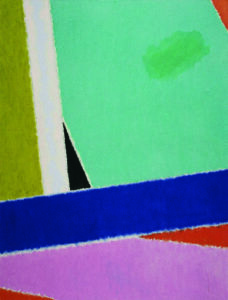
Irregular Classic, 1991, oil/canvas, 78 x 60 in.
@The Estate of Herman Cherry
Artist Herman Cherry (1909–1992) experienced but also relished the struggle inherent in creative life. In conversation with critic Judd Tully, the artist compared his own path toward abstraction as an arduous journey. He noted, “The abstraction of painting is a very difficult fence to climb. It took me a long time to see non-objectively…I went through an exploratory period until I found my own idiom.” Later in that same conversation, Cherry continued, “I have to make my own roads and sometimes I go the wrong way. But I’m always willing to take the chance. If I discover a straight road then I’ll get bored…It’s very difficult to explain but you have to create a struggle that could be made easier—to create situations that are untenable. How else can you get energy into painting?” Thus, for Cherry, the best paintings never came easy, and the search for inner voice and creative idiom should never go stagnant or become effortless. To find that sweet spot required patience, endurance, and a willingness to tussle with the forces—existential or otherwise—that seek to upend us.
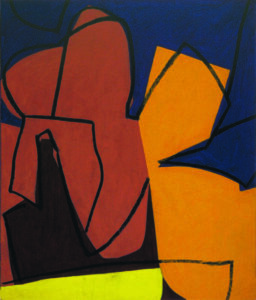
Retrieval 3, 1962/4, oil/canvas, 40 x 34 in.
@The Estate of Herman Cherry.
Born in Atlantic City, New Jersey, Cherry (then Hyman Cherkovski) was the middle child of Russian-Jewish immigrants who met on U.S. shores. Raised in Philadelphia, Cherry benefitted from community art programs at the city’s Fleisher School and trips to the Philadelphia Museum of Art. At 14, he relocated to Los Angeles with his family. After his father abandoned the family, Cherry took on odd jobs and struggled in school, eventually dropping out. However, these challenges did not quell his goal of a creative career. He found work in the construction and plasters department at 20th Century-Fox studios and began classes at Otis Art Institute on scholarship. In 1926, looking to further expand his training, he began drawing classes with Stanton Macdonald-Wright at the Art Students League of Los Angeles.
Around 1929, Cherry faced mounting economic distress and signed as a crewman on a freighter bound for Europe. To escape abuse and discrimination, he jumped ship in Poland, eventually making his way to Hamburg, Germany, where he frequented the city’s museums and searched for a ship home—despite having no formal papers. Upon his return to the U.S., Cherry spent a year in New York, studying with Thomas Hart Benton at the Art Students League. He made an excellent impression on the Regionalist master, who brought him on as an assistant for his America Today murals at The New School. The next year he returned to Los Angeles and resumed studies with Macdonald-Wright. Cherry’s career-long affinity for color can certainly be traced to his interactions with these teachers and their experiments with Synchronism.
For the full story click on the preferred link below
for your Print or Digital subscription:

Subscribe to Art & Antiques for your Digital or Print copy