Subscribe to Our Newsletter
Blonde Ambition
The Art and Times of Tamara Lempicka
By Lilly Wei
Tamara de Lempicka (1894–1980) has always been enveloped in a (couture) cloak of mystery, much of it of her own design, created by a disarming, if also disingenuous, vagueness in the telling of her life story that was only loosely fitted to facts. Her art, once hailed as an embodiment of modernity, of Art Deco and the Paris of the 1920s and ‘30s, has roller-coastered through the ensuing years—forgotten, revived, then forgotten again.
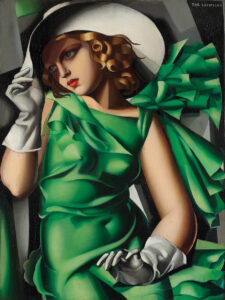
Young Girl in Green (Young Girl with Gloves), ca. 1931. Oil on board,
24 3⁄16 x 17 15⁄16 in. Framed: 29 15⁄16 x 24 3⁄16 x 2 3⁄8 in.
Centre Pompidou, Paris, Musée national d’art moderne/Centre de création industrielle. EX1138.12
She has always had her fierce supporters—lauded as a feminist by some—as well as her scathing critics, who dismissed her work as superficial, decorative, too feminine, not feminine enough, soft porn, or even fascistic. Her period of greatest acclaim was in Paris in the exhilarating, extravagant interwar years, a milieu that Lempicka embraced and was embraced by, spending two decades in the glamourous city. The party ended disastrously, savagely, as we all know, with the occupation of Paris by the Nazis and the near total destruction of Europe.
Lempicka, of late, is again ascendant, as the cultural and political environment has shifted once more. A painting of hers sold at auction for over $21 million in 2020, and her collectors are among today’s top celebrities. Barbra Streisand is one superfan, who contributed the preface to the sumptuously illustrated catalogue that accompanies the show and is chock-full of informative, well-written essays that present Lempicka in the round. Madonna is another. The singer has famously featured Lempicka’s paintings during her performances, with the pointed cone bras designed for her by Jean-Paul Gaultier seemingly directly based on Lempicka’s weaponizing interpretation of women’s breasts. And Jack Nicholson is yet another—though the connection with him to her is elusive.
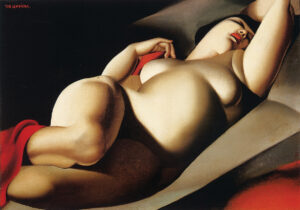
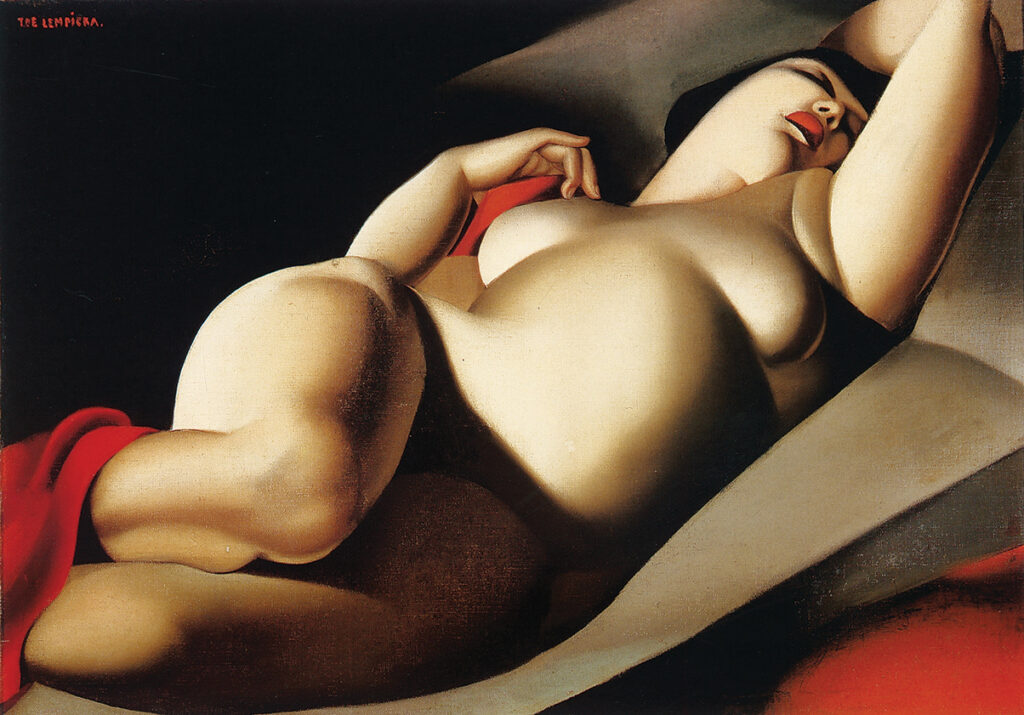
The Beautiful Rafaëla (La belle Rafaëla), 1927. Oil on canvas, 25 1⁄2 x 35 3⁄4 in. Framed: 30 1⁄2 x 41 in.
Collection of Tim Rice. EX1138.9
A namesake Broadway musical of her life was produced that opened this year (but, alas, closed almost immediately.) And now, this sweeping survey of her work at the San Francisco Fine Arts Museums that just opened (through February 9, 2025, and later travels to Houston’s Museum of Fine Arts, March 9-May 25)). Are audiences ready for her this time? Furio Rinaldi, who, with Gioia Mori, co-curated the retrospective, are betting that they are. “Someone like Lempicka, who presents a world of assertive women — incredibly empowered, towering — it’s an imagination that really speaks to today,” Rinaldi said.
For the full story click on the preferred link below
for your Print or Digital subscription:

Subscribe to Art & Antiques for your Digital or Print copy