Subscribe to Our Newsletter
Rooted in the Now
San Francisco’s de Young Museum refreshes its Indigenous America galleries to center
Native voices and connect the ancestral with the contemporary.
By Fred Voon
When Meyo Maruffo, a Pomo artist and curator, was invited years ago to the de Young Museum and asked for her thoughts on the Native American exhibits, she said, “It’s a lot of beautiful objects made by a lot of dead people.”
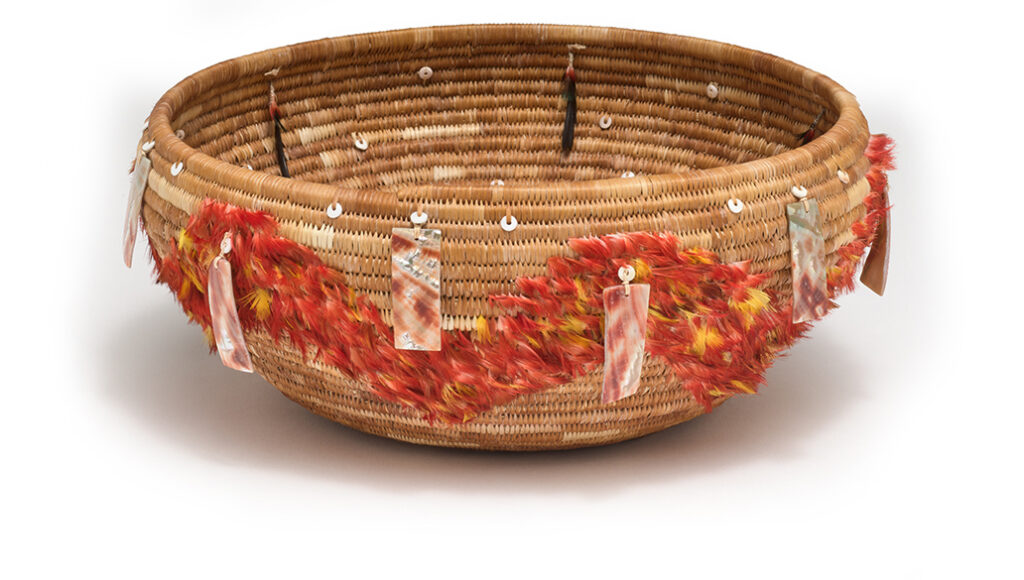
Ohlone basket, 2025, crafted by Linda Yamane (b. 1949) with red abalone shell and quail, mallard, western meadowlark, and red-winged blackbird feathers.
Maruffo is among a team of Native scholars and cultural leaders who have helped reimagine and reconfigure the Arts of Indigenous America galleries. The newly renovated spaces were unveiled in August. “What we’re here to do is bring life back into those galleries,” she said. Genuinely including Native perspectives is a marked shift in curatorial practice, which has historically treated Indigenous peoples as bygone curiosities rather than living cultures.
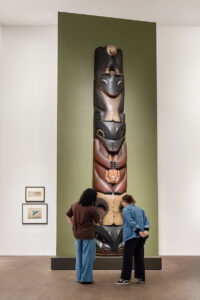
This cedar totem pole is attributed to Sm’oogyit Niishluut (aka Sidney Campbell, 1849–1934), a Ts’msyen master carver from Alaska.
The de Young—part of the Fine Arts Museums of San Francisco, which sit on Ohlone land—is known for its vast collection of American art, including pieces by Georgia O’Keeffe and Edward Hopper. Since the museum’s inception in 1895, its Native American holdings have steadily grown, and the revamped galleries reflect a more sensitive, more attentive approach to their presentation.
“We knew that we needed to foreground Indigenous voices and partner with artists, culture bearers, leaders from communities of origin,” says Hillary Olcott, who led a deeply collaborative process with four other curators and six advisers, most of them Native American. Together, they determined what items to display, how to care for them, and which artists to commission. “Our hope is that this will bring a liveliness to the galleries and will re-center people within the stories of this art,” Olcott adds.
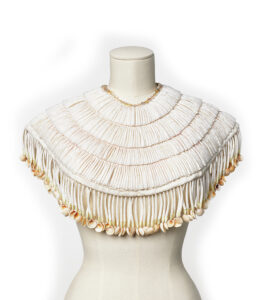
Holding Prayer 2024, by Yurok beader and fashion designer Shoshoni Gensaw-Hostler (b. 1982), is a cape constructed of elongated tusk shells and dangling clamshells.
Like many museums around the world, the de Young has had to remedy objectionable practices in its past handling of Indigenous materials. Human remains have been removed entirely from its collection. Sacred artifacts looted from gravesites have been repatriated. For the refreshed galleries, Native tribes were consulted on the interpretation of items, and for the permission to display them.
In Native American cultures, time is often viewed as cyclical, not linear. The future does not leave the past behind, and the existence of one’s tribe is ever-present. And yet museums have a tendency to perceive the Indigenous as ancient or primitive, as something extinct or extinguished, with no place in the modern day. Arts of Indigenous America, a suite of four galleries, seeks to correct this imbalance: two updated exhibits showcase historical relics, while two new spaces offer a mix of ancestral artworks and contemporary creations.
For the full story click on the link below for your Digital subscription:

Subscribe to Art & Antiques for your Digital or Print copy