Subscribe to Our Newsletter
Fit for a Queen
The Hispanic Society Museum & Library in New York spotlights the opulence and over-the-top silhouettes of the Spanish Golden Age, including hoop skirts so large that women were accused of concealing illicit pregnancies.
Written by Fred Voon
In the 16th century, the world’s fashion capital wasn’t Paris or Milan. It was Madrid. After all, this was the birthplace of the verdugado (farthingale), a hooped structure used to inflate the volume of skirts. As it evolved in shape and material, the verdugado spread to England and France and influenced the way women dress for centuries to come.
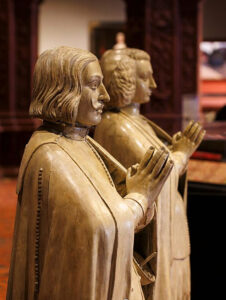
17th-century wooden effigies of a noble couple, painted white to look like marble.
All photos: Hispanic Society Museum & Library
Showcasing the sartorial culture of Spain’s Golden Age and its rich connections to religion, politics, and economics, New York’s Hispanic Society Museum & Library presents Spanish Style: Fashion Illuminated, 1550–1700 (through March 22). Curated by historian Amanda Wunder, the exhibition is mounted in the museum’s terracotta main court, which happens to be modeled after palaces of the same era. (Much of the campus is undergoing a second phase of renovations led by Selldorf Architects, the same firm behind the recent revamp of the Frick Collection.)
The Spanish Golden Age was marked not only by artistic flourishing—El Greco moved to Toledo and produced his greatest works, Miguel de Cervantes wrote the monumental Don Quixote—but also unrivaled political power. After funding Christopher Columbus’s cross-Atlantic expeditions, Spain deployed conquistadors to establish colonies across the Caribbean, the Americas, and beyond. For 60 years, the Spanish crown even absorbed Portugal and its holdings, forming the largest empire in the world.
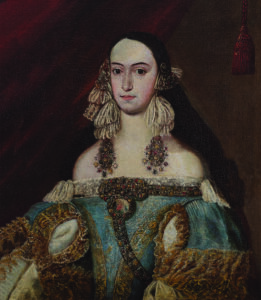
Portrait of a Woman (c.1670) wearing chandelier earrings and a daringly low neckline.
All photos: Hispanic Society Museum & Library
Imperial domination resulted in bulging coffers and a dazzling influx of precious materials that were incorporated into fashion: Flemish lace, Neapolitan silks, Mexican cochineal, Colombian emeralds, Bolivian silver, along with tons and tons of gold. And yet few of the opulent garments survive. Most were taken apart so that valuable components could be reused. Black dyes were ubiquitously applied, but their chemical makeups caused textiles to self-destruct over time.
A rare highlight in the exhibition, then, is a black velvet dalmatic (a tunic worn by clergy) with gold embroidery, painstakingly restored by conservators at the Metropolitan Museum of Art. Mostly, though, Spanish fashion of yore may be observed in manuscripts, paintings, figurines, and sculptures on display, such as the life-size effigies of noble couples: one pair recumbent and carved from alabaster, the other kneeling and hewn of wood.
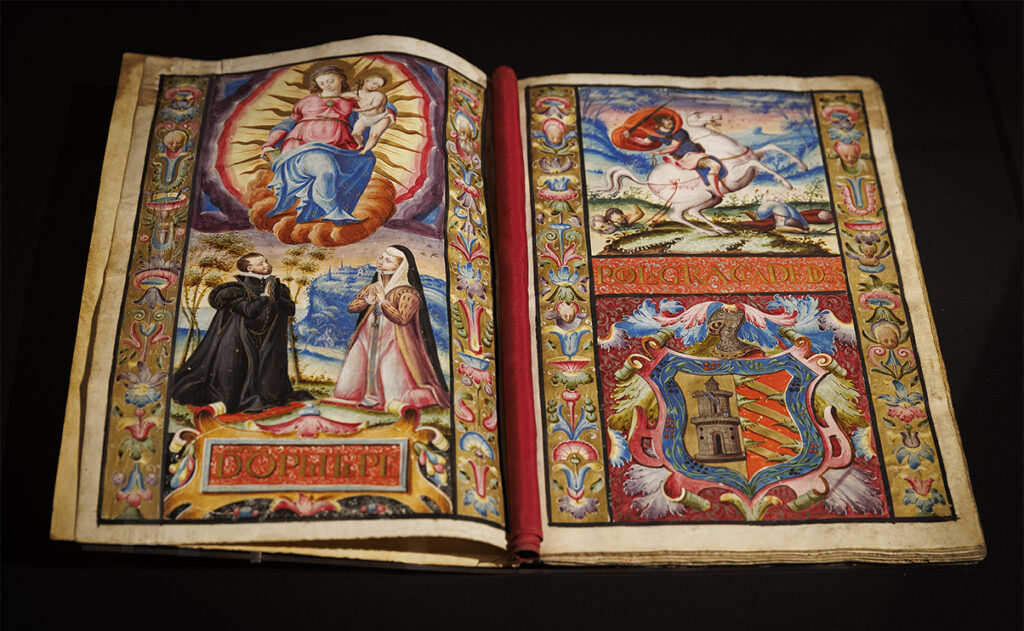
After the Inquisition purged Spain of Islam and the Alhambra Decree expelled recalcitrant Jews, the kingdom became a beacon of Catholic purity. Thus, we see pendants inlaid with religious imagery and over a dozen letters of nobility (cartas ejecutorias de hidalguía)—ornate manuscripts that legally induct families into the upper classes—illustrated with pious Spaniards praying before Mary and the infant Jesus.
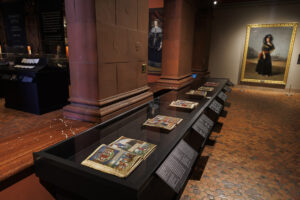
Letters of nobility (cartas ejecutorias de hidalguía) are ornate manuscripts—often with illuminations—that glimpses of shifting fashion trends.
All photos: Hispanic Society Museum & Library
For noblemen, these documents granted important privileges, such as the rights to bear arms and be exempt from taxes. For us, they offer glimpses of shifting fashion trends. Among the leafy branches of a family tree, the eldest patriarch is dressed in full body armour crowned with an explosion of feathered plumes, while his progeny don dark suits with white collars. Elsewhere, there are blonde hairdos swept up like candle flames and crimson velvet sleeves peeking out of black dresses secured with golden girdles.
As wearers grew wealthier, they adorned themselves with increasingly extravagant and impractical details like pompous ruffs and billowing sleeves. The verdugado morphed into the guardainfante (pannier), so-named because its preposterous proportions were said to harbor secret pregnancies, though this was anatomically impossible. Described by a French writer as “monstrous,” the guardainfante framework shot sideways from the hip like shoulder pads. Some were so wide that women couldn’t fit through the door. One was accused of smuggling tools to help her husband escape from prison.
For the full story click on the link below for your Digital subscription:

Subscribe to Art & Antiques for your Digital or Print copy