Subscribe to Our Newsletter
The City of Light in the Dark
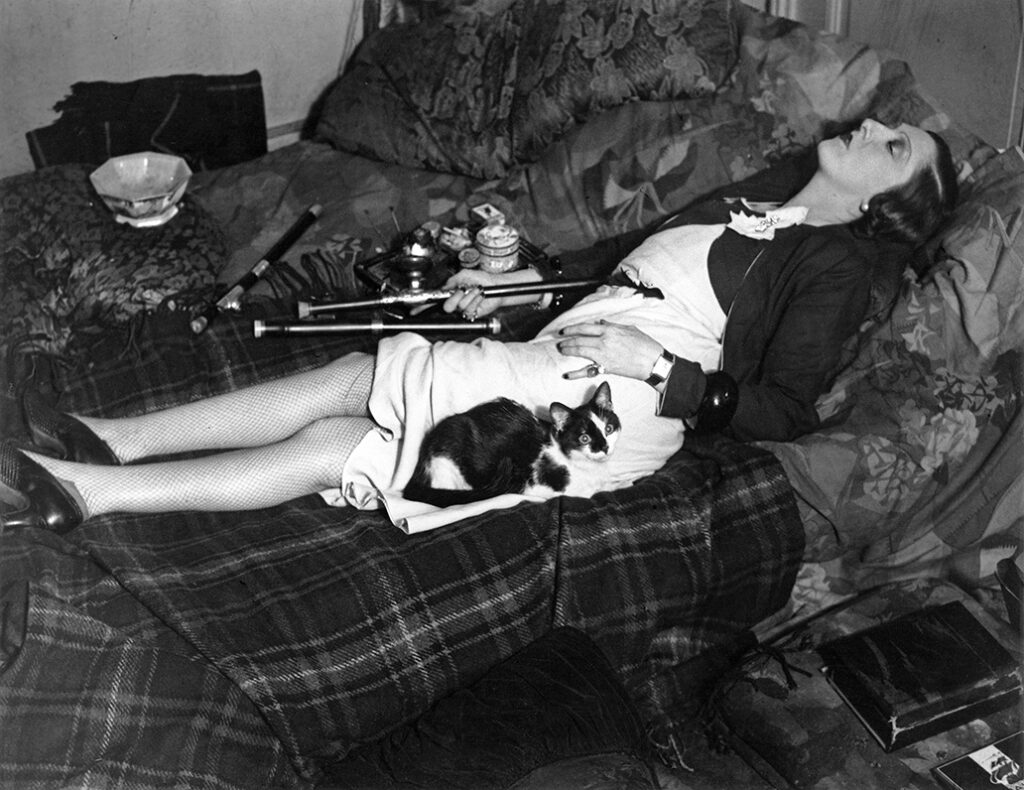
An opium smoker, along with her pet cat, circa 1931
Courtesy of Moderna Museet, Stockholm © Estate Brassaï Succession – Philippe Ribeyrolles 2026
The legacy of photographer Brassaï and his nocturnal wanderings through Paris in the 1940s goes on view at Stockholm’s Moderna Museet
By David Masello
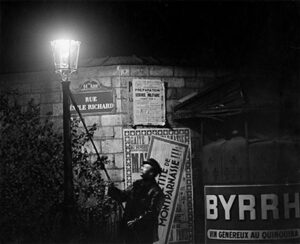
Brassaï was captivated by the remaining lamplighters of Paris, and he often followed them around the city as they performed their nightly tasks, as revealed in this shot, circa 1931.
Courtesy of Moderna Museet, Stockholm © Estate Brassaï Succession – Philippe Ribey-rolles 2026
For some, it’s among the most pleasurable and enlightening endeavors—to walk into the heart of a city, wander its streets, and discover what is there. For Brassaï, it was Paris. The American writer Henry Miller, then an expatriate living in the French capital, referred to his friend Brassaï, the prolific photographer, as possessing “the eye of Paris.”
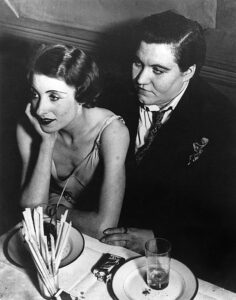
Fat Claude and Her Girlfriend at Le Monocle, Paris features a couple made immortal by Brassaï circa 1932. Le Monocle, a famous lesbian bar of the era, flourished at a time when monocles were often worn by females with an interest in meeting other women.
Courtesy of Moderna Museet, Stockholm © Estate Brassaï Succession – Philippe Ribeyrolles 2026
In his perambulations of the arrondissements in the 1930s and ‘40s and beyond, with his 4×5 large format camera in hand and glass plates ready to be loaded into the equipment, Brassai discovered a city both light and dark in character. From March 28 through October 4, 2026, an exhibition at Stockholm’s Moderna Museet, “The Secret Signs of Paris,” allows visitors a rare opportunity to see in depth what Brassai (1899–1984) saw on those after-dark explorations. Lovers locked in intimate embraces, prostitutes in brothels greeting clients, gay and lesbian bar life, sanitation workers at night, lamplighters, people gathered in cafés, restaurants, dance halls, even street gangs preparing for trouble.
The life of the city between the wars was rich with material for him. As Peter Galassi, the noted curator and art historian, wrote about an earlier exhibition of Brassaï’s works at the San Francisco Museum of Modern Art: “Paris of the 1930s was itself a casualty of the war,” meaning that what Brassaï had captured in that era was only of its time, especially what occurred at nighttime. Some 100 black and white photos have been carefully chosen by the Moderna Museet’s curator of photography and curator for the show, Anna Tellgren, who comments: “The exhibition focuses on the intense period in the 1930s when Brassaï became an innovator of nocturnal photography and one of the foremost portraitists of the city and life in Paris. The title of the exhibition, “The Secret Signs of Paris,” alludes to how the photographer opened the door to a hidden world using his camera, his curiosity and his artistic practice. His photographs challenge us to interpret signs—the traces of events and human presence —and to look for the answer to the many mysteries of the city. The exhibition allows us to follow in his footsteps.”
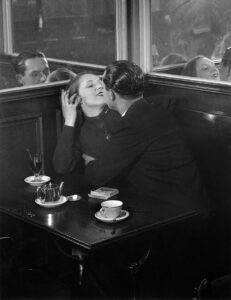
Perhaps Brassaï’s most iconic photograph shows an amorous couple in a Parisian café, circa 1932.
Courtesy of Moderna Museet, Stockholm © Estate Brassaï Succession – Philippe Ribeyrolles 2026
And that is what we are allowed to do in this show. Here, we see not only what he captured on film, but also to understand another dynamic of his personality as an artist: an ability to win the confidence of his subjects. The sheer nature of the then-existing technology in the 1930s meant that street photography was a difficult endeavor, one not prone to spontaneity, given the scale of the equipment a photographer needed to carry and the lighting often required to capture a shot.
For the full story click on the link below for your Digital subscription:

Subscribe to Art & Antiques for your Digital or Print copy