Subscribe to Our Newsletter
Portraitist of Moods
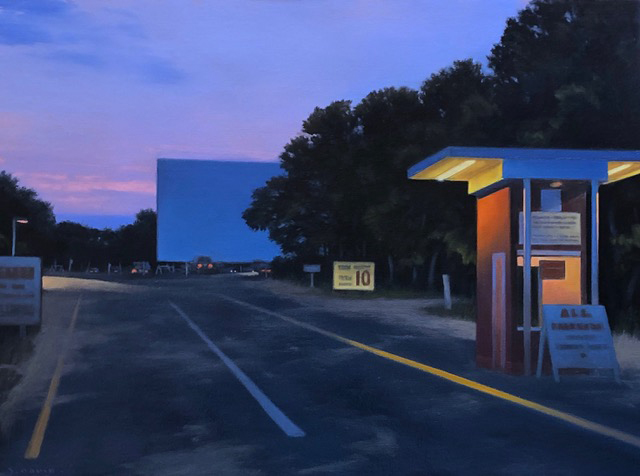
Drive-In Dusk (2020)
All images courtesy of John Dowd
Although John Dowd has been coursing the streets and beaches of Provincetown for decades, he always finds something new to paint. And even if it’s the same subject, he sees it differently every time.
By David Masello
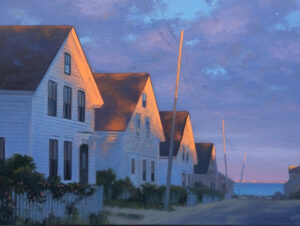
John Dowd frequently paints scenes of Provincetown, Massachusetts, where
he lives, such as Last Light (2020).
All images courtesy of John Dowd
Should you be walking the streets of Provincetown late at night, no matter what time of year, you might pass an old white clapboard house with a light on at the top floor. That could be the home of John Dowd, indicating that he is awake, and applying brushstrokes to a new canvas, likely depicting something right in town that he had seen by day or in the darkness. When the artist admits to being “a nocturnal person,” he is not being facetious, for, as he says, he “paints from after dinner till dawn. It affords me the opportunity to paint without any distractions.”
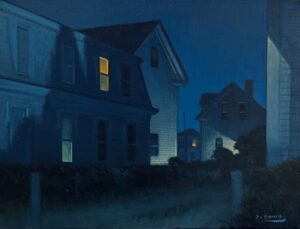
Night Shadows (2020)
All images courtesy of John Dowd
In working on his canvases, while the rest of the beach town at the coiled end of Cape Cod is asleep, Dowd is able to best harness, capture, and articulate on canvas what he calls “a portrait of a mood.” Even for those not familiar with the topography of Provincetown or the Colonial-era and Greek Revival architecture of much of the town, its commercial streets dense with quaint wooden structures, what Dowd features on his canvases can be as much a scene of something real as it is an emotion. “I know that a painting is most successful when someone feels something about it, rather than just being able to say, ‘Oh, I know where that house is in town.’”
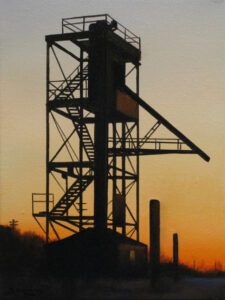
Along the Rail Yard (c. 1990s)
All images courtesy of John Dowd
“I like to think of my works almost as being like little poems of a place,” he says. Early morning sun, rays that he could be seeing as he is getting ready for bed, might illuminate the steep pitches of a streetscape of houses, each dwelling registering a different amount of the light and resulting shadow. A wet street at night curves its way through town, the lamplights in the neighboring houses bespeaking coziness and shelter from the elements. A single streetlight might illuminate a pointing traffic arrow stenciled to the pavement. A scene in Manhattan might show a pre-war apartment building stenciled against a moonlit sky. Palm trees in Hollywood, appearing lonely themselves, send shadows to the pavement. Dowd’s paintings affect and have an effect on a viewer. Even though there may be no figures present, a sense of a narrative is being subtly expressed. You are meant to feel the atmosphere of what is shown by him.
Even though Dowd, a native of Western Massachusetts, has been living in Provincetown since 1983, a small town of a few thousand in the off season, where, as he relates, “everybody knows who paints, who the grocer is, who the guy is who sells the fish,” he has not exhausted his locale for material. “It would take a lifetime for me to use up what is here. Every day I find a surprise in the town. Different light falls on something one day than on the day before. I might see a different pattern on the street or interesting angles and geometries it takes. I hope sometimes that the way I might paint something that people have seen a thousand times will make them aware of it in a new way or that they’ll see a new beauty in it from how light affects it. I want to prove how beautiful the world is if you pay attention to it.”
Although Dowd paints every day when he is in his Provincetown house, a structure that dates from the 1830s, he does travel frequently to Los Angeles and New York, the latter where he keeps an apartment. But wherever he goes, he paints what he sees. “When in Rome, I do some painting. I’m basically interested in just depicting my experience of places wherever they are.” He purposely avoids painting figures into his landscapes and streetscapes, preferring instead to show “quiet moments of a place rather than peopled moments.” He even describes his more careful, nuanced brushstrokes as indicative of his efforts to retain a sense of peace and calm. “I don’t have a lot of expressive brushwork, which would mimic movement and motion. I’m eager to not just depict a place, but to imbue what I show with something a little more. I don’t know exactly how that happens.”
For the full story click on the link below for your Digital subscription:

Subscribe to Art & Antiques for your Digital or Print copy