Subscribe to Our Newsletter
Aboriginal Originals
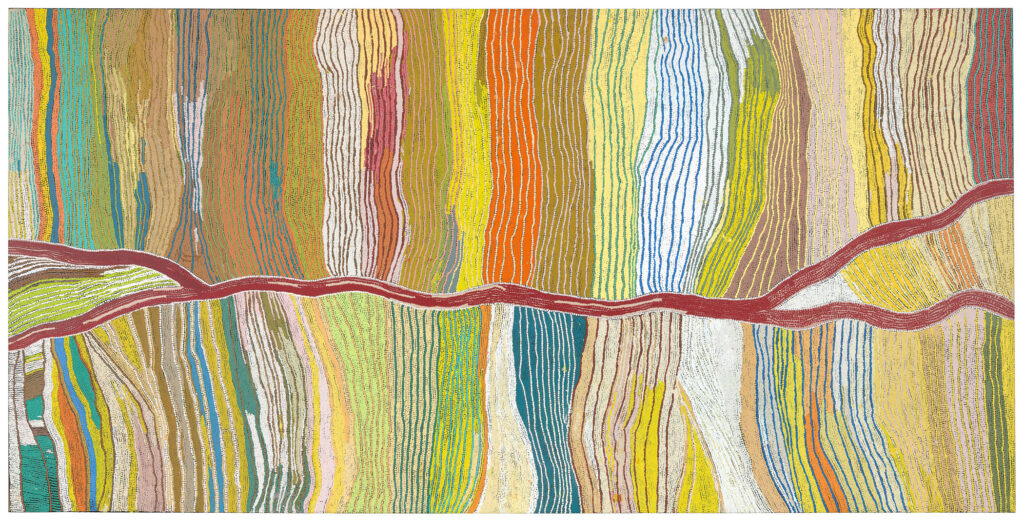
Indigenous artists of Australia reveal a people who create artworks that are ancient in origin while also remaining relevant and affecting today
By David Masello
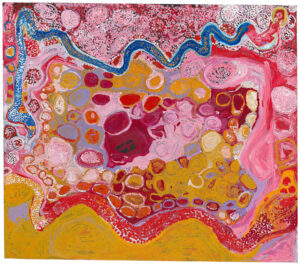
Wati Wanampi Tjukurpa (2010) by Tiger Palpatja (c. 1920–2012). Photo: Jeremy Dillon.
When Australian indigenous artists create works, they often use materials immediately at hand. Earth, sand, the bark of eucalyptus trees, resin, sap, timber, bush cane, jungle vines, dyes harnessed from the essences of plants. But many of the younger artists are fully acquainted with more advanced materials and mediums of our time—video, neon, photography, synthetic polymer paints, software that creates artworks composed of sounds. No matter which materials or mediums are employed, though, the art made by the Aboriginals and Torres Strait Islanders of Australia is like no other on earth. That fact is one of the mysteries of art. From where do such distinctive visions arise?
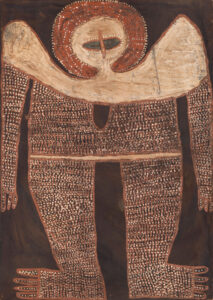
Wanjina (1980) by Alec Mingelmanganu (c. 1910–81). Photo: Christian Markel.
The Denver Art Museum (DAM) serves as the second venue for “The Stars We Do Not See: Australian Indigenous Art” (through July 26), a touring show that features 130 works by 142 artists, dating from the late 19th century to the present; many of the works have never before left Australia. “‘The Stars We Do Not See’ presents an exploration of Indigenous Australian art and culture, challenging visitors to examine their own perceptions of this vast and extremely diverse region,” says Christoph Heinrich, the Frederick and Jan Mayer Director of the Denver Art Museum. What is immediately discernible upon viewing these works, some monumental in their scale and sheer vibrancy, is the fact that “Indigenous Australian art is simultaneously ancient and contemporary, serving as a powerful expression of identity and a vital vehicle for the transmission of cultural knowledge and practice.”
Wititji (Hair String) (1997) by Maggie Napangardi Watson (c. 1921–2004). Photo: Narelle Wilson.
Though some works can appear wholly abstract at first glance, many are, actually, representational, or imagined representations, of something real. Emily Kam Kngwarray’s Anwerlarr Anganenty (Big Yam Dreaming; 1995), for instance, a piece of cosmic dimensions (measuring 27 feet in length), depicts the subterranean networks of roots and yams as they grow and spread beneath the soil. Yet, an initial examination of her canvas might reveal to some viewers just a complicated scene of intersecting spirals and curves, resulting in a hypnotic, albeit abstract, effect. The artist depicts an imagined reality.
For the full story click on the link below for your Digital subscription:

Subscribe to Art & Antiques for your Digital or Print copy