Subscribe to Our Newsletter
Sights Unseen
A new show at Tate Britain reveals the singular way James McNeill Whistler looked at the world and found the material for his art
By David Masello
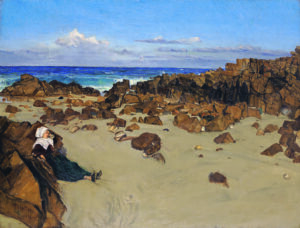
James McNeill Whistler’s surprising take on a French beach scene—The Coast of Brittany (1861)
All photos supplied by and courtesy of Tate Britain
James McNeill Whistler (1834–1903) was the best kind of visitor and observer of place. Wherever he roamed and lived, mostly in Europe, he sought out sites for his canvases, drawings, and etchings that most people would ignore. While in Venice, for instance, he would wander well away from St. Mark’s Square, the Rialto Bridge, and other landmarks that were tourist destinations even in his day to instead make etchings of beggars in an alleyway, women darning garments in a public square, or a lone and forlorn gondolier in the stilled lagoon. During his many years living in London, he captured the mist and fog even more often than the finished buildings and bridges that emerged through such conditions—with one of his most haunting paintings, Nocturne: Blue and Gold—Old Battersea Bridge (1872–75), depicting a hunched figure on a pontoon beneath the span appearing as a spectral presence. And even as a young boy living in St. Petersburg, Russia, where his father had been transferred from their home in Lowell, Massachusetts, for work, Whistler was doing candid self-portraits in pencil and drawing boys playing hockey.
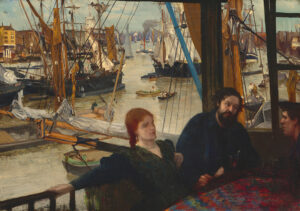
Wapping (1860–4) depicts figures in a working-class riverfront area of London.
All photos supplied by and courtesy of Tate Britain
While the American-born Whistler embraced city life, particularly in Europe, where he lived for most of his 69 years, equally compelling subjects for him were seascapes and beaches, fields and sunsets. “No matter how abstract, nature was the starting point of every work of art by Whistler,” writes Carol Jacobi, Curator of British Art 1850–1915 at Tate Britain, as well as the curatorial force for this monumental show there of more than 150 works. As for Whistler’s uncanny ability to capture the sense of place with such minimal articulation, a French critic of the day wrote in 1881 upon viewing some of the Venice scenes: “Never has anyone attempted to convey so much with so little apparent effort and such simple means. A small number of horizontal lines represent water and serve to throw back, into the immense distance, the shore, the city, and its monuments, simply marked in the paper by a few jagged lines…But how well this…reproduces the impression one remembers experiencing the sight of Venice.”
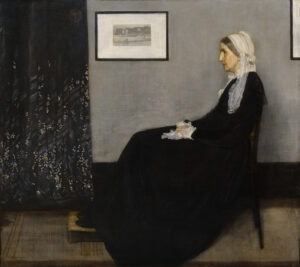
The most iconic of Whistler’s works, Arrangement in Grey and Black: Portrait of the Painter’s Mother (1871)
All photos supplied by and courtesy of Tate Britain
A viewing of virtually any Whistler work—be it a cityscape, portrait, interior domestic scene, or something as unexpected as a scene of street life in Algeria, yet another of his many locales—is to come away with a distinct impression of that place or person. Although Jacobi and other art historians who contributed to an accompanying volume of essays about the artist and the exhibition relate that he was a difficult person in life (argumentative, conceited, haughty, and impatient), he does seem to have had a sense of humor, even a penchant for self-deprecation. During his lifetime, especially when he was receiving considerable attention as an artist, critics of the time were confused about his origins. “To begin with I am not an Englishman,” he wrote with some wry humor in a memoir that Jacobi references. As she further relates, when he was asked why he was born in Massachusetts and not on the Continent, he is said to have replied, “I wished to be close to my Mother.” She recounts, too, that in his final years, when he was ill and aware that he might need to return to America after a long postponement, he wrote that “one cannot continuously disappoint a continent.”
For the full story click on the link below for your Digital subscription:

Subscribe to Art & Antiques for your Digital or Print copy