Subscribe to Our Newsletter
Outer Body Experiences
As you look at these hyperrealistic sculptures on display in Quebec City, you can’t help but wait for them to breathe and talk
By David Masello
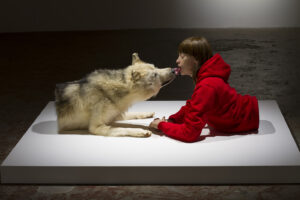
On Either Side (2016) by Karine Payette
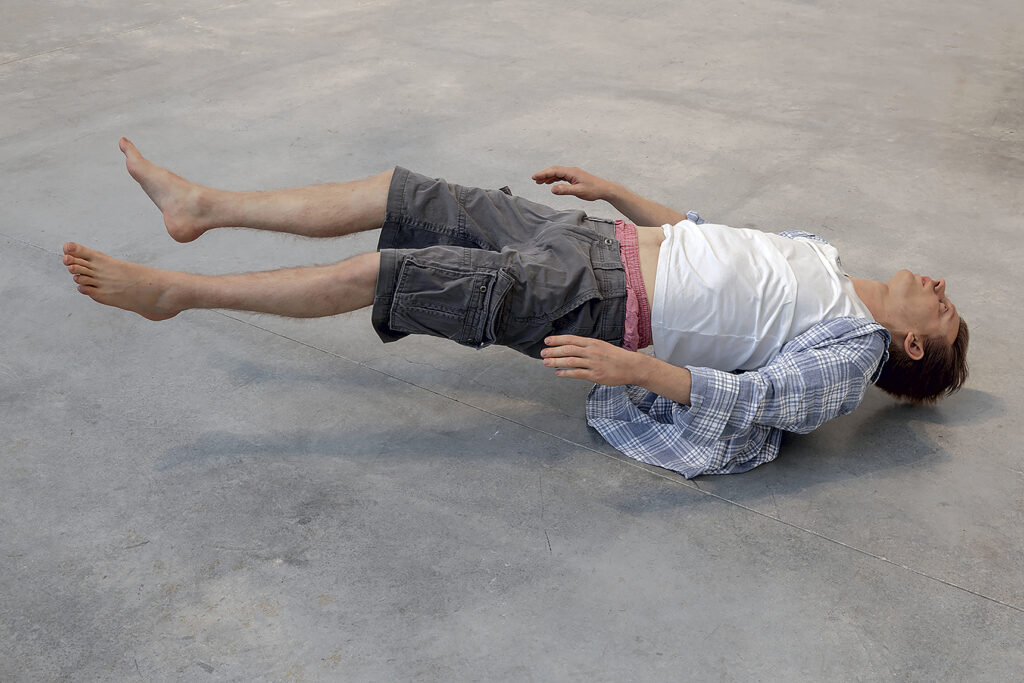
An attractive young man, casually garbed in shorts and a t-shirt, appears to levitate over the floor, as if in an otherworldly state of ecstasy. An elderly woman brings an infant, perhaps a grandchild, to her bosom to cradle. A cowled woman, each of her bare feet revealing six toes, seems lost in thought as she squats on the floor. A buff, bare-chested bodybuilder pauses in his gym routine, perhaps catching his breath for another rep. Two laborers take a break from work, one beside a ladder, the other with tools in his hand. A man and woman seem intertwined in a carnal embrace. And a cleaning woman, bucket in hand, surveys a gallery she is about to wipe down.
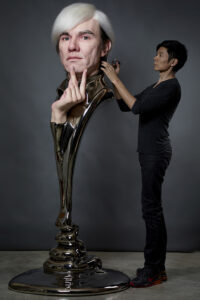
Kazu Hiro’s 2013 rendering of Andy Warhol.
Scattered in the galleries of the Musée National des Beaux-Arts du Québec (MNBAQ) are some 40 figures in various activities and poses, some seemingly beckoning us to approach and engage in conversation. Yet, none of them are real. So lifelike are they, though, that the difference between the living and the artificial is difficult to discern at first glance—and even more disconcertingly, in subsequent, lasting glances. Nothing about the figures seems to give them away as not being real people.
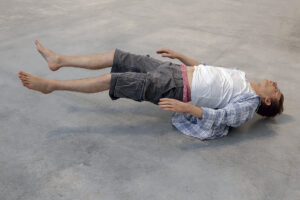
Before you start talking to the figures in the show in Quebec City, see if they’re made of human flesh or polyester and silicone like Josh (2010), by Tony Matelli.
“As our ability to distinguish truth from falsehood is undermined by artificial intelligence, the boundaries between the real and the virtual are becoming increasingly blurred,” says Caroline Lantagne, the MNBAQ’s exhibitions curator and curator of “Hyperrealism: This Is Not a Body,” a traveling show that has landed at the Canadian venue (through October 12). Although the flesh of these figures is eerily real, moles and wrinkles and all, their mouths poised to speak at any moment, their ordinariness, as well as their beauty, thoroughly realistic, each of the sculptures is made largely of silicone or fiberglass or resin. And just as the figures seem realistic, so, too, do the emotions they convey—be it loneliness, lust, self-absorption, or even terror. Unadulterated fear and distress are embodied in John DeAndrea’s American Icon—Kent State, a bronze sculpture covered in painted grisaille, that references a famous photograph from the horrific event at the college campus in 1970 that shows a young woman kneeling over a student shot dead by the Ohio National Guard during a protest over the Vietnam War.
While this hyperrealism show has been touring the world—17 cities so far—since 2016, every venue has had the chance to put its own human take on these humanlike figures. “We curated the exhibition for Canadian audiences by revising certain content and developing a theatrical exhibit design that used lights, lighting effects, and audiovisual projection to create an immersive experience,” says Lantagne. “We also enhanced it with pieces from our collection by Quebec artists like Alain Benoit, Stanley Février, Louis Fortier, Milutin Gubash, and Mark Prent, as well as a piece by Karine Payette on loan from the artist,” she adds. “Evan Penny was the only Canadian artist represented in the original touring exhibition.”
For the full story click on the link below for your Digital subscription:

Subscribe to Art & Antiques for your Digital or Print copy