Subscribe to Our Newsletter
A Bel-Air Birthday
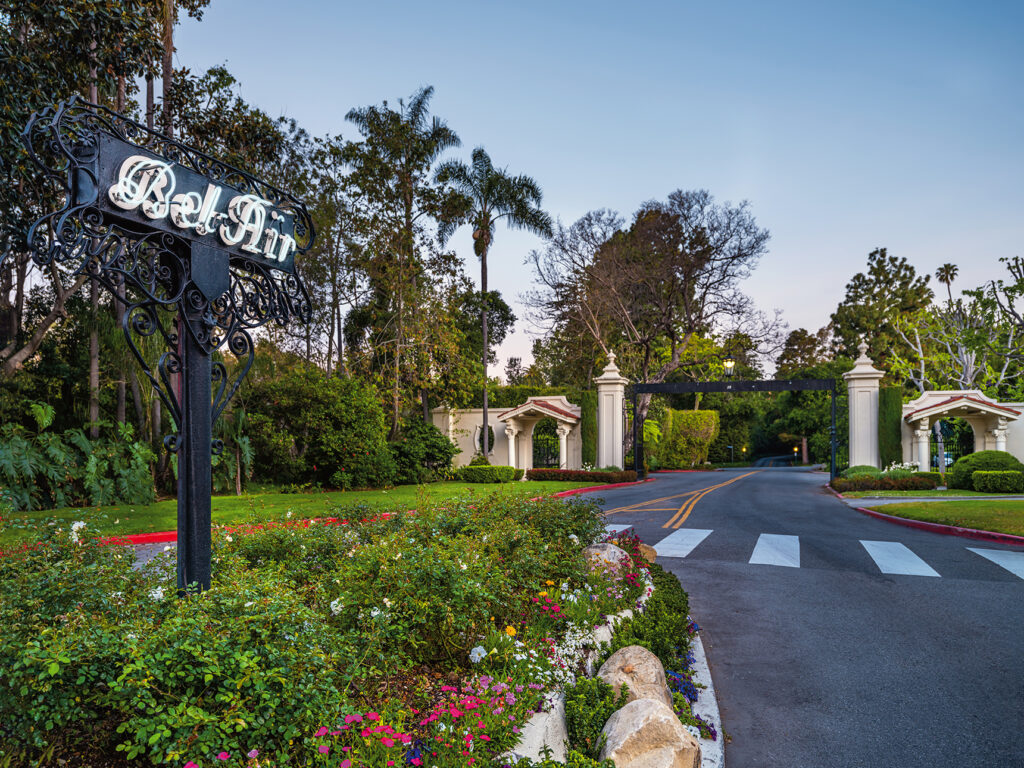
Making the case that a neighborhood, the luxe California locale of Bel-Air, is one of America’s most coveted antiques
By David Masello
One of America’s most beautiful places is one that largely can’t be seen. Many of Bel-Air’s greatest homes, estates, and gardens, even the vistas afforded from hilltops that take in the full expanse of Los Angeles, remain mostly invisible to those passing through. Apart from a couple of gas stations and a modest assemblage of professional offices and stores on Moraga Drive, there’s little semblance of a town center (though it could be argued that the Hotel Bel-Air serves as a kind of social town hall). Bel-Air’s only notable sculptural elements are its majestic East and West Gates, which mark the entrances to the neighborhood.
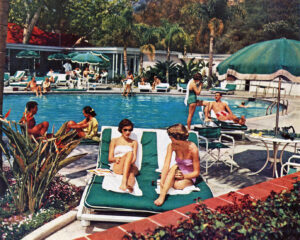
Hotel Bel-Air’s pool in 1951, which became, and has remained a hub of social activity in the neighborhood.
Photo courtesy of Rizzoli
So, where exactly is Bel-Air and why does it endure as a place with so much character?
Bel-Air, technically a neighborhood of the city of Los Angeles, is among the most desired of locales in which to live. On the occasion of its 100th anniversary in 2023, author David Silverman was commissioned to write Bel-Air: The Centennial (Rizzoli), a voluminous compendium that reveals much of what can’t be seen through a car window. And given that there are no sidewalks, a pedestrian has little chance to peek between hedges or over walls to see some of the grandest examples of residential architecture in America, with many homes dating to the 1920s and ‘30s. But on these pages, we can see what lies behind those barriers.
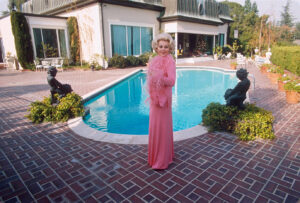
Zsa Zsa Gabor lived much of her life in Bel-Air. Her first home there burned in the 1961 fire, but she moved into 1001 Bel-Air Road in 1973 and lived there until her death in 2016 at age 99.
Photo courtesy of Rizzoli
Given Bel Air’s 100-plus years in existence, its parcels of land filled with architectural masterpieces, it’s fair to call the town an American antique—but one that is decidedly not locked in the past. Its very social patina, fueled by its roster of resident Hollywood stars, past and present, continues to assume a new luster.
“I agree with that idea that Bel-Air could be considered having attained antique status,” says Silverman, from his Brentwood home, where he founded LA House Histories. His one-man authorial enterprise produces commissioned books about the city’s historic houses. For Bel-Air: The Centennial, which he considers his first published by a mainstream publisher, as well as the first he’s written about a neighborhood, as opposed to a single residence, Silverman was invited in 2022 by the Bel-Air Association to put together a volume commemorating the town. Some 100 members of the Association funded his book, which was subsequently republished by Rizzoli as an oversized, deluxe edition.
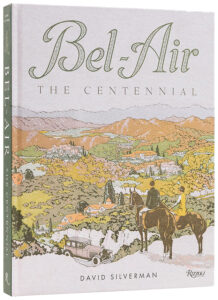
Cover of the book by David Silverman (Rizzoli).
Photo courtesy of Rizzoli
“Bel-Air remains a classic historical location that maintains a lot of its original historic character, with many of its original homes from the 1920s still in place,” Silverman emphasizes. What makes Bel-Air also an antique, of sorts, is its sheer history of who has lived there. In perusing Silverman’s book—which includes images of vintage maps and site plans, entrancing aerial perspectives, original brochures produced by the town’s developer, Alphonzo Bell, and photos of its resident Hollywood stars at their homes—we see a place infused with an allure that became famous in its own right. The Hollywood Walk of Fame might better have been placed on these streets, for Bel-Air’s galaxy of star residents of the past have included Marilyn Monroe, Elvis Presley, Frank Sinatra, Dean Martin, Jerry Lewis, Frank Capra, Sonny & Cher, Zsa Zsa Gabor, Henry Fonda, Kim Novak, Nancy and Ronald Reagan, Alfred Hitchcock, and, let’s add, Jack Ryan (the man who played a critical role in developing Barbie and Hot Wheels, among other pop-culture phenomena).
Of its founding, Silverman outlines how Bell purchased the 1,800 acres that comprise Bel-Air in 1922 (for $2.5 million), whereupon he soon started selling lots. Conservative by nature, Bell initially forbade Hollywood people from even moving into the town. “He restricted the town to having no movie people,” Silverman says, “because he found them morally suspect. He enforced that for six years, but as the Depression hit and buyers became scarce, he changed the rules to attract anyone who could afford to be there.”
For the full story click on the link below for your Digital subscription:

Subscribe to Art & Antiques for your Digital or Print copy