Subscribe to Our Newsletter
The Aristocrats
They were wealthy, privileged, and rigorously formalist. But the “Park Avenue Cubists” believed that the most sophisticated art should be available to everyone.
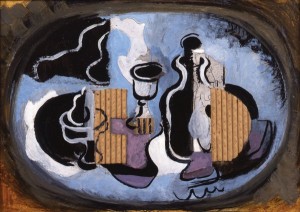
Suzy Frelinghuysen, Cubist Still Life;
Featured Images: (Click to Enlarge)
-
- Suzy Frelinghuysen, Cubist Still Life;
-

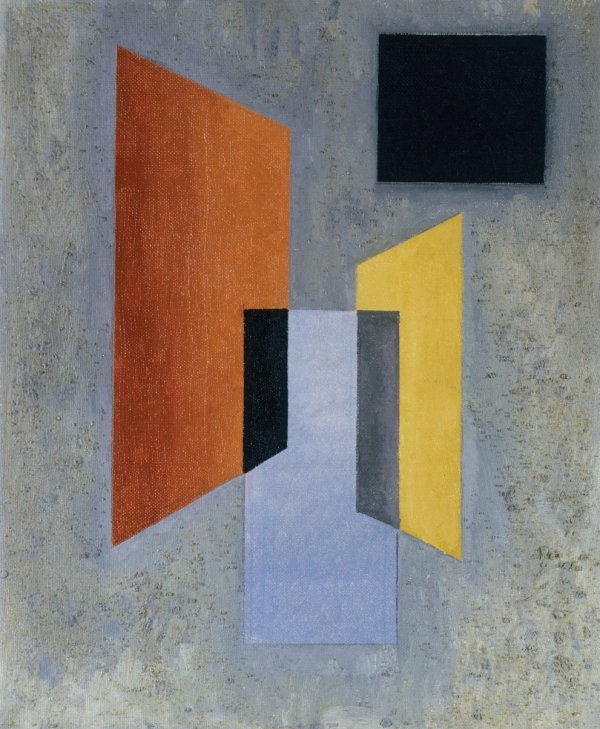
- Charles Green Shaw, Untitled (Intersecting Trapezoids No. 1), circa 1936, oil and sand on canvasboard, 18 x 15 inches.
-
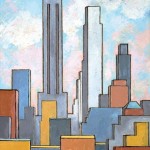
- Charles Green Shaw, Grooved Geometry, 1934, oil on artist board, 30 x 213⁄4 inches;
In 1927 the Gallery of Living Art opened its doors to a public that was in large part indifferent, if not hostile, to its contents. Housed in a spacious study hall in the main building of New York University, on the west side of Washington Square, the Gallery offered paintings and sculptures by such figures as Paul Cézanne, Jean Arp, and Constantin Brancusi. Pablo Picasso’s Three Musicians (1921) was on view alongside The City (1919) by Fernand Léger. There was a study for Picasso’s Les Demoiselles d’Avignon (1907), as well as Joan Miró’s Dog Barking at the Moon (1926). With over 125 astutely selected works, this was an impressive survey of European modernism. Now housed in the Philadelphia Museum of Art, it was assembled by Albert E. Gallatin.
Born in 1882 in Villanova, Pa.—an affluent suburb on Philadelphia’s Main Line—Gallatin was an heir to a banking fortune and a descendent of Albert Gallatin, who served as Secretary of the Treasury under Presidents Thomas Jefferson and James Madison. An art collector from an early age, Albert E. Gallatin began with Impressionist landscapes and urban scenes by John Sloan and other members of the Ash Can School. These acquisitions reflected the tastes of young man who was well-informed but not adventurous—and they changed quite suddenly, soon after the First World War, as his annual trips to Europe brought him into contact with members of the Parisian avant-garde.
Guided by Marcel Duchamp and a few New Yorkers with knowledge of advanced painting, Gallatin visited the studios of Picasso, Miró, Georges Braque, and Piet Mondrian, among others, acquiring their work as he divested himself of his Impressionist and Ash Can School holdings. Gallatin had been converted to the idea of aesthetic progress and felt that New York was in dire need of news about recent developments in the avant-garde. With its sprawling overload of new art, the Armory Show of 1913 had introduced the subject to a large and mostly baffled audience. In the first decade of the 20th century, Alfred Stieglitz’s 291 Gallery had dispelled a bit of the darkness with exhibitions of work by artists who later caught Gallatin’s attention. Yet modernism was a blank spot on the cultural maps consulted by most Americans. Hence, Gallatin felt, the need for a Gallery of Living Art to showcase his collection. There was enlightenment to be spread.
Gallatin was not only a cultural missionary. He was himself a painter. Though he put none of his own work on display at the Gallery, he did include canvases by two of his friends: George L. K. Morris, who had inherited a portion of the Woolworth fortune, and Charles Green Shaw, the son of a prosperous New York merchant with roots in the early Quaker settlement of Pennsylvania. Like Gallatin, Morris and Shaw had developed modernist styles. Like him, they resided on Park Avenue. And thus they came to be known as the “Park Avenue Cubists,” though only Suzy Frelinghuysen, Morris’s wife, continued after her avant-garde apprenticeship to paint in a Cubist manner. The others moved on from Cubism to cultivate variations of the geometric abstraction pioneered by Mondrian and de Stijl, Wassily Kandinsky and the Bauhaus, as well as Alexander Rodchenko and other Russian Constructivists. Nonetheless, Cubism haunted them throughout their careers.
Frelinghuysen’s forebears included a Secretary of State and the United States Senator who was Henry Clay’s vice-presidential running mate in 1844. Trained as a singer, she had a successful career at the New York City Opera in the years after the Second World War. Earlier, with her focus on painting, she developed a style that blended elements of Juan Gris’ elegantly restrained collages of the late 1910s with the smooth, often cylindrical shapes of Purism—an offshoot of Cubism invented by Léger, Amedée Ozenfant, and Le Corbusier in the days when he painted under his given name, Charles-Édouard Jeanneret.
Recognizable subjects—bottles, wine glasses—fill Frelinghuysen’s paintings of the 1930s. In those years her husband favored flat, abstract shapes with a lively, biomorphic flavor. Jean Arp was as important to Morris as Mondrian or Picasso. Interspersed with Morris’s curvilinear elements are linear forms that seem to be ushering the others into a state of compositional harmony. For the Park Avenue Cubists, visual order is the overriding goal. They sought to bring unity out of disparity. And so Morris often set aside his biomorphism, a pictorial petri dish conducive to exuberant eccentricity, and composed with straight lines and right-angled patches of color.
Though Euclidean propriety exercised a degree of authority over all these artists, it is especially evident in the paintings of Charles Green Shaw (with the exceptions of the ones where he, like Morris, took cues from Arp). Not that every form in his more severe compositions echoes the right-angled corners of the canvas. But when his deployment of typically hard-edged shapes departs from basic premise of his art it is with a delicacy and a deliberation that produce an almost paradoxical effect of architectural solidity.
In 1933 Shaw launched a series of paintings to which he gave the title “Plastic Polygons”—“plastic” in a double sense of moldable and having to do with the visual arts. Transposing radically simplified drawings of the New York skyline to canvas, he arrived at paintings with outlines at once squared-away and irregular: abstract images that powerfully evoke the verticality of space in Manhattan. In giving his rationale for these early instances of the shaped canvases, Shaw repeatedly invokes the ideal of purity—no realist detail, no picturesque effect, just form as self-evidently clear as he could make it.
Gallatin was so absorbed in running the Gallery of Living Art and encouraging other avant-garde ventures—he was among the chief supporters of the American Abstract Artists group—that he didn’t settle down to his own work full-time until the mid-1930s. When he did, he evolved into a painter even more devoted to geometric clarity—and compositional restraint—than Shaw. Step by step he worked his way beyond the broad shapes of Analytic Cubism, then the weighty, architectonic shapes of Purism, to a style consisting chiefly of elemental geometries in taut orbit around one another. Yet he didn’t abandon the role of modernist impresario.
In 1936 Gallatin renamed his collection the Museum of Living Art, hoping that it would serve as a counterweight to the Museum of Modern Art, which refused to show work by contemporary American modernists. In addition to the Park Avenue Cubists, Gallatin’s holdings featured Charles Biderman, John Ferren, Karl Knaths, and a few more—not a great many but enough to disprove the Modern’s contention that the younger members of the American avant-garde were deserving only of neglect. Though Gallatin’s contention was controversial in New York art circles, his Museum made his case. There is a quietly relentless insistence on excellence in his work and that of his friends. They believed in aesthetic sophistication, they believed they had achieved it, and their oeuvres justify their faith on both points.
None of the Park Avenue Cubists theorized a large social or political purpose for avant-garde art. No atmosphere of Bauhaus reform or de Stijl utopianism filtered into the Museum of Living Art, and so we can only guess at the values underpinning the aesthetics of Gallatin and the others. There are clues, however, in Shaw’s talk of purity and in a remark Frelinghuysen made after her successful debut as a singer. An interviewer had asked her how she reconciled her simultaneous devotion to music and to art. “In painting,” she replied, “you’re concerned with the arrangement of forms. On the stage, which is your frame, you’re concerned with arranging yourself. It’s like a picture, only, of course, you’re moving.”
Describing herself as a form to be properly arranged within the frame of the stage, Frelinghuysen stood revealed as an unapologetic formalist. The implication of her comment—an implication that would have been seconded by each of the Park Avenue Cubists—is that properly composed shapes on canvas generate, in their autonomy, a good in itself that needs no further justification. If this purely aesthetic variety of goodness is widely misunderstood, so be it. In his introduction to the catalogue of the renamed Museum of Living Art, Gallatin quotes Le Corbusier as saying, “The art of our period is performing its proper function when it addresses itself to the chosen few. Art is not a popular thing.” Gallatin agrees, yet he believes that here is more to be said on the subject.
There is a possibility, he argues, that a public that is exposed to the best of contemporary art will undergo an improvement in taste. Or if the great mass of people remains unaffected, there will be, nonetheless, some positive effect beyond the rarefied circles in which Gallatin moved. For that reason, he kept the Museum open in the evening, so that working people could visit and be exposed to avant-garde art. After all, the phrase “avant-garde” implies that, in the realm of culture, there are those who go ahead to show the way. As Gallatin saw it, the more who follow modern art’s leaders into realms of order and refinement the better it will be for everyone. So it would seem, after all, that a utopian optimism lurked in the militant formalism of the Park Avenue Cubists. During most of the 1930s this optimism persisted. Then the Second World War arrived, and it could only collapse. Nonetheless, these artists did much of their best work during the War years and in the early 1950s. Their hope for art’s ameliorating impact on the world was lost and yet their faith in art itself lived on unscathed.
By Carter Ratcliff

Subscribe to Art & Antiques for your Digital or Print copy