Subscribe to Our Newsletter
Mix Master
Archibald Motley relished the ambiguities of racial identity in America and imbued his paintings with both modernist refinement and pop-culture exuberance.
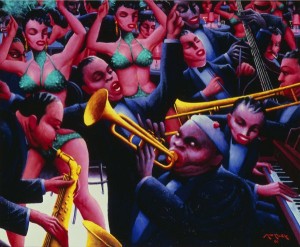
Archibald J. Motley Jr., Hot Rhythm, 1961, oil on canvas, 40 x 48.375 inches;
Featured Images: (Click to Enlarge)
-

- Archibald J. Motley Jr., Self-Portrait (Myself at Work), 1933, oil on canvas, 57.125 x 45.25 inches.
-
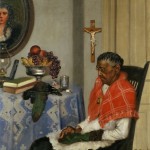
- Archibald J. Motley Jr., Mending Socks, 1924, oil on canvas, 43.875 x 40 inches.
-
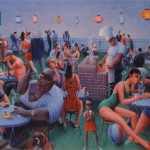
- Archibald J. Motley Jr., Barbecue, 1960, oil on canvas, 30.375 x 40 inches.
-

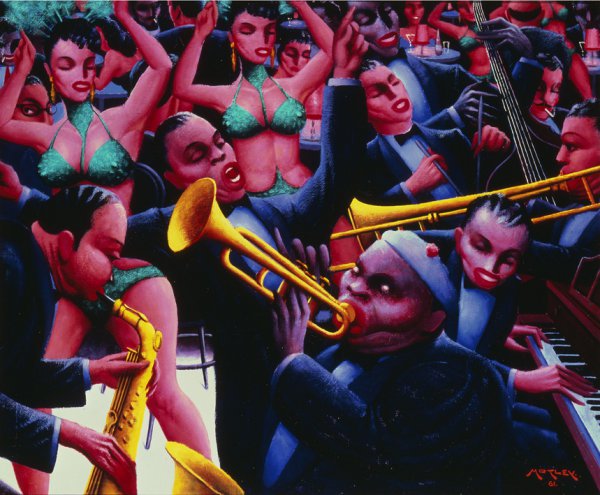
- Archibald J. Motley Jr., Hot Rhythm, 1961, oil on canvas, 40 x 48.375 inches;
-
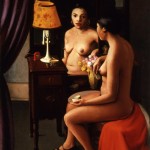
- Archibald J. Motley Jr., Brown Girl After the Bath, 1931, oil on canvas, 48.25 x 36 inches;
Almost a century ago, a black, classically trained modernist artist, Archibald J. Motley, Jr., had begun using paint on canvas to address such delicate, nuanced subjects as the dignity and beauty of mixed-race persons, skin-color-based discrimination among his own people, and what he regarded as the lowbrow, sometimes ridiculous, but still fascinating “hokum” of African-American popular culture.
In “Archibald Motley: Jazz Age Modernist,” which originated at Duke University’s Nasher Museum of Art in Durham, N.C., and this month will open at the Los Angeles County Museum of Art (October 19, 2014–February 1, 2015), the life story and achievements of this modernist innovator are finally receiving some much-deserved attention. Organized by Duke art history professor Richard J. Powell, this revealing exhibition will be seen at several venues in the United States before ending its tour in New York, where it is scheduled to open in the Whitney Museum of American Art’s new building next fall.
Powell’s examination of Motley’s work is an exemplary exercise in revisionist art history that seeks nothing less than to secure for its subject and his accomplishments an overdue, more prominent place in American modern art’s canon. “This exhibition makes clear that Motley was not only an important African-American artist but, indeed, one of America’s great artists, period,” says Nasher director Sarah Schroth. Powell says, “With this exhibition, in part we’d like to show that Motley was ahead of his time, and that his work is relevant to our world today, for through his art he addressed some complex themes that may still seem complex and difficult for some people to easily grasp.”
Motley, who is still not very well known today, was born in New Orleans in 1891 and moved with his parents to Chicago when he was an infant. His father worked as a Pullman railway-carriage porter. After declining a scholarship that would have allowed him to study architecture at Chicago’s Armour Institute, Motley was accepted at the School of the Art Institute of Chicago—and the Armour’s president still paid his first-year tuition fees. Motley went on to produce a technically inventive, thematically wide-ranging oeuvre that easily assimilated early-20th-century modern art’s stylistic developments—Cubism-derived, skewed perspectives here; wild, expressionistic color there—and, in general, much of its urban, individualistic, progressive point of view. In fact, as steeped as Motley was in traditional 19th-century academic painting techniques, his work was quietly edgy almost from the start of his professional career. Later it became stylishly exuberant and sometimes downright weird.
Some historians have described Motley, a light-skinned black man whose ancestry was African, European and Native American, as someone who throughout his life felt unsettled about his own racial identity. As Powell sees it, though, the artist “instinctively understood that the issue of racial identity was complex, because in his own case it was, too.” In other ways, Powell added, Motley’s life was neither simple nor conventional, and he had to emotionally and psychologically process its vicissitudes—that is, he had to grasp or at least accept life’s complexities. Like other artists and intellectuals of the Harlem Renaissance of the 1920s and ’30s (or “New Negro Movement,” as it was then known), he was interested in the multidimensional nature of black racial identity and its relationship to the forms of social and cultural expression that were associated with it.
The exhibition opens with a gallery full of stunning portraits in which the painter, in ways that are both subtly and not so subtly subversive, retooled a traditional artistic genre and its familiar, permissible content—stolid white burghers and high-society figures—to yield works that may be seen as having presaged some of late-20th-century postmodernism’s “transgressive recontextualizing strategies.” In them, Motley depicts black and mixed-race sitters in, as Powell puts it, “an in-your-face manner” that unabashedly captures their dignity as individuals and recognizes their legitimacy as subjects of works of fine art.
Motley’s oil-on-canvas masterpieces in this genre include, among others, Portrait of My Mother (1919), an essay in expertly modulated browns whose palette serves as a metaphor for the mixed racial background of its subject, a woman who grew up on a Louisiana plantation and whose father was white; her big eyes sparkle with the inquisitiveness and strength of a self-aware matriarch. Also on view are Mulatress With Figurine and Dutch Seascape (1920), the artist’s take on the “tragic mulatta” theme that had appeared in American literature since the 1840s, with its focus on mixed-race people who fit in neatly neither with the white world or the black world. Still, the props surrounding Motley’s sitter suggest that, for all her real or imagined suffering, she was a woman of style and modest erudition.
Motley also painted his wife, who was white, in the nude and, as Powell points out, with the precision and objectivity of the German Neue Sachlichkeit style of the 1920s. He portrayed her elegantly clothed and confident, too, with a fox stole wrapped around her neck. In his 1933 Self-portrait (Myself At Work) and his Brown Girl After the Bath (1931), the artist’s subjects confront viewers with intriguing reverse gazes. Brown Girl is especially mysterious. Who is this nude young woman at her dressing table, looking at and beyond herself in the mirror? The reflection in the mirror doesn’t seem to match the person seated in front of it. It’s the same woman, but in terms of representational accuracy, it’s slightly off; the posture of the figure in the mirror is different.
In 1928, Motley became the first “negro artist … in the annals of the American school of painting” to have a solo exhibition at a commercial gallery in New York, as a pamphlet from the event at Madison Avenue’s New Gallery stated. He won a Guggenheim Fellowship that allowed him to live and work during the next two years in Paris, where he made forays into its world of cafés and music clubs but rarely mingled with other artists. Mostly he focused on his painting. Later, back in Chicago, in subsequent decades Motley employed an often outrageous palette of electric blues, acid greens, hot pinks, and dark blues or purples in atmospheric scenes of everyday life in that city’s black neighborhoods. The compositions of many of his paintings, such as Barbecue (1960) and Hot Rhythm (1961), became dynamic, almost musical, but he traded the precision of his earlier portraits for more obviously stylized, almost cartoonish modes of rendering his subject matter—people, buildings, cars, circus sideshows—with a kind of visual shorthand. Mouths became red ovals filled with simple white strokes to represent teeth. Daubs of white paint became his subjects’ beady eyes.
Motley’s wife died in 1948. In order to support his family, the artist did some work for a company that produced hand-painted shower curtains. During the 1950s and ’60s, some of the pictures he painted during trips to Mexico reflected the influence of that country’s modernist movement, such as the thrust and harmony of the Mexican muralists’ compositions. He also produced some pictures of tourist-kitsch quality and some oddball gems, such as After Fiesta, Remorse, Siesta (1959–60), which shows a naked woman seated at a piano in a deserted after-hours nightclub. She is surrounded by a band’s abandoned instruments and empty, candlelit tables. A lone drunk lingers, sleeping, at one of them. The woman’s red high-heeled shoes lie next to her, and in the distance a couple embraces under a streetlamp.
If the cacophony of Chicago street life and the complexity of a single person’s identity—never mind that of an entire people in the broader sweep of American history—were subjects to which Motley brought a keen sense of observation and engagement, it seems that a quiet, constant, middle-class-grounded sense of self-inspection was also an integral part of his being. Powell’s research shows that Motley could party in Paris and bar- and bordello-hop in Mexico with gusto, but also that he was earnest about his work. The artist and art historian James A. Porter, who played a pioneering role in establishing the field of African-American art history, once wrote that “Motley’s preference for the wanton and gross in Negro life is basically sincere; his interpretation of the swaggering, picaresque humor of the scenes [he depicts] has virtually no intent to caricature.”
In an undated, mid-20th-century text of his own, Motley observed, “The Negro poet portrays our group in poems, the Negro musician portrays our group in jazz, the Negro actor portrays our group generally with a touch of comedy, hilarity dancing and song … All of these aforementioned portrayals are serious, original interpretations of the Negro. There is nothing borrowed, nothing copied … So why should the Negro painter, the Negro sculptor mimic that which the white man is doing, when he has such an enormous colossal field practically all his own; portraying his people, historically, dramatically, hilariously, but honestly?”
“Archibald Motley: Jazz Age Modernist” proposes that, for his technical accomplishments as a painter and the unprecedented candor he brought to examining his subjects in a fine-art context, the time has come to give Motley’s oeuvre some serious critical attention. Some students of American culture and society might find in his work, even decades after it was produced, some unexpected, subtle or quizzical contributions to a “national conversation about race.” More resonant, though, may be the ways in which Motley’s art probes the yearning, conflict, pain and pride in the heart of a people, and taps into the spirit of a particular society that has long nourished a nation’s soul.

Subscribe to Art & Antiques for your Digital or Print copy