Subscribe to Our Newsletter
The Imaginary Real
In his bold, geometric work, Al Held eschewed subjectivity and strove for structure
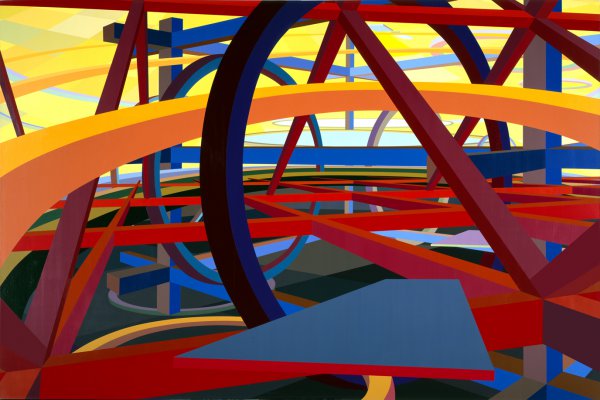
Al Held, Roberta’s Trip, 1985, acrylic on canvas, 96 x 144 inches. Courtesy of the Al Held Foundation, Inc. and Cheim & Read, New York / Licensed by Artists Rights Society (ARS), New York
Featured Images: (Click to Enlarge)
-
- Al Held, Courtesy of the Al Held Foundation, Inc. and Cheim & Read, New York / Licensed by Artists Rights Society (ARS), New York
-
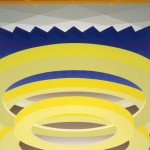
- Al Held, Trinity, 1998, acrylic on canvas, 60 x 48 inches. Courtesy of the Al Held Foundation, Inc. and Cheim & Read, New York / Licensed by Artists Rights Society (ARS), New York
-
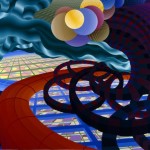
- Al Held, Genesis II, 2001–03, acrylic on canvas, 180 x 240 inches. Courtesy of the Al Held Foundation, Inc. and Cheim & Read, New York / Licensed by Artists Rights Society (ARS), New York
-
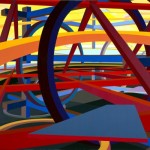
- Al Held, Roberta’s Trip, 1985, acrylic on canvas, 96 x 144 inches. Courtesy of the Al Held Foundation, Inc. and Cheim & Read, New York / Licensed by Artists Rights Society (ARS), New York
-
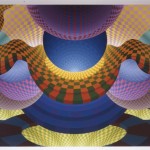
- Al Held, Eagle Rock II, Courtesy of the Al Held Foundation, Inc. and Cheim & Read, New York / Licensed by Artists Rights Society (ARS), New York
At the time of his death in 2005 at the age of 76, Al Held had achieved a startling degree of originality. A geometric painter, he was nothing like Mondrian—or the Minimalists, for that matter. Though he evolved from the New York School ferment of the early 1950s, Held never fully belonged to the splashy, swing-from-the-shoulder band of younger painters who gathered around Willem de Kooning. Though he dipped a toe—perhaps an entire foot—into the allover field opened up by Jackson Pollock, he didn’t plunge in. For he was never satisfied with texture, the gestural currents set in pictorial motion by followers of Pollock and de Kooning alike. Held wanted his paintings to have structure—a word that recurs with insistent frequency in his statements about his art. Working his way free of all the available exemplars he arrived, by the end of the 1970s, at a kind structure that is grand, complex, and yet bracingly clear. Shaped by no discernable genealogy, Held’s vast, intertwined geometries seem to have developed without the benefit of art-historical precedents, a possibility that gains plausibility from his early years.
Held grew up during the Depression, in a Brooklyn family with next to no interest in art. His mother once bought a set of Van Gogh reproductions on offer to subscribers of The New York Post, but they had no impact on her son. A chronic truant, he spent his days watching double features in the movie houses of Times Square. When he did attend school, he was so restless and unmanageable that he was invited, at the age of 16, to drop out for good. The following year, he joined the Navy. Discharged in 1947 at the end of a two-year stint, with little to do but collect unemployment insurance, Held fell in with a group of young people active in leftist politics.
All through his adolescence, his father had enrolled him in progressive organizations. Rather than participate, he would go to the movies or run with street gangs. Nonetheless, his sympathies were at least latently with the political left. When his new friends invited him to come along with them to Greenwich Village to work on a float for that year’s May Day parade, he decided that he would. And there, in the Village, he met Nicholas Krushenick—a happenstance that changed his life.
By the late 1950s, Krushenick had developed a style of painting that came to known as Abstract Pop. Hard-edged and hot-hued, with roots in comic books and the flashier extremes of graphic design, his imagery could be seen as a satire on commercial culture, but only if one overlooked its celebratory verve. In his Greenwich Village days, however, he was a social realist with dreams of making the sort of art that would save America from the depredations of capitalism and the always-lurking threat of fascism. He talked at length about his ambitions, and Held, now his friend, began to listen. Krushenick was planning to attend the Art Students League, on 57th Street in Manhattan. Held, who had been considering a career as a social worker, decided to take a single course at the League, as an experiment.
Soon he was studying with Kimon Nicolaides, author of The Natural Way to Draw, and a social realist named Harry Sternberg. After six months, Sternberg invited Held to his Union Square studio and told him in a kindly manner that he had no future as an artist. He should give it up. Deeply upset but not deterred, he made plans to travel to Mexico and work in the studio of the muralist David Alfaro Siqueiros, a high-profile member of the Communist Party. Then, upon learning that Siqueiros had been jailed on a weapons charge, he abruptly changed plans. With the help of the G.I. Bill, he would go to Paris. And, as it turned out, plunge into a maelstrom of innovation that utterly changed his idea of art—and of the sort of artist he might become.
In Paris he became part of an American colony that included George Sugarman, Friedl Dzubas, Ed Clark, Sam Francis, and Sal Romano. Later he got to know Earl Kerkam, the French-Canadian Jean-Paul Riopelle,and Joan Mitchell. In New York, Held had worked as a carpenter part-time and scrambled for any other jobs he could find. Receiving $75 a month in Paris, he enrolled, like so many other Americans before him, at the Académie de la Grand Chaumière. Attending only when he chose, he was free to paint full-time. There were frequent visits to and from the studios of his new friends and long evenings spent in cafés, drinking and arguing about art and its future, which these young artists felt was in their hands. Though Held still thought of himself as a social realist when he arrived in Paris, he was nagged by the Pollock paintings he had seen in New York. Dripped, spattered, and splashed, these canvases were unreservedly, unapologetically abstract and therefore exemplary—a spur to Held’s ambition, all the more so because, to his eye, they lacked something crucial.
In an attempt to make good this perceived lack, he tried to unite Pollock and Mondrian: subjective expression combined with objective structure. The result, he theorized, would encompass “the universal.” Though a small Parisian gallery showed these paintings, Held soon found them unconvincing and began to paint rocks and pebbles in heavy impasto. Here, he felt, was the real, not only in his tangible subject matter but in his equally tangible layers of pigment. Paris had made him uneasy about the real, in part his life there was so effortlessly enjoyable. As he said once in an interview, the G.I. Bill relieved him of the need to do anything “but eat and sleep and paint.” After two and a half years of it, he decided that ought to get back to “reality”—that is, New York.
Reality turned to be more challenging than Held had anticipated. Scrambling for work, never earning enough to feel secure, he nonetheless managed to find and to afford a loft on East Broadway. And he quickly became a member in good standing of the downtown art world—a habitué of the Cedar Tavern, a regular at the Friday night meetings of the Artists Club on West Eighth Street. He met the founding fathers of the New York School, and several of them—Franz Kline, Mark Rothko—invited him to their studios. In 1955 Held was included in a group show at the Tanager, a co-op gallery on East Tenth Street. Though the co-ops didn’t do much business, they had the crucial function of providing younger artists with places to show—and to find a serious audience. A year after showing at Tanager, Held’s work appeared in another group show on Tenth Street, at the Brata Gallery. In 1959 he had a solo show uptown, at the Poindexter Gallery.
During those years, Held made paintings by juxtaposing heavy slabs of pigment, each slab laid with just one or two swipes of a heavily-laden brush. The orientation of the slabs echoes the squared-away edges of the canvas, and thus a grid is implied. Yet these echoes are only approximate, so the stability of the pictorial structure is always undermined by a drift away from geometry toward the openness of the allover image. Held was replaying his early idea of combining Pollock and Mondrian, this time more successfully. Then, with the Taxicab paintings of 1959, the evolution of his imagery made its first grand leap.
The palette of the slab paintings ranges from black to various shades of brown and muddy ochre. Suddenly his colors were bright, even garish—not just taxicab yellow but also incandescent red and orange and neon blue. Crowding the surface of the canvas with hollow circles, squares, triangles, and other less easily named shapes, Held generated a feeling of speed and jostling energy. Next, he drastically reduced this population of shapes. A canvas would contain just one bold triangle or a triangle and a circle juxtaposed. Outlined in wide brushstrokes, these geometric forms feel heavy, even brawny. By the mid-1960s, the surfaces of Held’s paintings had become less agitated, his outlines more refined. The Big N, 1964, would count as a white monochrome painting if it were not for two triangular notches—one appearing along the upper edge of the canvas, the other along the lower edge. Cued by the title, we read this painting as a rendering of an “N” too large to be contained by the canvas where it appears. In Yellow, 1965, a notch near the midpoint of all four edges signals that we are looking at an equally uncontainable “X.”
The blunt clarity of these paintings originated in Held’s doubts about Abstract Expressionism. As he saw it, that sort of painting was too mistily subjective. Moreover, its practitioners tended to claim otherworldly significance for their incorrigibly elusive imagery. “No spiritual overlay,” became Held’s motto. Everything was to be on the surface and the surface was to be flat. But not flat according to Clement Greenberg’s prescription, which had its own ambiguities and covert spirituality. Nor did Held join with Donald Judd and the other Minimalists in their belief that a surface could be truly flat only if it had an industrial, untouched-by-human-hands impersonality. Held’s paintings from this period are intensely, self-evidently painted. In her essay for the catalogue of Held’s 1974 retrospective at the Whitney Museum of American Art, Marcia Tucker noted that some of his paintings from the mid-1960s bear up to 50 coats of pigment. Their smoothness is hand-made—and they are very flat.
In 1967 came another startling change. Drawing his geometric shapes in three dimensions, Held dispensed with flatness—or one could say that he drove it away with his thoroughgoing embrace of pictorial illusion. Squares became cubes, circles became cylinders, triangles became pyramids. Rendered in black outline on white fields, these forms are transparent. As their outlines became less brushy, their overlapping and interpenetration became more complex. And still more so as Held began to paint white outlines on black backgrounds.
With the introduction of color, in the late 1970s, an already intricate geometry became labyrinthine. Because the transparency of Held’s increasingly intricate forms allows vision to wander as it will, there is no proscribed path through any of these later paintings. Nor is there any settled agreement on their meaning. Some have seen in these works a dystopian fantasy, a vision of our bureaucratized, computerized world made all the bleaker by Held’s relentlessly vivid palette. More often, however, commentators have celebrated the sheer vitality of the late paintings and acknowledged the artist’s virtuosic mastery of structure—the element of pictorial art that, for him, was more than indispensable. It was the source of his first intuitions about painting and the end toward which he always worked.
Held’s last solo exhibition in his lifetime was at the Robert Miller Gallery, in New York, where he had shown his work since 1980. A year after joining Miller, he began to spend much of the year at his villa near the Umbrian town of Camerata. He had retired, not from painting, which continued to the very end of his life, but from 20 years of teaching in the art department of Yale University. Several generations of students remember him as a challenging teacher with a pugilistic style. The sculptor Judy Pfaff, who graduated from Yale in 1973, once recalled that she and Held often argued about the merits of Roman and Japanese architecture. “He would say that Rome was his city—the architects used real materials.” Japanese materials were too fragile, he believed, and employed by sensibilities far too oblique and evanescent for his taste. Held preferred the solid, the tangible, and—to recall one of his favorite words—the real. Products of the imagination, his late paintings show two of imagination’s powers, to invent and to impose order, brought into an astonishingly productive balance. In that balance, perhaps, he found a reality more convincing, even, than Rome’s sturdiest monuments.
By Carter Ratcliff
Editor’s Note: All Images Courtesy of the Al Held Foundation, Inc. and Cheim & Read, New York / Licensed by Artists Rights Society (ARS), New York

Subscribe to Art & Antiques for your Digital or Print copy