Subscribe to Our Newsletter
Enrico Donati: The Magician
Enrico Donati, acclaimed as “The Last Surrealist,” kept the impulse of Surrealism flowing through eight decades of work in a plethora of styles.
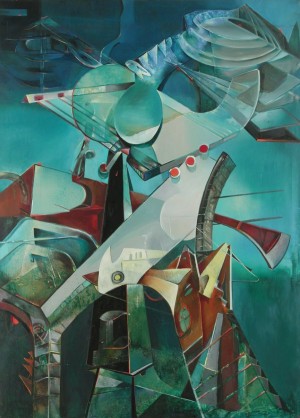
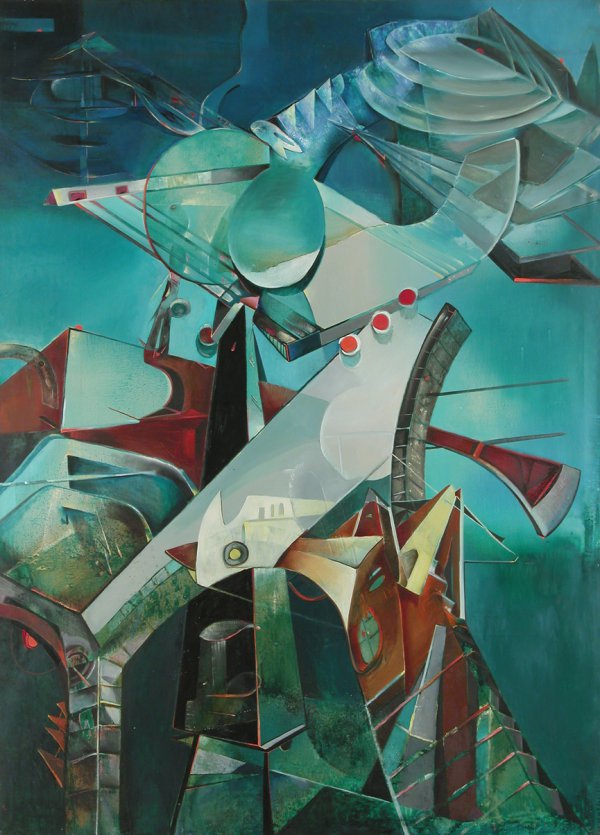
Enrico Donati, Tower of the Alchemist: Partie de l’ultrason, 1947;
Featured Images: (Click to Enlarge)
-
- Enrico Donati
-
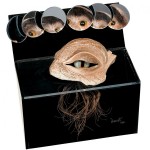
- Enrico Donati, Evil Eye, 1946, mixed media, 9 1⁄4 x 10 5/8 x 7 1⁄2 inches.
-
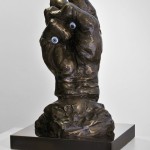
- Enrico Donati, Fist, 1946, bronze and glass eyeballs, 16 x 9 1⁄2 x 11 1⁄4 inches;
-
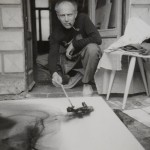
- Enrico Donati, circa 1950s.
-

- Enrico Donati, Tower of the Alchemist: Partie de l’ultrason, 1947;
Enrico Donati grew up in Milan and became a painter in Paris, but he had to go to New York to become a charter member of the European avant-garde. In late 1939, when he arrived, Marcel Duchamp, Max Ernst, Fernand Léger, Yves Tanguy, and Piet Mondrian—to name just a few—were already there, having fled fascism on the eve of war. With the phenomenal good luck that marked his entire career, before long Donati was introduced to none other than André Breton, who immediately took a shine to the 30-year-old artist. Donati had only taken up painting a few years before and had just one show under his belt, but Breton was excited by what he saw and exclaimed, “I love the paintings of Enrico Donati as I love a night in May!” High praise from the high priest of Surrealism, and with that, Donati was accepted into the magic circle.
During the early 1940s, Donati made Surrealist paintings in an abstract biomorphic style that astonish the eye and boggle the mind. Trouble-fête (Killjoy), from 1944, is typical of his work in this early period. In this strange and intricate composition, weird protoplasmic entities loom up out of the darkness, some of the them glowing with bioluminescence like deep-sea creatures, others bathed in rainbow hues. The picture space is complex, seemingly three-layered: At the bottom of the canvas is the ocean floor, above it is a landscape receding into the distance, and above that is a black sky. It could be night on earth, or it could be the perpetual blackness of the interstellar void, but really it is inner space. As a glimpse into the unconscious, Trouble-fête is particularly persuasive because instead of stocking its mindscape with conventional pop-Freudian symbols, it confronts us with figures that are individual, idiosyncratic, and baffling.
While the painting could be called figurative, Donati is using illusionistic space and carefully rendered surface detail in an essentially abstract way. His figures—more like the distended bladders of Bosch’s hell than anything that might show up to pose in a painter’s studio—at first sight may seem to resemble animals, plants, or people, but upon closer inspection the resemblance melts away. What Donati has given us is the experience of a dream, delivered with the classic Surrealist one-two punch of control and lack of control—polish carefully applied to the wild products of automatism.
In 1947, Donati helped his friend Duchamp organize an event called the International Surrealist Exposition, at Galerie Maeght in Paris. Donati contributed not only paintings but also several mixed-media sculptures, including Fist (1946), a literal representation in bronze of a clenched fist with two bloodshot glass eyes staring out from between the fingers, and Evil Eye (1947), a gruesome orb embedded in flesh, mounted on a glossy black box with circular mirrors and trailing a tuft of electrical wires. With these objects, which could be props in a horror movie, Donati strayed, rather effectively, into more conventionally Surrealist territory—ironically at the very moment when Surrealism was on the verge of coming to an end as an organized movement.
Surrealism’s demise was due to a changed political climate in which its revolutionary leftism suddenly seemed less relevant, as well as to creative fatigue and lack of solidarity among its members. However, the Surrealist impulse—to disturb both visually and socially, to mine the unconscious, to attain freedom—lived on in subtler guises. It continued to inform the work of many artists both from inside and outside the movement, including Donati. In 1947 he still had six decades of painting ahead of him (he died at 99 in 2008), during which he would explore many styles and techniques but always remain true to his original inspiration. At heart Donati was always a Surrealist.
His route to art was a somewhat circuitous one, and he actually became an art collector before he became an artist. Raised in comfortable circumstances in Milan, Donati originally wanted to be a composer but got a degree in sociology to satisfy his family, who respected academia and felt that a university career provided stability and financial security. But after graduating, he took music courses and then decamped for Paris, the world center for avant-garde “serious” music. He failed to impress anyone with his compositions, but he did make a discovery that would change his whole outlook. One day he wandered into the Trocadéro, Paris’ famous museum of tribal and ethnographic art and was captivated by the newness, energy, and graphic boldness of the works on view—in particular the American Indian artifacts. He decided to go to the United States and personally experience the cultures that made these things, and start collecting them himself.
So in 1934, Donati visited New Mexico and Arizona, where he spent three months living among the Apache, Zuni, and Hopi peoples. He quickly made friends with the Indians and managed to acquire a trove of artworks from them without spending any money, simply by bartering inexpensive European objets d’art and curiosities like Venetian glass beads, bird feathers, and Swiss army knives for kachinas, baskets, and masks. The fact that this naïve plan actually worked is absolutely typical of the artist’s charmed life. After his Southwestern sojourn, Donati went to Canada, where he repeated this modus operandi, and then to New York, where he and his wife stayed for the better part of two years. While there, he decisively gave up music and started to seriously study drawing and painting. In 1936, he returned to Paris, where he continued his artistic training and began developing his distinctive style.
Donati’s relationship to tribal art is an interesting one. Earlier modernists had also been inspired by so-called “primitive” art, but its influence on them had more to do with form than it did for Donati. Unlike, say, Picasso or Marsden Hartley, he inserted no explicit references to African masks or Native American sand paintings into his compositions. Instead, it was something of the function and intent of tribal art that he tried to emulate. Donati saw American Indian, Oceanic, and African artworks as magical objects, devices for channeling forces from outside our daily experience. Eventually, he would come to see his own works as similarly thaumaturgic. In the meantime, he lined his studio with the artworks and artifacts he had brought back from the U.S. and Canada, turning it into a sort of Wunderkammer, or cabinet of wonders. The studio functioned as an outward model of the inside of the artist’s head, in an especially vivid instance of the “artist as collector.” A 2007 exhibition at the de Young Museum in San Francisco in association with the Weinstein Gallery revealingly showed Donati’s artworks, including the sculptures, alongside ethnographic objects from his collection.
Influence from European occult traditions also fed into Donati’s growing sense of purpose. Throughout his career, he sought out what he called “talismans,” symbolic objects that crystallized the creative direction he was going in at any given time. His first talisman was the mandrake, a root that grotesquely resembles a human body and that was frequently used in folk-magic rituals and medicines. According to legend, the mandrake grows beneath a gallows, fertilized by the sperm of a dying convict, and shrieks when pulled from the ground. Undoubtedly it has all the ingredients bound to appeal to a Surrealist sensibility—the primitive, the uncanny, the creation of life out of death, the melding of the human with the non-human. The biomorphic elements in Donati’s 1940s paintings are clearly mandrake-derived, and he even created several paintings whose titles explicitly refer to it. Mandragore Split Twins (1946) depicts a stylized mandrake that manages to also evoke a nuclear mushroom cloud (this is less than a year after Hiroshima and Nagasaki) and the process of cell replications by mitosis. With this picture, Donati seems to be conjuring a hopeful regeneration of life after cataclysmic death, but the weird colors and forms raise the question of whether the new life form will be mutated or not.
As the ’40s drew to a close, Donati radically changed his style. Seeking a new direction and a more controlled, less “automatic” approach, he started painting hard-edged geometric abstractions. Works such as Decompression Chamber (1948) and Tower of the Alchemist: Partie de l’ultrason (1947) deal entirely in sharply incised lines, bright and even fields of color, and unidentified objects, flying and otherwise. As in his earlier work, there is illusionistic space to contain these objects, but otherwise the painter has left the world of living beings behind. We seem to be in the presence of mechanical gadgets set in motion for some unknown purpose. The Surrealist game of being enigmatic for enigma’s sake is still afoot. Donati actually held these works back in his studio, showing them only to close friends. They were not exhibited publicly until 1987, at the Zabriskie Gallery in New York.
When Donati was ready to show his work again after this period of experimentation, his style had shifted once more. Now he was working in a more abstract way, obliterating the three-dimensional space and covering the canvas with broad swaths of blacks, browns, and grays. He was also adding sand and ground-up plant matter to the paint, to create a gritty texture. These decidedly earthy (or perhaps lunar—several are titled Moonscape) compositions found favor with the Abstract Expressionist-dominated New York art world, even though they were not, strictly speaking, Abex paintings, and soon Donati was showing at the prestigious Betty Parsons Gallery. Once again, his charm was working.
This phase of Donati’s work was transitional, and he soon evolved another style that more clearly expressed his ongoing Surrealist concerns without returning to the overtly Surrealist style of his first major paintings. For this new phase, the talisman was the fossil. In 1949, walking along a beach, he picked up a smooth stone that gave him “an odd vibration” when he touched it. Yves Tanguy told him that a fossil was hidden inside and showed him how to split the stone in half without damaging its contents. For 11 years Donati resisted doing so, but when he finally cracked it open in 1960 to reveal the trilobite inside, he was transfixed. “Once again,” he recollected, “I was in touch with the cycle of creation, destruction, and rebirth.” This epiphany had been waiting to happen; Donati’s connection to the fossil image actually predated his beachcombing find by at least a year. In 1948 he painted Time Exposure, which looks like a fish illuminated by cosmic rays that reveal the skeletal structure within. Now, Donati saw that the fossil “had always been my true myth and metaphor, my guide from the very beginning of my career.”
Stones that hide secrets can be found in most of the artist’s work from after this point. A classic and very explicit example is The Great Stone (1965), in which the green shape superimposed on fields of black and white bifurcated by a red strip closely resembles the Rosetta Stone and is likewise inscribed with cryptic characters. Forms concealing other forms recur again and again, as do surfaces that look like rock or earth and seem to have faint traces on them, if not of human writing then of Nature’s own script. Donati’s more or less colorful abstractions of the 1960s through 2000s stay true to the Surrealist method if not to the overt appearances of Surrealism, by juxtaposing “objects” in collage-like fashion on a field where the imagination can freely associate them with each other in ways that, ideally create a magical state of consciousness.
Donati’s concern with nature, birth, growth, and transformation found expression not only in magic but also in another of the Western world’s forgotten and despised practices—alchemy. A show at the Weinstein Gallery, mainly of 1950s and ’60s Moonscapes and early stone paintings was titled “The Philosopher’s Stone,” and Donati more than once explicitly commented on the influence of alchemy on his work. He was not the only Surrealist to explore the Hermetic Art; Max Ernst filled his collages and paintings with images mined from medieval and baroque-era alchemical texts.
But Donati’s approach was less direct; his alchemy was a subtle process of transformation of elements, and he found as much inspiration in the alchemists’ self-described work processes as he did in the specifics of their imagery. Referring to the 17th-century German alchemist Heinrich Khunrath, he said, “Khunrath could not be bored. On the door to his entrance was written, Be vigilant, even when you sleep.” In one of the elaborate engravings in Khunrath’s huge work Theatrum Sapientiae Aeternae (1609), the alchemist is exhorted to pray (orare) as he works (laborare). “What interests me,” said Donati, “is the fight in which alchemists have sought the fusion of the spirit, the brain, and the divine. The alchemic vision of the world, for me, is not the creation of gold but something else, infinitely superior to mere craft or science because transformation cannot be reproduced solely by ability. Moral virtues are necessary.”

Subscribe to Art & Antiques for your Digital or Print copy