Subscribe to Our Newsletter
Diego Rivera and Frida Kahlo: Murals for Motor City

An exhibition of Diego Rivera and Frida Kahlo’s work at the Detroit Institute of Arts tells stories of painting, politics, and personal exploration.
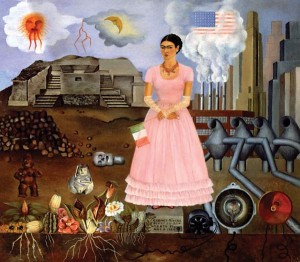
Frida Kahlo, Self-Portrait on the Borderline between Mexico and the United States, 1932, oil on metal.
Featured Images: (Click to Enlarge)
-
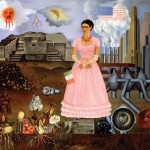
- Frida Kahlo, Self-Portrait on the Borderline between Mexico and the United States, 1932, oil on metal.
-
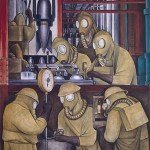
- Diego Rivera, Detroit Industry, north wall (detail), 1932-33, fresco (poison gas bombs manufacture);
-
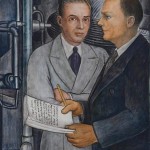
- Diego Rivera, Detroit Industry south wall [detail] (1932-33)
-
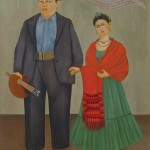
- Frida Kahlo, Frieda and Diego Rivera, 1931, oil on canvas;
-
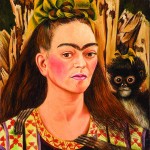
- Frida Kahlo, Self Portrait with Monkey, 1945, oil on Masonite.
-
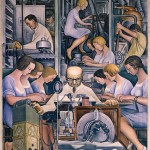
- Diego Rivera, Detroit Industry, south wall (detail), 1932, fresco;
At the heart of the exhibition “Diego Rivera and Frida Kahlo in Detroit,” which is on view at the Detroit Institute of Arts through July 12, is the period of time between April 1932 and March 1933. This is the year in which the couple stayed in Motor City and Rivera painted Detroit Industry, a series of frescoes for the DIA. It’s also the year that Kahlo suffered a miscarriage and painted Henry Ford Hospital shortly after her recovery in that hospital (the industrial landscape of Detroit can be seen looming in the background of the composition). However, the show also examines work by both artists, made before, during, and after their Michigan sojourn. In total, some 70 works will be on view—including eight of Rivera’s preparatory sketches for Detroit Industry and 23 pieces by Kahlo, seven of which were made during her year in Detroit (throughout this period she created 11 works all together).
“I came up with the idea for the show about 10 years ago,” says Graham W. J. Beal, the director of the DIA, “but as I learned about Rivera coming to Detroit, I also began to learn how significant he was overall in the United States. The show then took shape as ‘Rivera’s Universe in the U.S.’ and turned into an art-historical exhibition.” However it was only after the financial crisis, when the museum “knew it was going to be around,” that the show could be fully realized. “We went back to the human interest story,” says Beal, and the couple’s time in Detroit—a period that has seldom been explored compared to other phases of their lives—became the show’s central thesis again.
The arrival of the couple—or more specifically, Rivera, as Kahlo was virtually unknown at the time—on April 21, 1932, made page-three news in the Detroit Free Press and included photographs taken at the train station. Rivera had been given the commission to paint a series of frescos in the Garden Court of the recently built DIA by the museum’s intrepid director, William R. Valentiner. It was Valentiner who envisioned modern art on the walls of the museum—which had previously been devoted to the Old Masters—and had hand-selected Rivera. The artist was in high demand within the United States at the time. In 1931, the Museum of Modern Art in New York hosted a solo survey of Rivera’s work (Alfred H. Barr, Jr., the founding director of MoMA, was a friend and patron of Rivera’s, the two having met in Moscow in 1927 when Rivera was slated to paint a mural for the Red Army Club.) The year before, architect Timothy L. Pflueger invited Rivera to San Francisco, where he painted a mural for the City Club of the San Francisco Stock Exchange and a fresco for the California School of Fine Art (it has since been relocated to the “Diego Rivera Gallery” at the San Francisco Art Institute). While in San Francisco, Rivera met tennis player Helen Wills Moody, who modeled for the City Club mural and is said to have become his lover. Valentiner, who was eager to make the acquaintance of the artist before he become too highly in demand and out of reach for the DIA, went to San Francisco to secure an introduction through Moody. In turn, Valentiner invited Rivera to “come here to help us beautify the Museum and give fame to its hall through your great work.”
Arrangements were made for the artist and his wife to come to the museum in the beginning of 1932. However the plans met with scheduling difficulties on Rivera’s part—he was committed to work on the ballet H.P., which was opening in Philadelphia in March—and political and monetary difficulties on the DIA’s part. When Valentiner and his assistant director, E.P. Richardson, set about securing Rivera’s commission, they were met with opposition. The museum’s architect was not in favor of the idea, and Albert Kahn, an architect and major player on the Detroit Art Commission, didn’t seem swayed one way or the other. However, Edsel Ford, Henry Ford’s son and the president of the Ford Motor Company, was a patron of the DIA and proved supportive of the idea. Ford funded the project without—it is conjectured—ever having seen Rivera’s work.
It has been suggested that Ford saw his patronage of the murals as an opportunity to extend good will towards the Ford Motor Company’s local workers and those employed at the company’s Mexican subsidiary. The timing was certainly fortuitous, considering that the Ford Hunger March—a protest against wage cuts and layoffs organized by Ford workers and the Communist Party USA that became known as the Ford Massacre after the Dearborn, Mich., police and Ford security forces killed four people and injured 20—had only recently occurred, on March 7, 1932. The Ford Motor Company could have used some good p.r. If it was a political play by Ford, Rivera, a known Communist (though he was tossed out of the Mexican Communist Party in 1929) who wished to infiltrate capitalist institutions with his art, was not aware of it.
Nevertheless, Ford’s commission of $10,000 for two Rivera murals was not only necessary for the project’s sake but arguably also for the museum’s. By 1932, Detroit was crippled by the Depression and facing bankruptcy. Four years earlier, the museum’s art-buying budget was over $400,000, with $170,000 coming from the city, but by 1932 it had dwindled to $40,000 with another cut on the way. In fact, it was nationally publicized that the city might shutter the museum and sell the collection—a fate that was narrowly avoided with the help of the city’s elite. The DIA’s 1932 predicament echoes the museum’s recent past: “Diego Rivera and Frida Kahlo in Detroit” is the DIA’s first major exhibition since the city of Detroit settled its bankruptcy in November 2014 (not without help from the museum). Though the timing is largely coincidental, it is still poignant.
Rivera’s commission for two panels at the north and south of the Garden Court eventually increased to the 27 that now occupy the area. Though the cause for this favorable augmentation is not known for certain, Beal cites dinner. “Rivera presented Edsel Ford with drawings at dinner one night,” says Beal, “and then Ford was so excited he had Rivera paint all the panels.” Perhaps it was Rivera’s fascination with the River Rouge automobile factory that persuaded Ford. Rivera spent months sketching the factory, which was the largest factory complex in the world. The artist, who had a fantasy of a utopian future built by machines, felt a dream had come to life. Kahlo described Rivera’s giddiness for the machinery as “like a child with a new toy.” The massive drawings Rivera created for the DIA’s walls depict machines as the necessary inner workings of American society, as essential, and nearly as natural, as bodily organs. The cartoons, of which there are 13, were given as a gift to the museum by Rivera and are now on view for only the second time (the first was in 1986 for the DIA’s “Diego Rivera: A Retrospective”). Several are in a range of colors, while others are simply outlines with color notes. The main panels depict automobile manufacturing, but the others also incorporate depictions of medicine, laboratory processes and various scientific fields, workers, ancient Mexican myth, and organic materials—themes Rivera had employed for his murals in Mexico and California.
When the murals were completed they garnered mixed opinions. “It was highly controversial,” says Beal. “He was a communist and a foreigner. It wasn’t a beautiful landscape in a garden court, it was industrial imagery with workers being glamorized. To some people it was blasphemy.” However, the DIA stood by the murals (though during the McCarthy period the museum did put up a sign that said it stood by the mural artistically, not politically). Today, Detroit Industry is considered one of the finest representations of technology in 20th century art, as well as Rivera’s last great work in America, if not in his career. His next project, a commission by the Rockefellers for Rockefeller Center that began in 1933, proved to be a major turning point in his career. The artist strayed from the approved sketches and painted a portrait of Communist Russian revolutionary leader Vladimir Lenin. His refusal to change the face of the portrait, as well as a depiction of one of the Rockefellers drinking alcohol, lead to the deliberate and complete destruction of the mural, Man at the Crossroads, in February 1934. Rivera recreated the mural in Mexico, after which he only returned to the United States once more, to paint a 10-panel mural in San Francisco.
Kahlo, who is much more famous in American culture than her husband, didn’t arrive in Detroit as a well-known artist. At the train station, when the couple arrived, Kahlo, who was two months pregnant at the time, was asked by the reporters from the Detroit Free Press if she was a painter. Kahlo replied in jest, “Yes, the greatest in the world.” In truth, Kahlo had painted rather sober portraits of family members back in Mexico and made a few sets of Surrealism-inspired drawings while in New York for Rivera’s MoMA exhibition but didn’t have a true breakthrough as a artist until she came to Detroit. Kahlo hated America and had a particularly tough time in Detroit. She said of the city, “[it] gives the impression of an ancient and impoverished hamlet…I don’t like it at all.” Detroit’s industrial sector was also detestable to Kahlo. “[It] interests me a lot, I find it completely lacking in sensibility and good taste,” she said. “She was implacable in her dislike for America,” says Beal, “and to her, in Detroit, with her unbelievably wealthy people and all of her unemployed people, Kahlo saw everything that she thought was wrong with the world.” At dinners with Detroit’s elite, Kahlo would talk enthusiastically about Communism and pejoratively about the Catholic Church, or simply pretend to have poor English. The latter trick would often result in Kahlo exclaiming “shit on you” to dinner companions, feigning ignorance of its meaning.
When Kahlo was 18 she was in a bus accident that left her with serious injuries—eventually leading to 35 surgeries throughout her lifetime. During the accident an iron handrail pierced her abdomen and uterus, compromising her ability to reproduce. While in Detroit, Kahlo began having difficulties with her pregnancy. For years it was thought that Kahlo suffered a miscarriage but in fact, she drank quinine, inducing the loss of the child. The artist stayed in Henry Ford Hospital from July 4–17. Her mental state at the time was not favorable. However, after the abortion, with Rivera’s encouragement, Kahlo began to focus as never before on her art. About this period, Mark Rosenthal, the curator of the exhibition, writes in his catalogue essay, “Her newly found devotion to art represented a rebirth—a third intensely experienced component of the Kahlo who emerged in Detroit, along with procreation and death, the two other components of a life cycle, all of which made immediate and powerful appearances in her work.”
Rivera told Kahlo to “paint her life,” a charge which Kahlo seemed to have began immediately. In the hospital, she draws Self-Portrait, 9 July 1932. She wears a hairnet and appears to be grieving. Still, the Surrealist components Kahlo began to employ in her drawings in New York are present, as an oversized eye, reminiscent of Magritte, looks out from her shoulder. In the lithograph Frida and the Abortion, on which Kahlo began working on July 24, the artist still wears her hospital hairnet and her grieving expression but has sprouted a third arm that holds a palette. There is a fetus in her stomach connected by an umbilical cord to a baby floating outside of her body. Around her plants take root and the moon cries. In the 1932 painting Henry Ford Hospital, Kahlo agonizes in a pool of blood in a stark hospital. She is isolated in an unfamiliar, yet surreal setting of dirt and sky, totally alone save for Detroit’s industrial landscape, which rises in the background. Connected to her midsection by red threads are anatomical models, a snail, a fetus, and a flower. “Henry Ford Hospital” is written in clear lettering around the cold frame of the bed.
In Self Portrait at the Borderline between Mexico and the United States, another painting from 1932, Kahlo strands between the mythological symbols and ruins of Mexico and the skyscrapers and smoke stacks of America. In the dirt below her feet, flowers grow on the Mexican side, while machines root into the American soil. Just as her husband attempted to synthesize the mechanical developments of America and the powerful mythos of Mexico, Kahlo chose to keep the two worlds divided.

Subscribe to Art & Antiques for your Digital or Print copy