Subscribe to Our Newsletter
Elmer Bischoff: The Art of Friendship
From Abstract Expressionism to figuration and back again to abstraction, Elmer Bischoff’s work was a search for unity not only aesthetic but social.
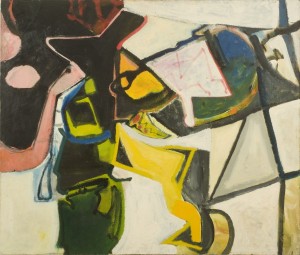
Elmer Bischoff, Untitled, 1952, oil on canvas, 58 x 68 inches
Featured Images: (Click to Enlarge)
-
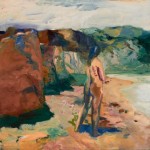
- Elmer Bischoff, Figure with White Lake, 1964, oil on canvas over Lexan panel, 79 1/2 x 79 1/4 inches
-
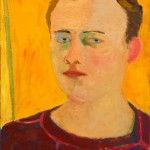
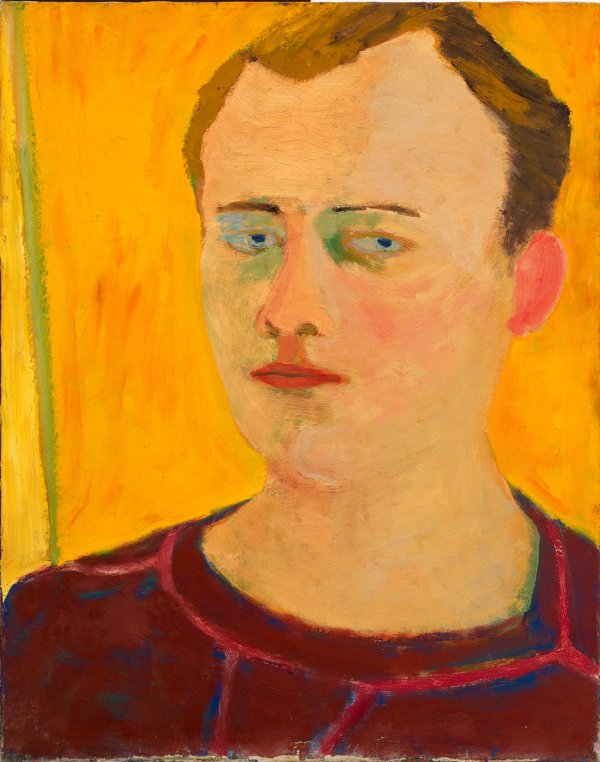
- Elmer Bischoff, Self-Portrait, 1955, oil on canvas, 28 x 22 inches
-
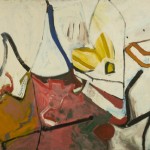
- Elmer Bischoff, Untitled, 1952, oil on canvas, 56 x 67 7/8 inches
-
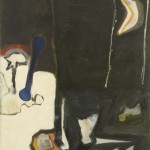
- Elmer Bischoff, Untitled, 1950, oil on canvas, 66×56 inches
-
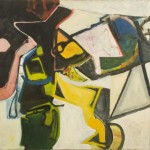
- Elmer Bischoff, Untitled, 1952, oil on canvas, 58 x 68 inches
“Abstract Expressionism” may be the most misleading bit of art jargon to have appeared in the past century or so. It sounds like the name of a shared style, and yet we use it to designate a group of painters whose work ranged from Willem de Kooning’s painterly bravura at one extreme to Barnett Newman’s imposing geometries at the other. Abstract Expressionism was not so much a style as a declaration of independence from European precedent. Emerging in New York in the late 1940s, its liberating message spread with startling rapidity to advanced art circles throughout the United States. In the process, a degree of lexicographical clarity developed. So, for example, when Abstract Expressionism arrived in the San Francisco Bay area, it was understood almost exclusively as a style of painterly painting—and welcomed for the permissions it granted. Among the first to embrace this new development was Elmer Bischoff.
Born in Berkeley, Calif., in 1916, Bischoff studied painting at the Berkeley campus of the University of California, receiving his Master of Arts in 1939. Decades later, he recalled the rigorous formal training he had undergone in an art department shaped by the legacy of Hans Hofmann, who taught at Berkeley in the early 1930s. Drawing on precedents set by Paul Cézanne and early Cubism, Hofmann stressed modernism’s capacity to refine and elaborate the formal bases of Western painting: line, color, effects of light and space. All were to contribute to a harmonious and unified composition. Hofmann did not see himself as a radical. For him, progress required not a rejection of the past but its fully theorized clarification. As a result of his influence, the curriculum at Berkeley bordered on academicism during the 1930s—or so Bischoff felt, and when Abstract Expressionism arrived on the West Coast, he responded immediately.
One of the major Abstract Expressionists, Clyfford Still, taught at the California School of Fine Arts (now the San Francisco Art Institute), from 1946 to 1950. In 1943, he had been given his first solo show at the San Francisco Museum of Art. Four years later, his second took place at the California Palace of the Legion of Honor, also in San Francisco. Though Still’s heavily-troweled version of painterly painting had a powerful influence on several of Bischoff’s friends—Hassel Smith, in particular—Bischoff was more deeply affected by the work of Mark Rothko, which was exhibited at the San Francisco Museum of Art in 1946. On the verge of the “multiform” paintings that would lead to the luminous color expanses of his mature style, Rothko was still employing his version of Surrealist automatism to produce delicately linear images of imaginary creatures in an environment at once airy and liquid. Bischoff painted variations on these works for a season and then plunged into a vigorously gestural version of Abstract Expressionism.
The Second World War had recently ended with the victory of the Allies. The United Nations was newly formed. The state of Israel had just been founded. Buoyed up by the optimism of the times, Bischoff conceived of the style he had just embraced as the medium of “a timeless, universal feeling.” Abstract Expressionist gestures, he said, comprised “a sign language, potentially readable by everybody … a sort of visual Esperanto, liberating to all who had eyes.” By then, Bischoff was teaching at the California School of Fine Arts, a congenial place where, in his words, there were few “who did not feel that their work might play a part in forming a better world—that it might assist toward a deeper understanding between people, even peoples.” Bischoff’s friend David Park, also a member of the faculty at the School of Fine Arts, had turned from his early, Picassoid work to Abstract Expressionism, as had many others on the Bay Area scene. Then, in 1951, Park suddenly started painting figuratively. Bischoff was shocked, as was everyone else in Park’s milieu.
In 1950s Willem de Kooning had launched a painting that, after two years, became Woman I. This was, strictly speaking, a figurative painting, yet de Kooning built his images from brushwork easily read as abstract. There is a similarly hybrid, abstract-figurative quality to the figures that emerged in Jackson Pollock’s black-on-white paintings of the early ’50s. However, Park’s paintings of nudes and dancers and musicians are too obviously the product of direct observation to count as abstractions, despite their vigorous brushwork. He and his friends had understood Abstract Expressionism not just as a pictorial option but as a force for cultural progress. Why this backward step? Park, of course, did not feel that his new work was regressive, nor did Bischoff when he turned to the figure in 1953.
Giving up Abstract Expressionism was, Bischoff later said, like “the end of a love affair.” As the passion went out of the painterly gesture, it began to feel “inauthentic … cooked-up.” Passion returned to his art when he turned to the external world and its inhabitants. Each of his subjects, he said, is something “that I have a certain response to, that I have a certain love for, possibly, and I want to show that in a canvas.” Bischoff’s subjects are recognizable, and yet his figurative paintings are not precise records of appearances. Driven to spontaneity by vivid intuitions, he rendered other people, their postures and their settings, as a kind of testimony to his feelings about them. No longer an abstractionist, he was still an Expressionist. And a veteran of the studio program at Berkeley. Never forgetting early lessons, he was guided by pictorial “ideas about space and about light and movement, about the proportions of things.” Above all, he strove to give a picture the traditional virtue of “unity,” which, he said, “I hold sacred.”
By 1956, Richard Diebenkorn, one of the most promising graduate students at the California School of Fine Arts, had followed Park and Bischoff’s path from abstraction to figuration. And the three of them became close friends. They visited one another’s studios often and during the mid-1950s met in the life-drawing classes they organized. The sense of community was strong and extended to colleagues who had not converted to figuration—among them Hassel Smith, who had developed distinctive variations on Still’s slabs of color. In 1952, when the administration of the School of Fine Arts announced plans to fire Smith, Bischoff and Park threatened to resign in protest. Smith was fired and they made good on their threat, which left Bischoff unemployed. Scrambling to make a living, he found work as a delivery truck driver. In his spare time he sketched and searched for a new teaching position. After a year and a half, he was made the head of the art department at Yuba College, in Marysville, a town northeast of San Francisco.
In 1955, Bischoff won first prize at the annual exhibition of Richmond Art Center Annual, just north of Berkeley. This distinction led to a solo show at the Paul Kantor Gallery in Los Angeles. The following year, he was rehired by the California School of Fine Arts, as the head of the graduate department. The movement that Bischoff had such a powerful hand in defining was by now known as “Bay Area Figurative Painting.” An exhibition by that name was organized by the Oakland Museum in 1957 to celebrate what had come to be recognized as one of the most significant developments in postwar American art. Park continued to paint figuratively until his death in 1960. Diebenkorn returned to abstraction in 1966, as Bischoff had done the previous year.
While he was still making pictures of recognizable things, Bischoff had said, “Ideally, one would wish to do away with the tangible facts of the thing seen.” For that would allow the painter to “deal directly with the matter of feeling.” After more than a decade of responding to “tangible facts,” Bischoff found in abstraction a more directly expressive path. Moreover, non-figurative painting may have still held for him the promise of universality he once found in Abstract Expressionism. In the abstract canvases he made from 1965 until his death in 1991 streaks and zigzags, swirls and blocks of color fill the surface, each incident a response to the pictorial activity in its vicinity. It’s as though these forms were having a conversation, lively and unscripted. Yet the overall effect is of calm and balance. Bischoff nearly always achieves the “unity” that early on became his ideal—along with a luminous “thereness,” an elusive quality he saw in the Impressionist paintings he admired at every stage of his career.
From 1965 until his retirement in 1985, Bischoff taught at the University of California, Berkeley. A student named Ellen Singer recalled him as a “paternal” presence. “There was a stillness about him,” she said. “He would come around and quietly look at our work. There wasn’t a lot of direct instruction, and his teaching was more about asking questions. He didn’t talk to us about technique. He asked us ‘why’ questions including why we wanted to portray something.” Behind those questions was a larger one: why be a painter? Bischoff never answered that question directly, yet his early belief that painting could bring people together seems never to have left him. To make art was not, for him, a narrowly aesthetic endeavor. His sense of the aesthetic encompassed social ideals and the best hopes for our culture. And the values he cultivated in art were indistinguishable, ultimately, from those of the personal character that endeared him to his students and made him such a good friend to the artists in his circle.
David Park’s daughter Helen Park Bigelow once asked him, “If you were an art critic, evaluating the work of Park, Diebenkorn, and Bischoff, and if you were obliged to make a … negative comment about each painter’s work, what would you say?” Park said that perhaps Diebenkorn’s paintings were “a bit too intellectual.” As for himself, “I guess I’d have to say that sometimes I’m a little bit lugubrious.” And Bischoff? A touch “sentimental,” as Park saw him. These judgments originated in deep respect, for himself and his two closest colleagues. And of course they are open to question. Perhaps Park at his darkest is not so much lugubrious as saturnine, a painter alert to all that is troubling—and troubled—in human beings. Bischoff, by contrast, is not sentimental but sanguine, an artist sustained by a faith that his art is not merely an occasion for pleasant experiences. Viewed with the openness he brought to the work of others, whether colleagues or students or members of the modernist canon, Bischoff’s paintings, whether abstract or figurative, are alive with quietly magisterial joy.
By Carter Ratcliff

Subscribe to Art & Antiques for your Digital or Print copy