Subscribe to Our Newsletter
Moon Struck
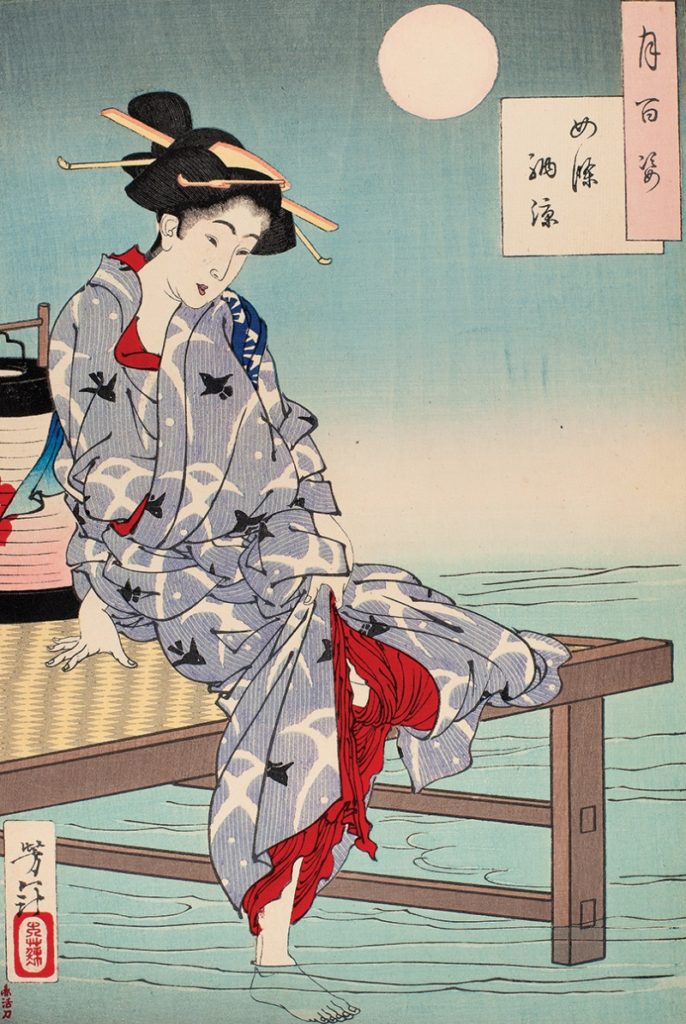
Yoshitoshi’s “100 Aspects of the Moon” are revealed in full at the Dayton Art Institute.

Tsukioka Yoshitoshi , Cooling off at Shijo, 1885, woodblock print, ink and color on paper;
-
- Tsukioka Yoshitoshi, Jade Rabbit – Sun Wukong, 1889, woodblock print, ink and color on paper.
-
- Tsukioka Yoshitoshi, How hopeless it is, it would be better for me to sink beneath the waves; perhaps then I could see my man from the Moon Capital – Ariko, 1886, woodblock print, ink and color on paper.
-
- Tsukioka Yoshitoshi , Cooling off at Shijo, 1885, woodblock print, ink and color on paper;
One of the greatest masters of the classic Japanese woodblock print was also the last. Tsukioka Yoshitoshi (1839–92) created his virtuosic, wildly imaginative works during the twilight of the ukiyo-e tradition, when the rapid Westernization threatened established art forms and transformed the Japanese art market. Photography and mechanical printing techniques imported from Europe made the time-consuming woodblock printmaking process uneconomical, while the Japanese public’s craving for Occidental imagery made many turn away from the old styles and subjects. Yoshitoshi, a stubborn and perfectionistic man, persevered and right up until his death turned out print series after print series that seemed to encapsulate the whole range of classic Japanese myth, legend, history, and symbolism. This last flowering of ukiyo-e was lush and heavily scented indeed.
Ukiyo-e originated in the 17th century, in Edo, the capital of the Tokugawa Shogunate (and predecessor of modern Tokyo). The term doesn’t actually mean woodblock printmaking (the medium itself is called nishiki-e); it means “pictures of the floating world.” The floating world, in Edo-period Japanese literature, was the realm of courtesans, actors, and other denizens of the urban night, and therefore ukiyo-e originally meant pictures of any kind, whether printed or painted, that depicted such characters and scenes

Subscribe to Art & Antiques for your Digital or Print copy