Subscribe to Our Newsletter
Fighting On

Jacob Lawrence’s great lost Struggle series is finally reunited and exhibited—and it couldn’t come at a more appropriate time.

Jacob Lawrence, … for freedom we want and will have, for we have served this cruel land long enuff … —a Georgia slave, 1810, Panel 27, 1956, egg tempera on hardboard. Credit: Private collection. © The Jacob and Gwendolyn Knight Lawrence Foundation, Seattle/Artists Rights Society (ARS), New York
-
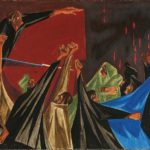
- Jacob Lawrence, … is life so dear or peace so sweet as to be purchased at the price of chains and slavery? —Patrick Henry, 1775, Panel 1, 1955, from Struggle: From the History of the American People, 1954–56, egg tempera on hardboard. Credit: Collection of Harvey and Harvey-Ann Ross. © The Jacob and Gwendolyn Knight Lawrence Foundation, Seattle/Artists Rights Society (ARS), New York. Photo by Bob Packert/PEM
-
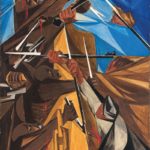
- Jacob Lawrence, We have no property! We have no wives! No children! We have no city! No country! — petition of many slaves, 1773, Panel 5, 1955, egg tempera on hardboard. Credit: Collection of Harvey and Harvey-Ann Ross. © The Jacob and Gwendolyn Knight Lawrence Foundation, Seattle/Artists Rights Society (ARS), New York. Photo by Bob Packert/PEM
-
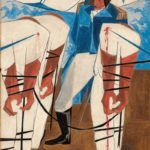
- Jacob Lawrence, Thousands of American citizens have been torn from their country and from everything dear to them: they have been dragged on board ships of war of a foreign nation. —Madison, 1 June 1812, Panel 19, 1956, egg tempera on hardboard. Credit: Collection of Harvey and Harvey-Ann Ross. © The Jacob and Gwendolyn Knight Lawrence Foundation, Seattle/Artists Rights Society (ARS), New York. Photo by Stephen Petegorsky
-
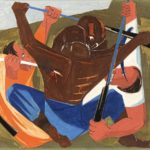
- Jacob Lawrence, … for freedom we want and will have, for we have served this cruel land long enuff … —a Georgia slave, 1810, Panel 27, 1956, egg tempera on hardboard. Credit: Private collection. © The Jacob and Gwendolyn Knight Lawrence Foundation, Seattle/Artists Rights Society (ARS), New York
-

- Jacob Lawrence with panels 26 and 27 from Struggle: From the History of the American People, 1954–56. Credit: © Robert W. Kelley/The LIFE Picture Collection/Getty Images
A decade after his great, 60-painting Migration series of 1940, the African American painter Jacob Lawrence set himself another, equally ambitious task. Instead of portraying the present—the Migration series had depicted the exodus of black Americans from the Jim Crow South to the North during the Depression—the new series would deal with history. And unlike most of Lawrence’s work to date, it would take for its theme not just the black experience but the American experience as a whole, the fight for freedom and dignity that began with the assertion of independence from Britain—and that, as Lawrence was painfully aware, had borne far more fruit for whites than for blacks.
The Migration Series had made Lawrence, just 23 at the time, a star, the first black artist to have a solo show at a mainstream New York gallery. Soon, though, he had to put his career aside to serve in World War II, in a Coast Guard crew that happened to be one of the first integrated units in the U.S. military. After the war, Lawrence suffered from depression, and in 1949 he checked himself into Hillside Hospital in Queens, N.Y., where he spent 11 months undergoing therapy and recovering. Shortly after leaving the hospital, Lawrence conceived the idea for his new series. Its title would be Struggle: From the History of the American People.
It was not until the spring of 1954 that Lawrence began work on the paintings, giving himself a deadline of two years to finish. The research that went into the project was prodigious. Working mainly in the Harlem branch of the New York Public Library on West 135th Street (now known as the Schomburg Center for Research in Black Culture), Lawrence amassed a huge collection of notes, news clippings, image references, and quotations from historical figures and documents. The latter became key to the project, because Lawrence titled (or captioned) each panel by matching it with a quotation of some kind. The logic behind this was that instead of assuming an omniscient third-person narrative voice, the series would let the participants in history speak for themselves, in a diversity of voices.
Subscribe online to finish reading this article
—
By John Dorfman

Subscribe to Art & Antiques for your Digital or Print copy