Subscribe to Our Newsletter
The Independent
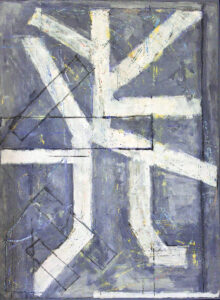
Acteon #12, 1946, oil on canvas, 42 x 30 in.
Estate of Fritz Bultman
Fritz Bultman, a first-generation Abstract Expressionist painter, sculptor,and collagist, went his own way and is now coming our way.
By John Dorfman
The January 15, 1951, issue of Life magazine featured a photograph of 15 American artists. Formally dressed in their best, carefully stage-managed into a group pose, they glared into photographer Nina Leen’s lens with severe expressions well befitting the moniker the magazine gave them: “The Irascibles.” The reason for their irascibility—and the reason they were in Life at all—was that they had recently sent an open letter of protest, dated May 20, 1950, to the Metropolitan Museum of Art in New York, slamming the venerable institution for what they considered the retrograde policies behind the selections for its exhibition “American Painting Today – 1950.” The juries had largely ignored the abstractionist avant-garde that would soon be known as the New York School or Abstract Expressionism in favor of more traditional and figurative work. The scorching letter was published in the New York Times, and the artists who signed it—including Mark Rothko, Jackson Pollock, Willem de Kooning, Clyfford Still, and Ad Reinhardt—had a major media moment.
However, not quite all the artists who signed the letter made it to the photo shoot. Fritz Bultman, who at 31 was younger than many in the group but already making waves as an abstract artist, happened to be in Florence, Italy, at the time, studying techniques for the bronze casting of sculpture. And while one should be cautious about reading too much into any single event, there is undoubtedly a connection between Bultman’s future lack of fame and his absence at this defining moment. As the critic Irving Sandler observed decades later, the Life photograph “has become the image whereby we envision the artists who achieved the triumph of American painting.” (The other missing signatories were Hans Hofmann, who as an elder statesman and respected teacher already had a cemented reputation, and Weldon Kees, a poet and jazz pianist as well as a painter who fell into an obscurity even deeper than Bultman’s.)
But there was more than just chance behind Bultman’s lack of presence in the picture. It was typical of his mode of being to be off on his own exploring new possibilities, and while he was a very social person, artistic politics and polemics were far from his first priority. Nonetheless, in his 64 years of life Bultman accomplished a great deal and created a unique and powerful mode of abstraction that only now is getting full recognition and appreciation. As his friend and fellow Irascible Robert Motherwell put it, “After forty years of acquaintanceship with Fritz Bultman and his work, I am still convinced that he is one of the most splendid, radiant and inspired painters of my generation, and of them all, the one drastically and shockingly underrated.”
Bultman was born in 1919 into an old and well-established New Orleans family. Their wealth came from the Bultman Funeral Home, also known as the House of Bultman, a multi-generational business dating back to the 19th century that was closely entwined with the city’s history. Bultman’s parents gave him every advantage and encouraged his creativity; when the artist Morris Graves, a friend of the family, came to stay with them, he gave the young Fritz art lessons. At the tender age of 13, Bultman was sent to study at a prep school in Munich, Germany, where he met Maria Hofmann, the wife of Hans Hofmann. The Hofmann connection became key to Bultman’s formation and life as an artist, and when he returned to the U.S. he would study extensively with Hans Hofmann at his school in New York and Provincetown, Mass. Bultman’s decision to eventually make Provincetown his home base owed a great deal to Hofmann.
But before any of that could happen, though, Bultman bowed to pressure from his father to get training for a career more profitable and practical than art—architecture. The Bauhaus in Germany, where he had originally wanted to study, was closed by the Nazis, so in 1937 Bultman went to Chicago to enroll in the New Bauhaus, which had just been founded by the refugee artist and designer László Moholy-Nagy. In its few years of existence, the New Bauhaus became known more for quirky abstract non-functional objects than for buildings, and Bultman never did become an architect.
His next stop was New York, where he arrived in 1938. The Depression was still on, and life for artists was difficult, not only for economic reasons but because the artists themselves were unsure of their direction, torn between Social Realism, Surrealism, and the emerging styles of gestural abstraction in a politically charged climate. Bultman studied in New York with Hofmann, absorbing the German teacher’s highly influential “push-pull” doctrine of composition. Bultman’s earliest abstractions of the 1940s show the Hofmann heritage in their heavy, almost crusty application of paint and in the way the contrasts of color and form create a sense of depth in space and dynamic tension.
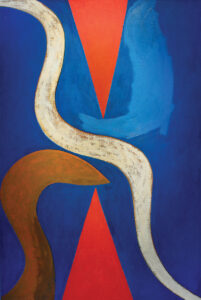
Seaworm, 1976, oil on canvas, 72 x 48 in.
Estate of Fritz Bultman
Bultman’s early work sometimes alludes to figuration and participates in a kind of sublimated mythological thinking. The Greek myth of Diana and Acteon, in which the hunter is turned into a stag and then killed as punishment for spying on the goddess while she bathes in the forest, had a profound meaning for him and figured in many canvases. Sometimes the antlers and trees are almost visible. The exact significance of the myth for Bultman is difficult to arrive at, but it appears to have had something to do with ambivalence about his sexual orientation and his relationship with his father. Aside from the Acteon paintings, many of Bultman’s early works have a mythic or even totemic quality that links them to Surrealism, which of course is an important strand in the Abstract Expressionist DNA. Bultman exhibited his work in New York at the Hugo Gallery and with the dealer Sam Kootz, a champion of the new abstraction. Later he would exhibit at Stable Gallery, Martha Jackson Gallery, and Tibor de Nagy.
In Provincetown, Bultman met Jeanne Lawson, a dancer and model, and on Christmas Eve of 1943 they were married. The marriage proved satisfying and enduring, and Jeanne and Fritz Bultman became the hub of a circle of creative people—not just visual artists but poets, writers, and musicians, as well—in the artistic community at the tip of Cape Cod, as well as in Manhattan, where they also lived for extended periods. In Provincetown he had a studio designed for him by his New Bauhaus colleague, the sculptor and sometime architect Tony Smith.
The first half of the 1950s, though, was a difficult time for Bultman. Around 1951 he fell into a deep depression and although he taught at Pratt Institute in Brooklyn, he was able to produce little work of his own until about 1956. During that period he devoted himself to psychotherapy and emerged stronger and once again creatively vibrant. In the late ’50s and into the ’60s he enthusiastically devoted himself to sculpture, making abstract bronze pieces that seem to translate the gestures of his paintbrush into three dimensions.
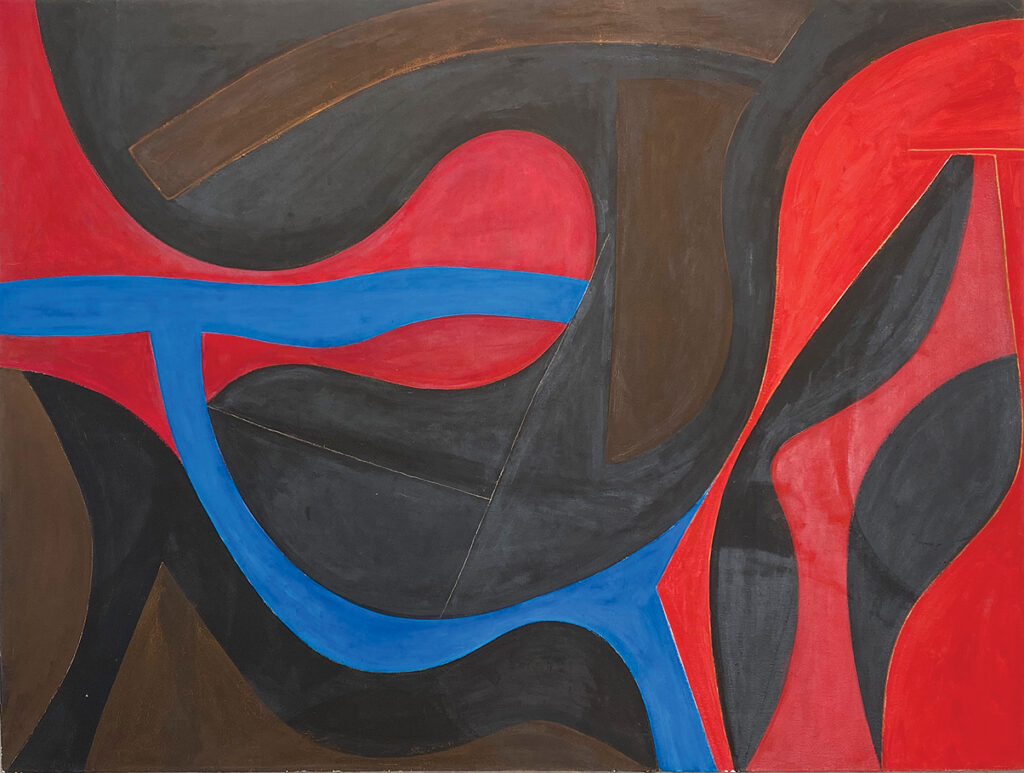
It was in the early ’60s that Bultman hit upon the innovative technique that gives his work its greatest distinction. It was a form of collage based on cutting and tearing up pieces of painted paper and gluing them onto the canvas. Motherwell also made abstract collages, but Bultman eschewed his friend’s penchant for using found materials and typography; his collages are pure paint, so in a paradoxical sense closer to paintings than collages, and very much indebted to the late Matisse. In a statement he wrote for an exhibition, Bultman explained: “I took the painting of papers with gouache from Matisse’s cut-outs, but I began to work anew in collage from a center outward, rather than working on the confines of a sheet of paper. By adding piece to piece I find a means that give me a collage of random shape through random growth…Because my collages are conceived as independent shapes the frame is only a makeshift method of displaying them….What I aim for is a surface that is charged in all its parts, yet has reference to the rectangle of a canvas.” The collages or cut-outs, which are large and use mainly bright colors, have a hard-edge quality to them and yet can’t be considered geometric abstraction. Many are almost biomorphic, with shapes that have an undulating, irregular quality in keeping with his idea of “growth.” In these works, Bultman transcends the dichotomy between positive and negative spaces.
In addition to his work as an artist and teacher (in addition to Pratt he also taught at Hunter College in Manhattan), Bultman did something important as a arts patron during the Civil Rights era. In 1963, he and his wife spearheaded a group of artists and writers in establishing a modern art collection at the museum of Tougaloo College, a black university in Jackson, Miss. It was actually the first collection of modern art in the state of Mississippi. Bultman himself donated some works on paper by Picasso, Karl Schmidt-Rottluff, and Hans Hofmann to Tougaloo, as well as some of his own work. The New York Art Committee for Tougaloo College did its work in the hope that modern art would help to promote racial understanding and justice. Tougaloo was deeply involved in the struggle for civil rights for African Americans, and while the artworks themselves may not have had any direct bearing on that struggle, as Motherwell put it, “Modern art had an important place in society, because art was not an abstract concept but a concrete means to express human contact and to depict feelings universal to modern man.”
Intrusion of Blue, 1974, oil on canvas, 72 x 96 in.
Estate of Fritz Bultman
Bultman remained active as an artist throughout the ’70s and early ’80s, although he exhibited less than before. As art world fashions changed, he stayed true to his own vision, working hard and constantly through severe pain caused by the cancer that would kill him in 1985. His relative obscurity compared to some other members of the Abstract Expressionist school seemed not to bother him very much. In fact, he accepted it as inevitable given his nature and his decisions. In a letter to his friend the poet Donald Windham, Bultman wrote, “I have long realized that your position, like mine, was untenable in the face of worldly acceptance and that the price of independence was obscurity. You must realize that character-wise you cannot make any other choice….It is only thru work that pleasure/reward will come to us, to make work the be all and the end all in itself.” As his work becomes more widely known, now that the dust has settled from the rivalries of the past and the art matters more than the personalities, the independence of Fritz Bultman’s art will guarantee it a place in the firmament of 20th-century modernism.

Subscribe to Art & Antiques for your Digital or Print copy