Subscribe to Our Newsletter
The Classic Cubist
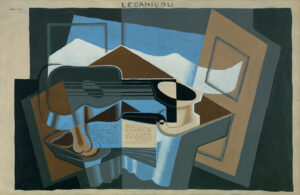
Le Canigou, 1921, oil on canvas
Collection Albright-Knox Art Gallery, Buffalo, New York, Room of Contemporary Art Fund, 1947 (RCA1947:5). Photo : Albright-Knox Art Gallery / Art Resource, NY
Juan Gris, a master of the Cubist still life, is getting a closer look thanks to a new museum exhibition.
By John Dorfman
Juan Gris is often the odd man out in discussions of Cubism, with Pablo Picasso and Georges Braque at the center and Albert Gleizes and Jean Metzinger slightly off to stage right and left. Gris, Picasso’s fellow-Spaniard, has been characterized as a conservative, a classicist, preoccupied with precision and elegance, and therefore somehow out of step with the radical spirit of the Cubist movement. While his aesthetic was undoubtedly different from Picasso’s, he was a brilliant thinker as well as a master craftsman and revealed to his colleagues new places that Cubism could go. To Picasso he was always deferential, referring to him as “dear master”; in return, Picasso recognized Gris as “a painter who knew what he was doing.”
Another reason for Gris’ comparative obscurity is his early death from disease at the age of 40, in 1927. His entire painting career fits into 15 years. During the 1930s, when the American abstract painter and art patron Albert E. Gallatin was assembling his historically important collection, he predicted that Gris, “whose importance as yet is fully recognized by comparatively few connoisseurs, by virtue of the purity of his painting no doubt one day will be considered, in certain of his paintings, the equal of Picasso, in his Cubist and more abstract work only.” The prophecy has not quite come true yet, but a major Gris exhibition, co-organized by the Dallas Museum of Art and the Baltimore Museum of Art, might just do the trick.
“Cubism in Color: The Still Lifes of Juan Gris” opens in Dallas on March 14, running through July 25, and then moves on to Baltimore, where it will be on view from September 12 through January 9, 2022. Bringing together about 40 paintings and collages, it is the first monographic show in the U.S. devoted to the artist in over 35 years. “It is extraordinarily rare to see so many works by Juan Gris together, particularly in the United States. We are pleased to bring them together for this exhibition to offer a rich and nuanced re-examination of the artist’s important role in a defining art-historical movement,” says DMA director Agustín Arteaga. “As the DMA aims to explore new or underrepresented narratives in art history through its exhibitions and programs, we’re excited to introduce our audiences to the life and legacy of this principal figure within Cubism.”
The focus on still life should not be construed as a narrowing constraint; although he painted Cubist portraits, still life was Gris’ central subject, as indeed it was the central and most characteristic subject of Cubism itself. Cézanne, the forerunner of Cubism, made a specialty of fruit still life, and there is something about everyday objects placed on a table that lends itself to bold artistic examination. From its origins in ancient Greece, still life has taken on many resonances throughout Western art history— a presentation of sacramental offerings, a celebration of abundance, an acknowledgement of mortality, a subversion of domesticity. For the Cubists, the extraordinary quality of the new vision, fracturing reality into multiple views and facets, was best appreciated when applied to the most ordinary objects. The still life—unmoving, humble, yet full of enticing diverse textures—was the perfect Cubist genre.
Juan Gris was born in Madrid in 1887 as José Victoriano González-Pérez. Juan Gris (literally “John Gray”) is a pseudonym he invented for himself when he started out as an artist around 1906; it sounds as if he were craving anonymity, trying to inhabit the role of a gray man. Of course he was anything but gray, and in an essay in the exhibition’s catalogue, Harry Cooper suggests the possibility that he may have created “Gris” from the first two letters of his father’s name (Gregorio) and that of his mother (Isabella). At first he studied engineering in Madrid, then painting with a traditional academic-style artist. The engineering background can be seen in the extreme geometric precision with which many of his paintings are planned. Gris’ first works as an artist were caricatures and satirical magazine illustrations. When he moved to Paris in 1906 and became friends with avant-garde artists and poets including Guillaume Apollinaire, Max Jacob, Metzinger, and Braque, he continued as a cartoonist and did not take up painting seriously until 1911.
Perhaps because of his background in magazine illustration rather than in fine art, Gris had a certain hesitancy and lack of self-confidence when it came to technical matters of painting. As late as 1915, when he had already made significant contributions to Cubism, he wrote to his dealer, Daniel-Henry Kahnweiler, “I think I have really made progress recently and that my pictures begin to have a unity which they have lacked till now. [. . .] But I still have to make an enormous effort to achieve what I have in mind. For I realize that although my ideas are well enough developed, my means of expressing them plastically are not.”
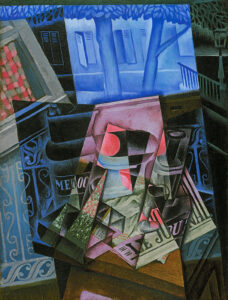
Still Life before an Open Window, Place Ravignan, 1915, oil on canvas
Philadelphia Museum of Art, The Louise and Walter Arensberg Collection, 1950
Looking at his works today, it’s hard to think of Gris as a mere “idea man” who struggled to translate his conceptions into physical reality. His earliest Cubist paintings are fully formed, in the muted color palette, almost monochromatic, of Analytic Cubism—a term, by the way, that Gris himself coined. For example, his Still Life With Flowers (1912) pulls its subject apart kaleidoscopically in a technical tour de force. The total effect is one of abstraction and we almost lose touch entirely with the flowers amid the severely geometric planes; only the guitar manages to preserve enough of its familiar contours to be recognizable. In The Siphon (1913), Gris performs a characteristic piece of magic by cutting his subject into strips and then rearranging them in alternating fashion so that their spatial integrity and continuity are sacrificed. Although the painting is oil on canvas throughout, it evinces a fascination with wood grain that would soon lead Gris into experimentation with collage. By the following year, he was already pasting paper onto his works, as in The Lamp (1914), which also uses gouache and conté crayon. In contrast to Picasso’s collages, Gris used collage elements fairly literally (a newspaper portrays a newspaper) rather than as raw material for representation of other objects (as when Picasso cut newsprint into the shape of a guitar). He also took a firmly mixed-media approach, adding collage elements to paint rather than doing pure collage.
The year 1915 saw Gris make a major breakthrough. As he expressed it to Kahnweiler, he felt that his paintings were lacking a “sensitive or sensuous side,” and so he added color, a very rich and glowing set of colors, with fascinating complementary-color effects and even allusions to Pointillism. Still Life Before an Open Window, Place Ravignan (1915), an astounding bravura piece, has it all—rich color at the center, with green and purple contrasting with each other and even creating a positive-negative effect, as when the letters of “Le Journal,” the newspaper title, appear in different color combinations against both light and dark backgrounds. The open window is rendered in a moonlit light blue, while the surrounding street is shown in grisaille darkness. The luminescence of looks like a stained-glass window in the upper left of the composition is conveyed by Pointillist dots in complementary colors. Around this time in his career, Gris moved toward so-called Synthetic Cubism, which sought to build up a whole image out of parts rather than shattering an image into its parts, as in Analytic Cubism. Furthermore, it gave up the illusionism of rendering space as three-dimensional, albeit a fractured manner, in favor of flatness, and that flatness is clearly visible in Still Life Before an Open Window. The same devices are used in Fantômas (1915) with even greater flatness and space-abolishing trompe l’oeil effects such as the interpenetration of the wood with the newspaper and book.
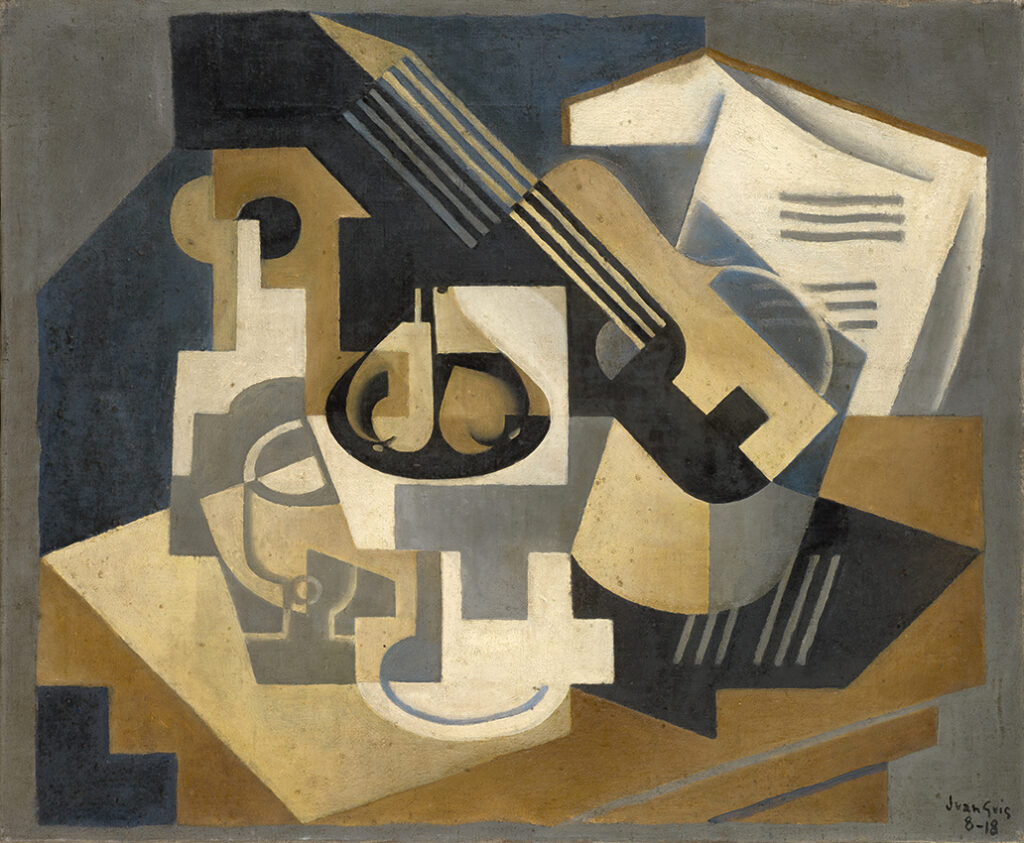
Gris moved fast in his artistic progress; by mid-1916 he had given up the Pointillist effects and brought in black shading as a way of depicting the volume and solidity of objects. The somewhat austere quality of many of his paintings from the period 1916–19 recall Spanish still lifes of the 17th century, which Gris deeply admired. This phase of Gris’ work is often called Crystal Cubism or Classical Cubism, a reference to the crystalline clarity or classical purity of the mode of expression, and this rational style of painting resonated with the “return to order” mood that came over many European artists in the wake of World War I.
Gris’ search for order took on mathematical and even metaphysical forms. Although he lived for over a decade in the infamous Bateau-Lavoir building where Picasso’s circle had their homes and studios, he also associated with the rival school of Cubism based in the Paris suburb of Puteaux, consisting of Gleizes, Metzinger, and the Duchamp brothers (Marcel, Raymond, and Jacques). These artists were enamored of mathematical concepts both classic and modern—the “golden section” ratio and the fourth dimension. They even called themselves the “Section d’Or” group, in homage to the aesthetically satisfying proportion of approximately 1.618 to 1 which occurs in the growth patterns of organic forms in nature as well as in architecture and art. Gris’ later paintings can profitably be analyzed with reference to the golden section as well as other geometrical templates, which the authors of the exhibition catalogue thoughtfully diagram. Le Canigou (1921), a bright and cheerful version of the guitar-by-the-window archetype, is particularly susceptible to the analysis by the golden section, and the proportion’s well-known property of self-reduplication can be seen in the way various-sized rectangles within the painting echo each other.
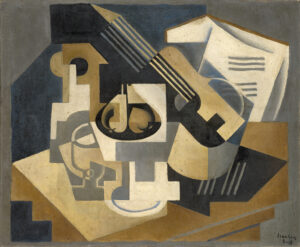
Guitar and Fruit Dish on a Table, 1918, oil on canvas
Kunstmuseum Basel, Gift Dr. h.c. Raoul La Roche 1952
During the last eight or so years of his life, during which he increasingly struggled with illness, Gris focused on open windows, streaming sunlight, and architecture, with an overall “classic,” Mediterranean feel. He painted these subjects prolifically despite his physical weakness, and he must have derived great solace from these warm and life-affirming images. In The Painter’s Window (1925), he depicted his own palette and brush, alongside the typical leisure-time objects such as the guitar, playing cards, and dish of fruit, adjacent to a symbolic, almost featureless, open window. The light coming in from that window can be seen and felt in all his late paintings.
Gris always had a firm sense of what he was doing and could articulate it clearly. In 1921, he told the artist and writer Amédée Ozenfant, “I work with the elements of the intellect, with the imagination. I try to make concrete that which is abstract. I proceed from the general to the particular, by which I mean that I start with an abstraction in order to arrive at a true fact. . . . That is why I compose with abstractions (colors) and make my adjustments when these colors have assumed the form of objects….This painting is to the other what poetry is to prose.”

Subscribe to Art & Antiques for your Digital or Print copy