Subscribe to Our Newsletter
Glass Acts
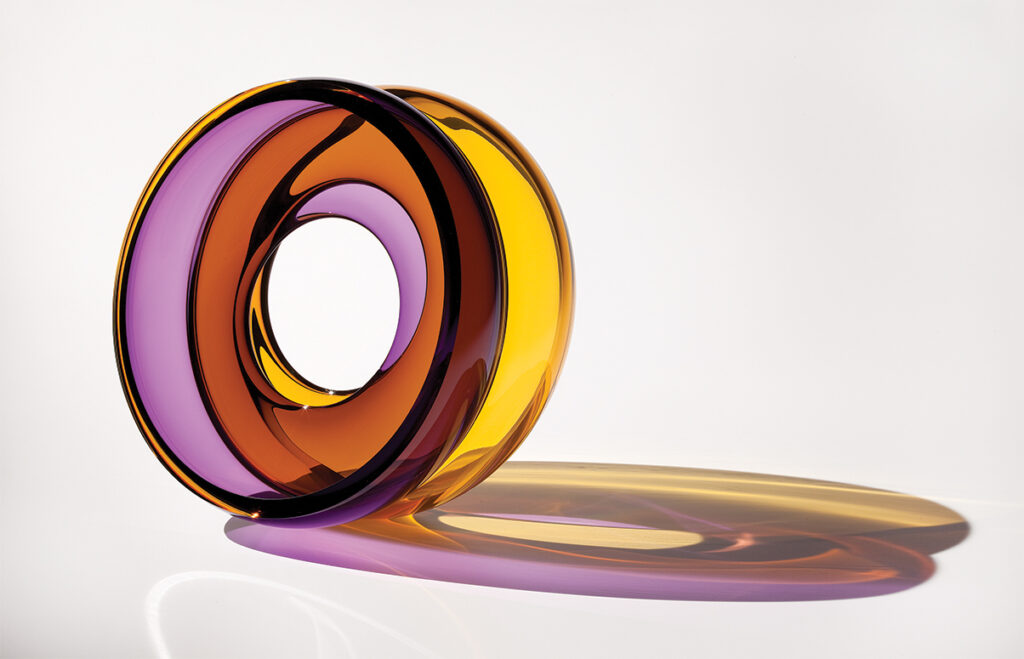
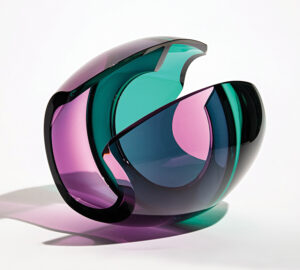
Falco, 2016, glass, 14.5 x 13.5 x 11.5 in.
Courtesy of John Kiley Studio
John Kiley brings inspiration from conceptual and performance art to his glass-making.
By John Dorfman
Making glass art is usually a collaborative process, due to its technical demands, but the Covid-19 pandemic forced John Kiley to go it alone. The last time time he blew glass was in early March in the hot shop at the Museum of Glass in Tacoma, Wash., with his good friend and collaborative partner Dante Marioni. Kiley’s wife is an immunologist, and at the time, when the “novel coronavirus” was still novel, friends would ask, “What do you guys think is going to happen here?” “She said everything is about to change,” says Kiley. “Now here we are!” Left to his own devices in the studio, a lesser—or perhaps just less driven—artist might have decided to rest, or maybe contemplate creative directions to take when the lockdown was over. But not Kiley. Already at work on a new monumentally-scaled series called “Towers” that consists of slabs of glass stacked atop each other at gravity-defying angles, he decided to continue without help.
The blocks of colored optical glass are made in a factory, ground and polished to spec in another factory, and then shipped to Kiley’s studio for assembly and final polishing. “So I had this mass of expensive material,” he recalls. “One has to take a block of glass that weighs 60 to 80 pounds and could be almost six feet tall and balance it on top of a stack of other blocks that are already balanced. That happens several times before I get the composition the way I want it. Then I have to bond it together. Before the pandemic, an assistant helped with the adhesion process, but now I had to work on ways to do it alone.” Out of this almost Sisyphean grappling with massive pieces of glass came not only some powerful works of sculpture but also personal growth for the artist. “Art imitates life in some ways,” he says. “So here we are dealing with the weight of this worldwide change, and that reality works its way into the studio. Without Covid I wouldn’t have attempted it alone. The physical act aside, it felt like there was no choice but to take that leap away from glassblowing and the team and do something totally different. There was no reason not to—you don’t know what’s coming next.”
Truth to tell, Kiley had never really aspired to be a glassblower in the first place. Sculpture was his first love, and he was lucky enough to grow up in an era when glass had freed itself from its traditional ties to decoration and the craft of vessel-making and had become a fully-fledged medium for fine art, very much including sculpture. Kiley was born in 1973 in Seattle, a fourth-generation resident of that city, which, as it happens, is basically Rome, Jerusalem, and Mecca all rolled into one as far as American art glass is concerned. In high school, Kiley realized that he had a “knack” for ceramics and, since he was clearly not on the “traditional path” to college, decided to save his money to take a class at the Pilchuck Glass School in nearby Stanwood, Wash., founded in 1971 by the art-glass pioneer Dale Chihuly. While taking the class, he was also apprenticing with a chef in a restaurant in Seattle, and one day, while working in the restaurant, he saw someone wearing a Pilchuck t-shirt and struck up a conversation. That person turned out to be Dante Marioni, a young glass artist and the son of Paul Marioni, a member of the first generation of the contemporary American art glass movement. Dante Marioni invited Kiley to come over to a friend’s place to cast glass, but Kiley, busy with restaurant duties, didn’t show up. Nonetheless, he had made an important connection, one that would bear fruit later in various ways, culminating in a creative collaboration that goes on to this day.
When he wasn’t in the kitchen, Kiley was working at sculpture in a makeshift studio of his own. Marioni suggested that he try and get a job at a place called Glass Eye Studio, which turned out to be just 100 yards down the street from Kiley’s studio. One of the first production glassblowing shops, Glass Eye was where such well-known artists as Marioni, Benjamin Moore, and Preston Singletary got their start. Kiley was persistent and eventually got himself hired, set to grinding and polishing 700 paperweights a day. One day a member of Chihuly’s studio called and said, “Call in sick and take the day off; we’re short-handed here.” He did, and got hired as an assistant to Chihuly. For six months, all he did was heat up colored glass, use shears to clip a little glob of it onto a red-hot blowpipe, and put it back into the pipe warmer for someone else to use.
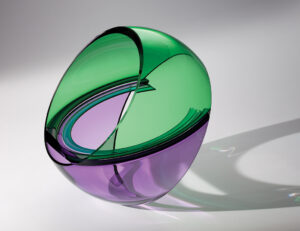
Kilkenny, 2015, glass, 14 x 13 x 12.5 in.
Courtesy of John Kiley Studio
His next big break was to land a position on the team of Lino Tagliapietra, the legendary Italian master who had come to work in the U.S. and share the centuries-old knowledge of Venetian glass. “For a couple of years on Lino’s team,” Kiley recalls, “my only job was to run doors. That’s the one spot where you can see what everyone in the shop is doing. I could look over Lino’s shoulder and see how he took glass out of the kiln without putting in any bubbles.” Kiley would spend a total of 16 years working with Taglipietra.
“I was very fortunate to be in the right place at the right time,” he says. “But I wanted to be a sculptor. So it really took me a long time to figure out what to make with glass. My first work was in 1991, but my first solo exhibition wasn’t until 2010. I wanted to understand all the decorative techniques under the sun—before leaving them behind.” Some of his best-known works are spherical pieces, which use some of the traditional tropes of vessel-making but in ways that completely undercut any idea of practical use. Some are cut open at various angles, and some are pierced with holes or apertures through which the viewer can look to see their inner structure. Kiley says that part of his motivation in making these pieces was to create on a small scale so as to convey something of the experience of a large-scale work. The apertures give the viewer the sense of being inside the glass, as if they were walking through a massive outdoor sculpture.
In his “Towers” pieces, Kiley combines the monumentality he favors with a sense of vulnerability. “I positioned the sculptures so they are protruding off the pedestal,” he says, “and they got a visceral response—‘This freaks me out! I don’t want it to fall!’ You enter into a relationship of a sort with this piece, realize where you are in space, and pay attention. People know that glass is breakable and fragile. If they see it looking precarious, that creates a feeling that isn’t available with other materials.”
Kiley’s most innovative achievement in glass, the one in which he leaves the traditional techniques the farthest behind, is his “Fractograph.” This series involves cracking blocks of glass, using either physical force or heat, and reassembling the pieces so that the randomness of the breakage pattern creates the design. “Shock waves travel 9,000-11,000 miles per hour through the glass,” he explains, “so it’s almost instant. These are tears at the atomic level, since there is no crystalline structure inside the glass; it really is random. Even in a lab you can’t create the same break in glass twice, so this is an irreproducible record of time, place, and energy, captured visually in this block. It has nothing to do with glassblowing technique whatsoever. My knowledge of the material helped me to do this, but nothing about glassblowing goes into it.” At first he simply hit the blocks with a sledgehammer but later came up with the technique of dropping a glob of red-hot molten glass onto a block and then dousing the surface with cold water, creating a thermal shock. “That was to remove my own physical energy from causing the break,” says Kiley, “ so that there would not be an exchange of energy between me and the material. Instead it was the other material, the broken glass, interacting with the block and transforming it.”
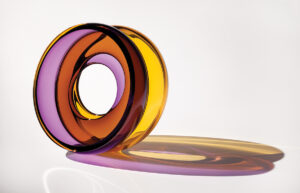
John Kiley, Golden Roller, 2015, glass, 12.5 x 8 x 13 in.
Courtesy of John Kiley Studio
The intricate shatter pattern of a Fractograph makes it beautiful, but there is more to it than just the object you see mounted on a pedestal. Every time he makes one, Kiley films the process of preparing and then breaking the glass, so that the irreversible moment of breakage is forever preserved. “Not everyone thinks this, but I personally think it’s necessary to view the footage to fully appreciate the work,” he says. “If you don’t have the footage, you probably would never draw the conclusion that this was done with thermal shock.” With the Fractographs, Kiley has taken glass into the terrain of conceptual, performance, and video art.
In a sense, though, he hasn’t strayed all that far from his origins. He recalls that when he was growing up in Seattle, he and his friends would sometimes have dirt-throwing wars. “I picked up a piece of mud and started to shape it,” he says, “and 40 minutes later I had a perfect sphere. I put it in a bottle in the shed and viewed it—my perfect object. My friends didn’t believe I made it, because it was too perfect; they thought there must be something inside to give it structure. To prove them wrong, I had to break it and show them. Looking at that broken sphere, with its jagged edges, that’s kind of where this whole thing started.”

Subscribe to Art & Antiques for your Digital or Print copy