Subscribe to Our Newsletter
Castles in Spain
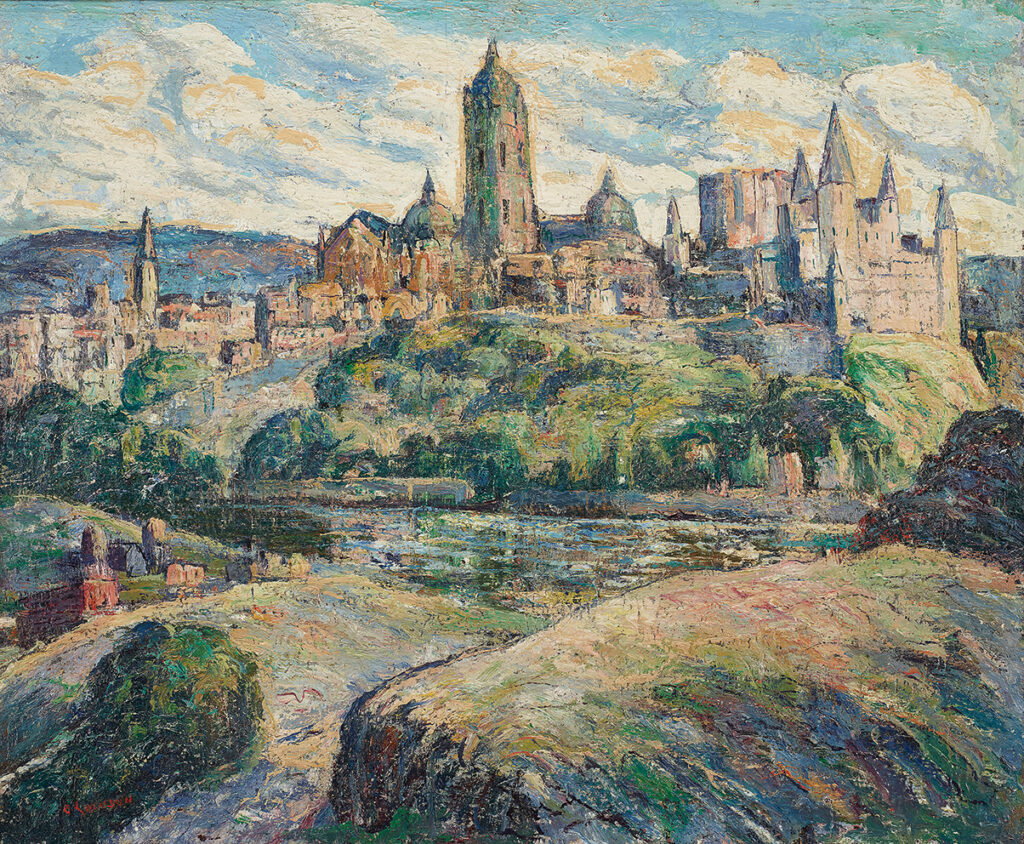
For American artists of the 19th and early 20th centuries, Spanish art and culture held an irresistible allure.
By John Dorfman
Spain once exerted a magnetic force on the American imagination. After losing most of its New World colonies in the 1820s, Spain entered a long period of political and economic decline during which it came to seem like a backwater of Europe, a land that time forgot. The country represented the opposite of modernity, an improbable survival of folkish and even medieval ways of life. During the later part of the century, and for Americans in particular, tourism in Spain was a trip back in time to a romanticized rural Mediterranean world of colorful costumes and customs, exotic dances and music, and delightfully affordable arts and crafts. In addition to the ambience there was the Prado in Madrid, full of works by Spanish Old Masters such as Velásquez, Murillo, and Ribera who were profound inspirations to the realist painters of the time.
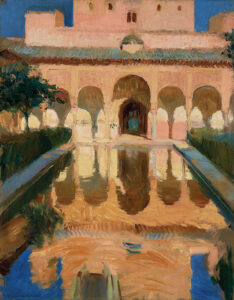
Joaquín Sorolla y Bastida, Hall of the Ambassadors, Alhambra, Granada, 1909, oil on canvas.
The J. Paul Getty Museum, Los Angeles
This little-known history is brought to life in a fascinating and innovative exhibition, “Americans in Spain: Painting and Travel, 1820–1920” co-organized by the Chrysler Museum of Art in Norfolk, Va., and the Milwaukee Art Museum, which runs at the Chrysler through May 16 and then moves to Milwaukee, where it will be on view from June 11–October 3. Drawing on the Chrysler’s holdings of American and Old Master paintings and the Milwaukee Art Museum’s collection of the Ashcan School and The Eight, it brings together over 100 artworks, including paintings, drawings, prints, photographs, and ephemera such as travel guides. Among the American artists whose works are on view are William Merritt Chase, Robert Henri, Mary Cassatt, and John Singer Sargent, who not only painted Spanish themes and subjects but did not hold back from copying the works of the Spanish painters of the Golden Age in the 17th century.
The story of the Anglo-Saxon world’s artistic infatuation with Spain begins in the 1830s, which, not coincidentally, also marked the inception of Orientalist art. English and Scottish painters, skilled in landscape and architectural rendering, traveled around the Continent creating views that served as documents, artistic expressions, and, eventually, visual aids in the promotion of the infant industry of tourism. The most prominent among these artists who painted in Spain were the Scotsmen David Wilkie and David Roberts and the Englishman John Frederick Lewis. Wilkie was good friends with the celebrated American writer Washington Irving, whose Tales of the Alhambra (1832), based on a mixture of myth and history having to do with the Arabs and Spaniards during and after the Middle Ages, did a great deal to spread awareness of Spain as a locus of legend. Wilkie illustrated some episodes from the Tales, setting a precedent that would be followed by others in decades to come, not only English and American artists but even Spanish ones such as Mariano Fortuny, whose Slaughter of the Abencerrajes (1870), on view in the exhibition, gives vivid life to a grisly scene of death. Roberts, best known for his scenes of the Middle East, including the Holy Land and the red-rock city of Petra in Jordan, contributes to the exhibition an astonishing oil-on-canvas panoramic view of The Fortress of the Alhambra, Granada (1836). As for Lewis, “American in Spain” features several lithographs made from his paintings, depicting not only the Alhambra but also the great Mosque of Cordova, converted into a church. (Around 1880 the American Orientalist painter Edwin Lord Weeks depicted the mosque as he imagined it had been in medieval times, with Muslims worshipping against a background of unfaded splendor.) Prints made from paintings and drawings served as illustrations to travel guides that began to appear during the decade of the 1830s, most notably Thomas Roscoe’s The Tourist in Spain volumes, which featured engravings after drawings by David Roberts.
The Orientalist connections of Spanish-themed painting become clear when one realizes that not only was Spain profoundly influenced by centuries of Islamic rule, but that even in the 19th century the country—especially the southern province of Andalusia—was considered by Anglo-American writers, artists, and tourists to be almost or just as exotic as the Middle East itself. The Spanish gypsies in particular provided a rich vein of inspiration for artists, even some, like Thomas Sully, who had never been to Spain. His Gypsy Girl (1839), is richly Romantic, even if the girl does bear a striking resemblance to Lady Hamilton.
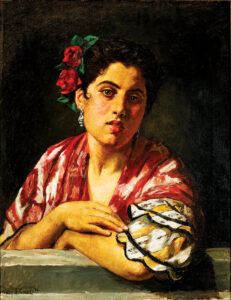
Mary Cassatt, Spanish Girl Leaning on a Window Sill, ca. 1872, oil on canvas
Manuel Piñanes García-Olías, Madrid
Literary works continued to be important to the growth of the Spanish mystique in art. The English writer George Borrow’s books The Zincali (1841) and The Bible in Spain (1843) celebrated Spanish Romany culture and influenced Prosper Mérimée’s novel Carmen (1845), the basis for Bizet’s opera Carmen (1875), which made the tragic Spanish gypsy dancer a permanent archetype in world culture (Ava Gardner’s character in the 1954 film The Barefoot Contessa is her lineal descendant). The Chrysler-Milwaukee exhibition features several images of “Carmens,” including William Merritt Chase’s exuberant, castanet-clicking Carmencita (1890). This was a portrait of a real-life dancer, Carmen Dauset Moreno, who took New York by storm in 1889–90. John Singer Sargent was so impressed that he arranged for La Carmencita, as she was known, to give a private performance for none other than Isabella Stewart Gardner, the Boston art patron and collector. The evening is said to have been a success, despite some “temperamental outbursts” by the dancer (in the words of Chrysler Museum curator Corey Piper in a catalogue essay). Sargent also painted La Carmencita; his 1890 portrait shows her not dancing but posing proudly, imperiously, hand on hip and one foot forward, a half-smile on her face. Other Spanish female performers in the exhibition include Robert Henri’s Betalo Rubino, Dramatic Dancer (1916), sensual to the point of sexual (elsewhere, Henri painted this woman bare-breasted), and Chase’s A Tambourine Player; Mrs. Chase as a Spanish Dancer (circa 1886), a bit of Orientalist-Hispanic masquerade.
The male equivalent of the Spanish dancer is, of course, the bullfighter, and the exhibition offers examples aplenty. Mary Cassatt, who spent time in Seville in the 1870s, made several matador-themed canvases. While her Offering the Panal to the Bullfighter (1873) has been described as owing a great deal to Murillo (whose works Cassatt had studied in the Prado), rather than being an Old Master homage, it uses its Spanish material in a fundamentally non-picturesque, modern manner. Most if not all of Cassatt’s Spanish paintings have a frank, authentic quality to them; her Spanish Girl Leaning on a Window Sill (circa 1872) subverts the “Carmen”-type conventions and shows us, with great immediacy, an ordinary yet somehow powerful young woman leaning out the window toward us. Henri, who led groups of students to Spain in the early years of the 20th century, became obsessed with bullfighting and made many paintings on the theme. His 1906 portrait El Matador (Felix Asiego) is decidedly Romantic, with its focus on the melting eyes and warm complexion of the famous bullfighter and the loving attention given to his brocaded garments.
Less overtly exoticizing and myth-making are the landscapes and townscapes on view in “Americans in Spain.” The American painter Robert Frederick Blum’s Spanish Courtyard (1883) belongs to what almost amounts to a sub-genre—the courtyards in Spain proved almost irresistible to 19th-century painters, who relished the contrast between the architectural splendor left over from wealthier days and the relative poverty of the modern-day denizens. In Blum’s canvas, the trees and the pool of water compete with the architecture for picturesque power, while a little flirtation between a man and a woman adds narrative interest. Childe Hassam’s Plaza de la Merced, Ronda (1910) revels in the effects of sunlight on the pastel-colored buildings lining the street; the contrast between the deep blue of the sky and the lighter blue of the house in the foreground is exquisite. This is a set of colors that Hassam, an enthusiast for light and its properties, couldn’t have found back home in the U.S.
One of the interesting aspects of the touristic-artistic perception of Spain in the 19th and early 20th centuries is the way the country was positioned as a place where traditional hand crafts abounded and their products could be purchased cheaply. Antiquing in Spain was a popular pursuit among travelers, and the guidebooks made sure to address the subject in detail. Artists, both Anglo-American and Spanish, followed suit by depicting Spaniards working at traditional trades (cigar factories were a favorite, due to the fact that most of the workers were young women), the shops in which these products were sold, and the shops of the antiquaries who made Spain’s historical legacy available for purchase by affluent foreigners. José Jiménez Aranda’s Figaro’s Shop (1875) combines a real genre scene with a reference to Verdi’s opera The Barber of Seville, which was second only to Carmen in spreading notions of Spanish exoticism far and wide.
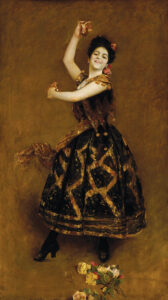
William Merritt Chase, La Carmencita, 1890, oil on canvas
Metropolitan Museum of Art, Gift of Sir William Van Horne, 1906
American interest in Spain seemed to increase after the Spanish-American War of 1898, in which Spain lost the last of its colonies—Cuba, Puerto Rico, and the Philippines. Spain in defeat became even more an object of aesthetic desire than before. The collector Louisine Havemeyer recollected that her husband “always maintained that after the Spanish War we should have demanded the Prado as an indemnity instead of taking over the Philippines.” The remark sounds like a joke, but it was meant absolutely seriously. The influence of the 17th-century painters on American artists at the cusp of modernism was very deep, and the degree of admiration for Spanish Old Master painting among American collectors was such as to bring to these shores, if not the actual Prado, then as many Golden Age pictures as could be prised away from impoverished Spanish noble families. For collectors and artists alike, Velásquez was the greatest of all; in 1896 Chase said, “Of all the old masters he is the most modern.” Velásquez’s technical perfection and realism endeared him to artists as diverse as Manet, Whistler, and Sargent, and many great and lesser artists flocked to the Prado to copy his works. (The exhibition features a whole section on 19th-century American copies of Spanish Old Masters, made with varying proportions of imitation and originality.)
The war and its aftermath also led to genuine American-Spanish friendship and mutual admiration, as the “Generation of ’98” advocated for a belated modernization and liberalization of Spain. Enthusiasm for all things Spanish swept elite circles in New York, epitomized by Archer Milton Huntington’s founding of the Hispanic Society of America in 1904. Huntington (whose love of Spain began when he read Borrow’s The Zincali) was close friends with Joaquín Sorolla y Bastida, whose Impressionist-influenced realism represented the most modern trend in Spanish painting at the time. Sorolla loved the United States and American art, spent time in New York, and contributed a mural cycle, A Vision of Spain, to Huntington’s new museum. Several Sorollas are featured in “Americans in Spain,” among them Hall of the Ambassadors, Alhambra, Granada (1909). With his sun-dappled, Impressionistic rendering of this old chestnut of a subject, Sorolla brings the story full circle, taking a new, modern look at the medieval castle that originally captured the imaginations of Washington Irving’s readers and the artistic pilgrims to 1830s Spain.

Subscribe to Art & Antiques for your Digital or Print copy