Subscribe to Our Newsletter
East of Eden
An exhibition highlights the fruitful overlap of women artists connected to both abstraction and New York’s storied East End.
By Sarah E. Fensom
The first artist group to establish roots in the Hamptons was a sort of boys’ club. The Tile Club, an informal, New York City-based fraternal order of artists, writers, and musicians, was formed in the 1870s and included figures like Winslow Homer, Augustus Saint-Gaudens, J. Alden Weir, William Merritt Chase, and Stanford White. The group, indulging in the decorative arts fervor of the Aesthetic Movement, gathered weekly in the city to paint eight-by-eight-inch tiles and socialize. But the club also made excursions to paint and sketch en plein air, with these trips taking them on numerous occasions to the secluded, naturally abundant East End. The Long Island Railroad even sponsored a sort of artist junket out to the Hamptons with 11 Tile Club Members in tow. The sketches and resulting works became promotional materials for the railroad.
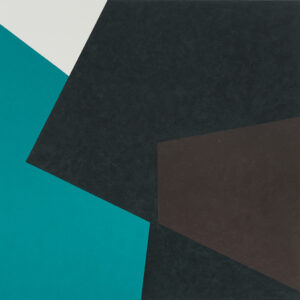
Virginia Jaramillo, Site: No. 15 13.5099º S, 71.9817º W, 2018, acrylic on canvas, 72 x 72 in.
Courtesy the artists and Hales, London and New York
Homer had already ventured out to the Hamptons on his own in 1874, and his excursions resulted in sunny works like East Hampton Beach, Long Island (1874). In 1891, Chase opened the Shinnecock Hills Summer School, which championed plein air painting, and established a summer residence in the area, built by White. Nearby, Thomas Moran—a painter more closely associated with the American West than the East End—and his wife, the printmaker Mary Nimmo Moran, set up their home and studio in East Hampton in 1884.
The early 1940s saw the formation of the Hampton Bays Art Group, a circle of Russian émigrés that congregated in the Hampton Bays area of the East End. The group included the so-called “father of Russian futurism,” David Burliuk, Nicolai Cikovsky, and the Soyer Brothers, Moses and Raphael, and peripheral members like George Constant, Arshile Gorky, and Milton Avery. Though the circle’s members practiced different styles of avant garde painting, they were united by an overarching sense of creativity and progressivism. Burliuk’s Squirestown Road home became the de facto salon for his fellow artists—a surviving guest register accounts for visitors’ comings and goings, as well as sentiments and sketches. The house became a locus not just for exhibitions, but for poetry readings and dances, as well.
This wartime period saw an influx of European artists to the East End, in a sort of reversal of the expat infiltration of Paris in the 1920s (and even more so like the mix of Americans and the European avant-garde at Gerald and Sara Murphy’s French Riviera villa, though the socialite couple, who served as the basis for Dick and Nicole Driver in F. Scott Fitzgerald’s Tender Is the Night, met in the Hamptons in the 1900s). Members of the Surrealist movement flocked to the Hamptons with André Breton, Enrico Donati, Pavel Tchelitchew, and Max Ernst, among them.
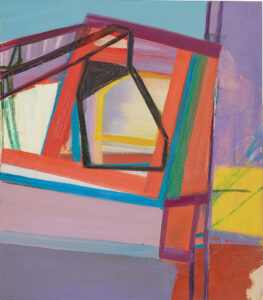
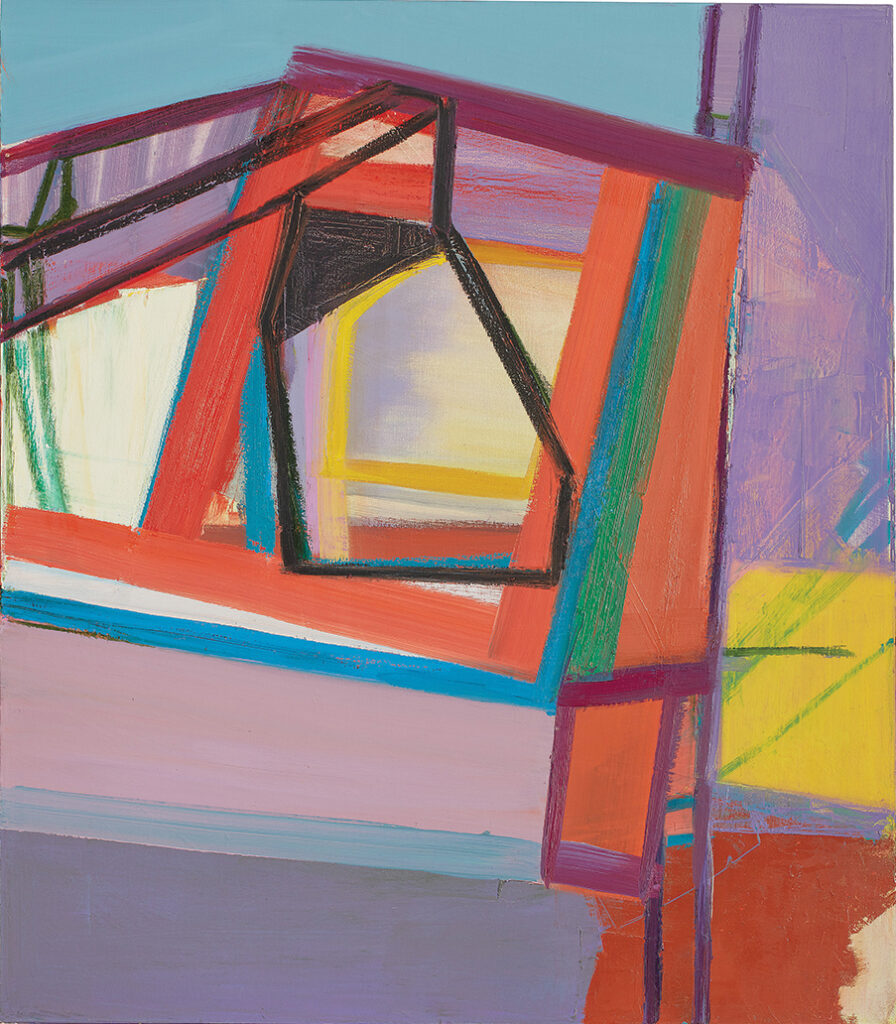
Amy Sillman, C, 2007, oil on canvas, 45 x 39 in.
Bronzini Vender Family Collection
The Hamptons’ role as a great incubator for abstract painting is owed, in part, to one woman. Peggy Guggenheim, who was married to Ernst between 1941 and 1946, served as a sort of bridge between the Surrealists and Abstract Expressionists, showing both groups at her Manhattan gallery, Art of This Century. But she also helped populate the East End with artists. It was Guggenheim who loaned Jackson Pollock and Lee Krasner $2,000 with which to make a down payment on a home in Springs, an East Hampton hamlet, in 1945. It was also Guggenheim who, earlier that year, had pressured Pollock to make new work for her gallery, leading the artist to join friend and fellow artist Reuben Kadish at an East End rental for the summer, acquainting him with the place. Willem and Elaine de Kooning visited the couple in 1948 and eventually bought their own house in the Hamptons in the early 1960s. Many other Ab-Ex-affiliated artists, like Robert Motherwell and Franz Kline, followed.
It’s rather silly to think that this area of New York that inspired so many creators—even those working outside of representation—wasn’t also fertile ground for women artists. But it really isn’t until the middle of the 20th century that women artists seem to be featured in the common narrative of the East End’s rather clubby artistic legacy. It’s funnily enough through the advent of Abstract Expressionism, a male-dominated movement at its outset, that a critical number of women artists, their studios, and their bodies of work seem to enter the idyllic seaside picture.
Though Abstract Expressionism may still have a knee-jerk association with a certain image of masculinity—blame it on Pollock’s mythic pervasiveness, the “action painting” moniker that sounds so natural preceded by “man of,” or simply the patriarchal arc of the art-historical canon in general—the New York School benefited from crucial female voices, whose reputations, thankfully, continue to be galvanized today. Many of these women, like Joan Mitchell, Grace Hartigan, and Helen Frankenthaler, produced highly significant work in the East End and joined in the fray of creative leisure and socialization that the enclave encouraged (like the famed annual Artists & Writers softball game that was founded in 1954).
In the Hamptons, too, Krasner and Elaine de Kooning made work and occupied spaces outside of their artist husbands’ purviews. Krasner, who divided her time between Springs and New York City after Pollock’s death in 1956, painted many of her major canvases in the barn she converted into a studio on the house’s property. Elaine de Kooning, who in 1975 purchased a saltbox house on Alewive Road, created her last important bodies of work in East Hampton. This included Cave Walls and Cave Paintings (1985–88), as well as commissioned portraits of Pelé, the Brazilian soccer player, and Berry Gordy. The house, which since 2011 has hosted exhibitions and artist residencies, has become an art-historical landmark—it served as home and studio to John Chamberlain and then to painter Richmond Burton, after de Kooning’s passing.
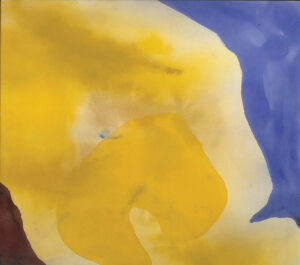
Helen Frankenthaler, Yellow Vapor, 1965, acrylic on canvas, 69 1⁄8 x 77 3⁄4 in.
JPMorgan Chase Art Collection © 2021 Helen Frankenthaler Foundation, Inc. / Artists Rights Society (ARS), New York
A current exhibition at the Parrish Art Museum is devoted to this historical intersection—the women artists working in abstraction with ties to the East End. “Affinities for Abstraction: Women Artists on Eastern Long Island, 1950–2020” is currently on view at the Water Mill, N.Y.-based institution through July 18. It hosts 58 works by 42 artists who have called the region home for a week, a season, or longer.
Though its scope is much larger, the show is replete with significant works by the New York School’s first and second generations. Krasner’s Comet (1970), a powerful large-scale painting that features explosive white, green, and pink swirls on an off-white ground, is a standout. De Kooning’s Sun Wall (1986–87), a late oil on canvas from the Parrish’s collection, showcases the artist’s ability to incorporate a loose suggestion of figuration within her abstractions.
Perle Fine, a seminal Ab-Ex artist, is represented in the show by works like Plan for the White City (1950, oil and sand on canvas) and Image d’Hiver (1958, oil and mixed media on canvas). Both highlight the artist’s fluid, almost topographical line work and her natural knack for a type of highly organized chaos. Fine’s accomplishments in the notoriously macho group were fairly exceptional: she was nominated to the legendary 8th Street “Artists’ Club” by Willem de Kooning, she exhibited at the Ninth Street Show, and was included in each of the New York Painting and Sculpture Annuals from 1951 to 1957 (one of only 24 of 256 artist to do so, with the only other women being de Kooning, Hartigan, and Joan Mitchell). Fine moved to Springs in the 1950s and spent much of her time in East Hampton thereafter.
Joan Mitchell’s Pour Patou (1976), a bold and atmospheric oil on canvas, is another highlight of the exhibition. Mitchell fills the canvas with thick, stubby marks of greens, golds, blues, and black. Mitchell, who also exhibited in the Ninth Street Show and gained entry into the New York School’s circle, lived and painted in the East End during the summers of 1953 and 1954. In 1959, Mitchell moved to Paris and spent much of the rest of her career in France.
Mary Abbott, who, along with Fine and de Kooning, was one of the only three women in the “Artists’ Club,” is represented by Imrie, a 1953 oil on canvas, in the Parrish show. Abbott moved to Southampton in 1950 with her second husband but spent many of her winters in Haiti and the Virgin Islands—both major influences on her work. After a stint throughout the 1970s teaching at the University of Minnesota in Minneapolis, Abbott moved back to New York, setting up a studio in an abandoned ice house in Southampton. Imrie, a large-scale oil on canvas, features the lush, richly colorful elements Abbott is known for. Its gestural line work bears a feverish intensity.
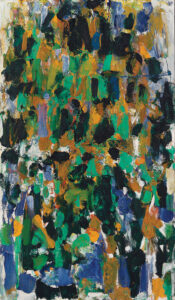
Joan Mitchell, Pour Patou, 1976, oil on canvas, 78 x 45 1⁄2 in.
Private Collection, Coral Gables, Florida
Frankenthaler, who developed the “soak stain” paint application technique, was the pioneer of color field and post-painterly abstraction. The method, which she created in 1952, consisted of unfurling unprimed canvas on the floor and flooding it with paint that seeped into and stained it. A visit to Pollock’s Springs studio in 1951, during which Frankenthaler observed the artist painting with black enamel paint on unprimed cotton duck unfurled on the floor, served as inspiration for her groundbreaking development. Yellow Vapor, a 1965 acrylic on canvas in the Parrish show, is a fruit of the technique—with a large daffodil yellow field, balanced with blue and a small section of brown.
“Affinities for Abstraction” reaches beyond abstraction’s pioneers, chronicling seven decades of exploration. Joan Snyder, a painter who first gained acclaim in the 1970s with her gestural “stroke paintings,” is represented by a 2020 work, Weeping Cherry Tree & Thee (oil, acrylic, papier-mâché, burlap, straw, and paper on linen). The highly textural, three-canvas work features staccato, dripping forms and a palette that mixes pink, lavender, brown, and neon yellows. Mary Heilmann’s Narrow Lane #3 (2001), a rigidly geometric oil on canvas, is inspired by a view from her Bridgehampton home. Heilmann’s work, like this one with its colorful squares on a green ground, is characterized by lively, almost playful brushwork that animates the canvas’ surface. Virginia Jaramillo, an artist of Mexican heritage born in El Paso, Texas, who works out of a studio in Hampton Bays, first gained exposure from her “Curvilinear” series in the early 1970s. In those works, thin, sinuous lines gracefully floated over solid grounds. In her work in the Parrish show, Site: No. 15 13.5099º S, 71.9817º W, a 2018 acrylic on canvas, block-like forms in black, brown, white, and teal cover the composition. However, even with larger, bolder forms, the canvas is no less serene or ordered than its predecessors.

Subscribe to Art & Antiques for your Digital or Print copy