Subscribe to Our Newsletter
Portrait Mode
When the Medicis ruled Florence, a current exhibition at the Met showcases, portraiture ascended to new heights.
By Sarah E. Fensom
The art of political propaganda was perfected thousands of years ago. The ancient Romans, in particular, excelled at communicating sensationalized messages about its leaders through artistic means. The Metropolitan Museum of Art’s collection is rife with prime examples in marble. For instance, a marble portrait bust of the emperor Gaius, known as Caligula (37–41 A.D.) imitates the facial attributes of Augustus, Caligula’s predecessor in the Julio-Claudian dynasty, stressing a connection with Rome’s first (and as of 14 A.D., deified) emperor. Conversely, a marble portrait bust of Marcus Aurelius (circa 170 A.D.), depicts the emperor and Stoicist as a “philosopher king,” with a mature, wise face and the long beard of the Greek philosophers; he’s also portrayed as a stalwart commander-in-chief with his shoulders draped in a military tunic and cloak. The emperor Caracalla’s official portrait (212–217 A.D.), communicates that the member of the Severan dynasty wanted to be seen purely as a no-nonsense military leader, as characterized by short-trimmed curls and stubble, the typical Roman army look of the period. A marble portrait head of the Emperor Constantine I (circa 325–370 A.D. ), the first Christian emperor of Rome, evokes the empire’s first leaders; Constantine’s neatly arranged, close-cropped bangs and a clean-shaven face are a deliberate attempt to associate the new ruler with figures like Trajan, who during the third and fourth centuries was seen as an ideal Roman emperor.
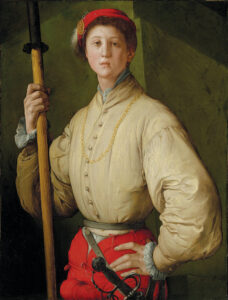
Jacopo da Pontormo, Portrait of a Halberdier (probably Francesco Guardi), ca. 1528-30, oil, possibly mixed with tempera, on canvas, transferred from panel, 37 1⁄2 x 28 3⁄4 in.
The J. Paul Getty Museum, Los angeles, Image courtesy of the Getty’s Open Content Program
Further north up the Italian peninsula but several centuries down history’s timeline arrives the Medici family. With its seat of power in Florence, the family, which functioned much in the same way as an ancient Roman dynastic line, knew that art was one of the most potent tools in its arsenal. And the Medicis employed it time and again to exert their dominance in Renaissance Europe. While they became the most successful bankers in Tuscany, they also became its most prominent artistic patrons, sponsoring artists like Michelangelo and Raphael (not to mention thinkers like Galileo). And while they ascended the political and religious ranks of Florence (several Medicis became popes) and Europe in general, the Medicis had their images rendered in novel and meaningful ways by the greatest portraitists of the day.
“The Medici: Portraits and Politics, 1512–1570,” an exhibition devoted to the particular ways artists portrayed the elite of Medicean Florence, is now on view at the Met. The show
features 90 works of art by masters like Raphael, Jacopo Pontormo, Rosso Fiorentino, Benvenuto Cellini, Agnolo Bronzino, and Francesco Salviati. It showcases a broad range of media—paintings, sculptural busts, medals, carved gemstones, drawings, etchings, manuscripts, and armor. Loans come to the exhibition from private collections and institutions throughout Europe, North America, and Australia, with many works drawn from the Met’s own holdings.
“Throughout history, art and imagery have been used to promote cultural and political agendas—a strategy that continues to be prevalent in our world today,” says the Met’s director, Max Hollein. “This exhibition celebrates the achievements of the painters and sculptors responsible for these memorable masterpieces from Renaissance Italy, as it also explores the historical, social, and political context of these works, inviting us to more fully appreciate their artistic relevance and their role in culture and society.”
The exhibition begins with a hulking bronze bust of Cosimo I de’ Medici by Cellini (1545). Cosimo serves as the show’s main character, with the exhibition’s major plot point, as it were, his rise to the position of Duke of Florence in 1537, following the assassination of his cousin and predecessor, Alessandro de’ Medici (the first Medici to rule Florence as a hereditary monarch, and the last to rule from the senior line of the family; Cosimo was from the Medici’s junior branch). The larger-than-life bust comes to the Met from the Museo Nazionale del Bargello in Florence. And it’s being shown in pristine condition, with a recent cleaning recovering its silvered eyes, an element Cellini borrowed from ancient bronze sculpture. The Cellini bronze is accompanied by a Cellini marble, a bust of Cosimo carved around 1550–51 and finished after 1571. That work, on loan from the Fine Arts Museums of San Francisco, will be exhibited with the bronze for the first time.
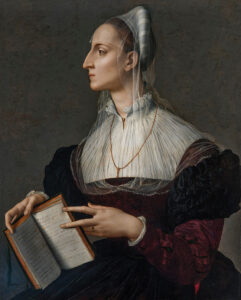
Bronzino, Laura Battiferri, ca. 1560, oil on canvas, 34 1⁄2 x 27 5⁄8 in.
Museo di Palazzo Vecchio, Florence Donazione Loeser, Image: © Musei Civici Fiorentini—Museo di Palazzo Vecchio
Giorgio Vasari wrote, “White, shining armor is the mirror of the prince, so that his subjects can see themselves and their lives reflected in him,” and in 1534, the painter portrayed Alessandro in gleaming, mirror-like armor. Vasari accompanied Alessandro, whose ascendance to the dukedom in 1532 kickstarted 200 years of Medici monarchy in the region and dispelled Florence’s republic, with rich symbols of the ruler’s military victory and family history. That work symbolizes a turn from the Republican portraiture of the first 30 years of the quattrocento, which was set on upholding the austerity of Florentine conventions and traditional moral values.
The busts of Cosimo, which portray the second Medici duke in highly detailed armor, similarly showcase how artistic changes coincided with changes in Florentine leadership at that time. To help forge his public image, Cosimo appropriated Augustan and imperial Roman models, Hispanic Habsburg paintings and martial images of Emperor Charles V, and even aspects of Florentine Republican portraiture for his own portrayals. Imperial Rome served as the overarching influence of the allegorical Cellini busts, which feature lions’ heads, imperial eagles, and winged gorgons crowned with laurels along Cosimo’s breastplates. Grotesque faces toot the trumpets of fame, flanking the symbol of the Order of the Golden Fleece (Charles V gave Cosimo the honor in 1545). Writing to Cosimo about the bronze, Cellini said the work was “in accord with the elevated manner of the ancients.” However, the representation maintained “abundant similitude” and “bold, lifelike movement,” the artist insisted. These attributes—a lively imitation of a sitter’s appearance combined with a deeply considered portrayal of his or her status or intentions—came to define this new era of portraiture.
Following the Cellini busts, the Met’s exhibition breaks down into six sections. The first considers the years 1512–32, focusing on Florence’s transition from Republic to Duchy and the Spanish-supported siege that helped install Alessandro. This period of portraiture is marked by a somber color palette, scant decorative embellishments, and object details employed to indicate a sitter’s profession. Bronzino’s Portrait of a Woman with a Lapdog (circa 1532–33, oil on panel), on view in this section, is like a flare indicating a new, sumptuous style in court painting. Bronzino was also a poet (and a Petrarch fanboy), and his verve for semiotic detail and his analytic talent led to a new, sophisticated poetics in portraiture. In Portrait of a Woman with a Lapdog, the refined female sitter wears opulent jewels and the colors of the Salviati and Medici clans. Open books, the symbols of her higher learning and class, sit obscured behind her, with a small, fluffy spaniel fronted on her lap instead. Her face and stature aloof, she breaks into a faint smile that seems to greet the viewer, while still allowing her to recede into the privacy of her privileged position.
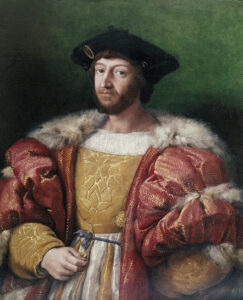
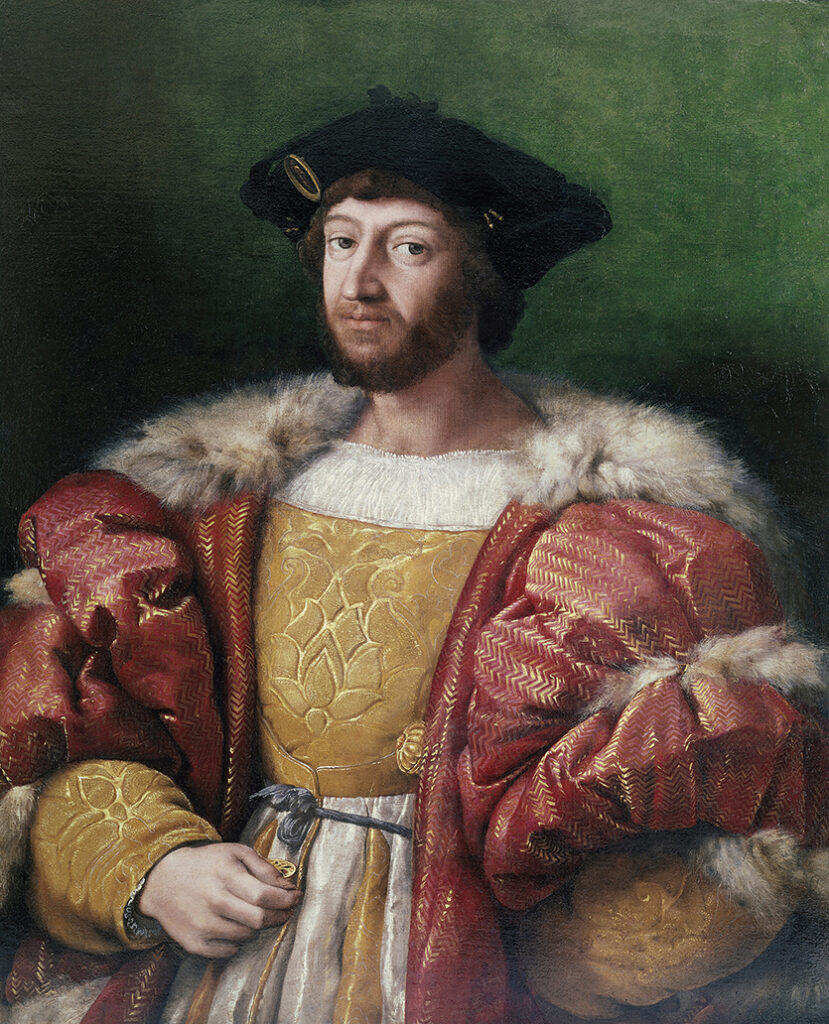
Raphael (Raffaello Sanzio or Santi), Lorenzo de’ Medici, Duke of Urbino, 1518, oil on canvas, 38 1⁄4 x 31 1⁄4 in.
Private Collection, Image: Private Collection/Bridgeman Images
The show’s second section focuses on the Medici popes and the seats of power the family held in the Catholic Church in Rome. Raphael’s Lorenzo de’ Medici, Duke of Urbino (1518, oil on canvas) finds pride of place here. The sumptuous portrait depicts Lorenzo, the de facto leader of the republic in the late 15th century, in a Roman style. Raphael lavishes detail on the tactile quality of the luxurious fabrics Lorenzo wears. The third section, dedicated to Cosimo and his ducal family, features artworks that convey the authority of the ruler’s dynasty as well as a sense of cultural refinement. Here are Bronzino’s portraits of Cosimo’s children (like the intense Francesco de’ Medici painted circa 1551), and a red velvet dress worn by his wife, Eleonora di Toledo (on loan from the Museo Nazionale di Palazzo Reale in Pisa).
Cosimo established the Accademia Fiorentina, a literary institution, in 1542, and in general fostered an unprecedented kinship between letters in the arts during his reign. “A Poetics of Portraiture,” the exhibition’s fourth section, emphasizes this connection in Florentine portraiture. Francesco Salviati’s Carlo Rimbotti (probably 1548, oil on wood), showcases a popular convention of the day—a sitter portrayed holding a small volume of poetry. Rimbotti was a medical doctor and member of the Accademia Fiorentina, who participated in readings of Petrarch at the literary establishment.
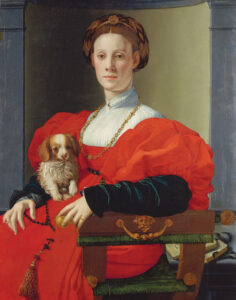
Portrait of a Woman with a Lapdog, ca. 1532-33, oil on panel, 35 3⁄8 x 27 3⁄4 in.
Städel Museum, Frankfurt, Image: © Städel Museum, Frankfurt am Main
Bronzino’s portrait of the poet Laura Battiferri (circa 1560, oil on panel), on loan from the Palazzo Vecchio in Florence, is in the show’s fifth section, “Cosimo and the Politics of Culture.” Battiferri participated in a three-way exchange of sonnets with Bronzino and Antonfrancesco Grazzini (Il Lasca). Bronzino painted his correspondent in profile as a female Dante, fingering a book of sonnets by Petrarch. Also on view are a manuscript of the verses the two poets traded and a copy of Vasari’s Lives of the Artists, which is dedicated to Cosimo. The influential book is seen in this context as an advantageous piece of propaganda that abetted Cosimo’s agenda to make Florence the center and standard of Renaissance art.
The show’s last section is a juxtaposition between Bronzino and Salviati. Though the two artists worked simultaneously on the Palazzo Vecchio, the seat of the old republic that Cosimo transformed into his home, they represent two divergent styles. Bronzino, who utilized a distinctly Florentine literary and artistic language, became the pet portraitist of the ruling elite. Conversely, Salviati was a Mannerist painter with a pan-Italian style. The show concludes with Salviati’s Bindo Altoviti (circa 1545, oil on marble), a powerful portrait of a Florentine banker and patron. Aspects of the painting have troubled attribution over the years: it bears both Venetian influence and a piercing naturalism that has led some scholars to attribute it to a northern European artist, while its stereometric proportions seem endemic to Florence or Rome. Altoviti, a powerful figure in Florence, was one of the most significant opponents of Cosimo’s rule. Like Cosimo, he depended heavily on art in his program of social and political self-promotion. Altoviti was painted by Raphael as a young man and was close with Michelangelo (another opponent of Cosimo’s reign). He supported Salviati, as well as Vasari, Cellini, Jacopino del Conte, and others. Salviati painted this portrait on marble (a skill he learned in Rome) as a reference to imperial Rome and the stalwart permanence of stone. The bearded velvet-and fur-clad sitter appears to cast a scathing eye off into the distance, as if to acknowledge that the Medicis weren’t the only heavyweights in the territory.

Subscribe to Art & Antiques for your Digital or Print copy