Subscribe to Our Newsletter
Life Out Loud
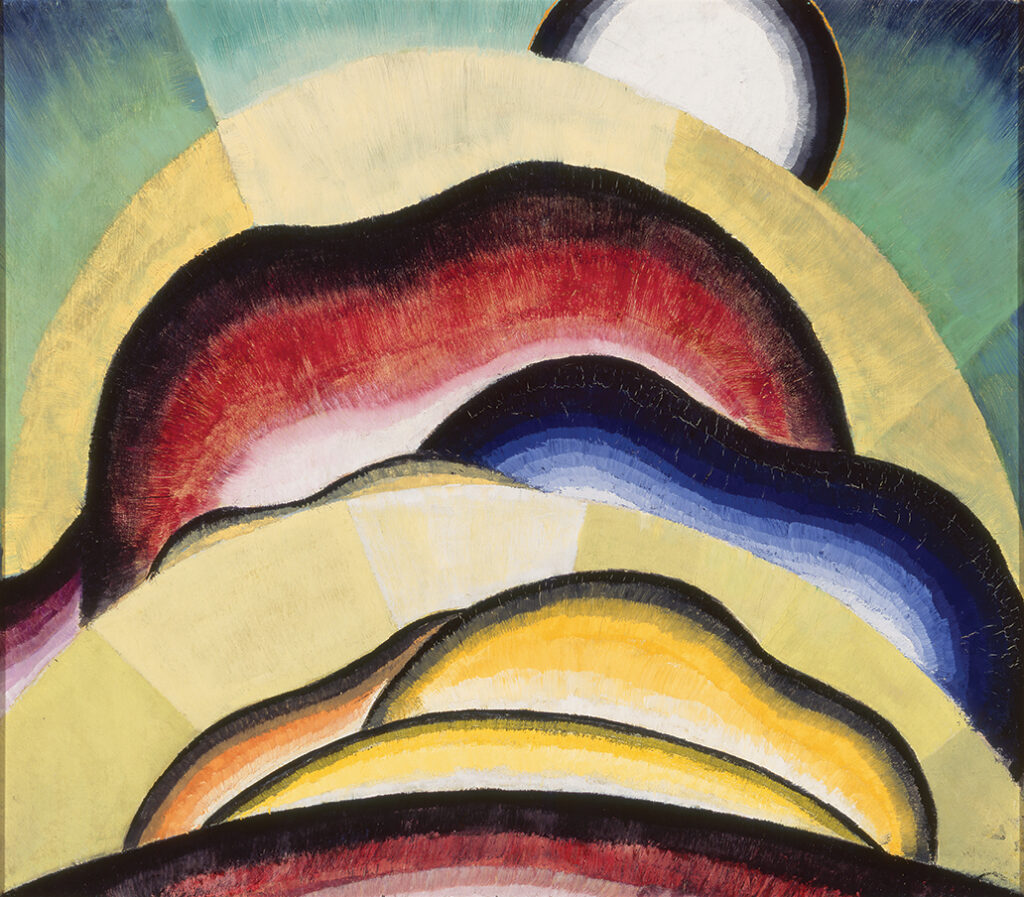
Arthur Dove, a pioneer of abstract painting, eschewed theories and dogmas, intent on
representing the forms and forces of nature in his art.
By John Dorfman
The inception of abstract painting was such a watershed in the history of art, such a transformative change, that historians are inevitably drawn to the question of who did it first. Ultimately, it doesn’t matter, because abstraction was simply “in the air” as the 19th century turned into the 20th, and the more interesting question is why that was so, which cultural forces coalesced so as to make it suddenly seem plausible that art could be art without depicting any of the objects that art traditionally depicted. In this quest, thoughtful examination of the works of the first abstractionists, different as they were in their aims, thoughts, and personalities, is essential.
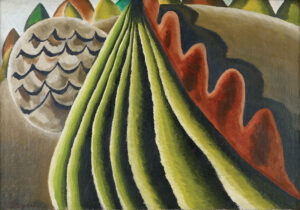
Arthur Dove, Fields of Grain as Seen from Train, 1931, oil on canvas; 24 x 34 1⁄8 in.¬¬
Collection Albright-Knox Art Gallery, Buffalo, New York; Gift of Seymour H. Knox, Jr., 1958 (K1958:1). Photo: Tom Loonan and Brenda Bieger for Albright-Knox Art Gallery, Buffalo, New York
One of those who deserve such examination is the American painter Arthur Dove. A modest and quiet man, not given to controversies and manifestoes, Dove tends to get less attention than fellow pioneers of abstraction such as Vasily Kandinsky, Frantisek Kupka, Robert Delaunay, Kazimir Malevich, and Hilma af Klint. His career unfolded almost entirely in this country, and as a result he had little direct interaction with the European avant-garde. He was neither a mystical theorist like Kandinsky nor a spiritualist like af Klint, and while his work is very much a part of modernism, Dove was also rooted in the American tradition of Romantic landscape. On the whole it can be said that he felt, rather than thought, his way toward abstraction.
Not all of Dove’s work is strictly speaking abstract. He began his fine-art work in 1907 (having previously worked as a commercial illustrator) with a figurative style strongly indebted to Post-Impressionism, and even after his leap into abstraction in 1910–11, he continued to allude—or more than allude—to figuration throughout his career, in varying degrees. His oeuvre is full of abstracted or symbolic versions of the sun and moon, as well as imagery derived from plant life and other elements of nature and even at times from the industrialized landscape. While some of the European painters as well as certain critics declared figuration a sin or at least an artistic dead end, Dove refused to limit himself to any such doctrine. “Theories have been outgrown,” he wrote in the notes to an early exhibition of his, “the means is disappearing, the reality of the sensation alone remains. It is that in its essence which I wish to set down. … My wish is … not to revolutionize nor to reform, but to enjoy life out loud.”
While many of his fellow pioneers of abstraction called their work “non-objective” and believed that it led the viewer into a spiritual realm beyond matter and the senses, Dove embraced physicality. He wanted, for example, to paint the patterns and forces that underlie the growth of plants, depicting nature symbolically rather than literally. And he was always preoccupied with “the complexity of the structure of light,” as the art historian and curator Debra Bricker Balken has expressed it. His unique way of layering semi-transparent colors and combining murky and luminescent elements testifies to his passion for optics as well as his attunement to the subtlest emotional effects of light. As Balken writes in her essay in the catalogue for the Dove retrospective in 1997–98 that was organized by the Addison Gallery at Phillips Academy in Andover, Mass., and the Phillips Collection in Washington, D.C., the artist’s “underlying impetus to capture ‘the sensations of light from within and without,’ as he put it, derives less from a metaphysical experience of nature than from a highly sensuous and quasi-scientific yearning to record its numerous optical effects.” There is a fascinating dichotomy in Dove—both sensuous and scientific, both Romantic and formalist. While he claimed that he simply wanted to enjoy life and make art without theorizing, he was well read and well aware of the critical and theoretical discourse that was buzzing through the journals and little magazines in the early 20th century. Formal rigor was very important to him, as was close, even technical, analysis of nature’s forms.
While there has not been a comprehensive Dove exhibition since 1998, a major event in Dove scholarship and appreciation has just occurred—the publication of his catalogue raisonné in 2021. Arthur Dove: A Catalogue Raisonné of Paintings and Things, authored by Balken, who directed the project, is available through Yale University Press. Richer in content than the usual catalogue raisonné, this massive volume is extensively illustrated in full color and features an essay by Balken on the critical reception of Dove’s work, as well as shorter pieces discussing some of the most important artworks.
Sunrise, 1924, oil on wood, 18 1/4 x 20 7/8 in.
Milwaukee Art Museum, Gift of Mrs. Edward R. Wehr M1960.32 Photographer credit: John Nienhuis, Dedra Walls © The Estate of Arthur G. Dove, courtesy Terry Dintenfass, Inc.
Arthur Garfield Dove was born in 1880 and raised in the upstate New York town of Geneva, where his father was a brick manufacturer. A large commercial building in Geneva’s downtown, known as the Dove Block, testifies to the family’s one-time prosperity and influence. (The Dove Block, where Arthur Dove briefly lived and worked in the late 1930s, is now the object of a restoration effort intended not only to save the structure but to commemorate the artist.) When he was just five years old, Dove became friends with a local farmer and amateur painter named Newton Weatherly, who lived across the street from the Dove family. Weatherly proved seminal for Dove’s development, introducing him to the study of and reverence for nature, as expressed through hiking, hunting, fishing, and painting. Dove, whose father intended him for a conventional business career and strongly disapproved of his son’s artistic ambitions, throughout his life had a strong need for father figures. He found one in Alfred Stieglitz, a long-term mentor who showed his work in his galleries and promoted it in his publications, but the prototype was Weatherly, whom Dove considered one of the four “great ones”—the others being Stieglitz, Albert Einstein (whom he never met but yearned to), and Jesus Christ.
In 1901, after two years at Hobart College in Geneva, Dove entered Cornell University, pressured by his father into majoring in pre-law. Soon, however, he was taking art classes at Cornell’s School of Mechanical Engineering, where his teacher was Charles Wellington Furlong, a naturalist and explorer in the vein of Weatherly. He encouraged Dove to pursue a career as an illustrator, and upon graduation in 1903, Dove took up the suggestion and moved to New York City. Soon he was getting work from magazines such as Century, Cosmopolitan, McClure’s, and Scribner’s, drawing in a style influenced by Charles Dana Gibson and the poster artist Edward Penfield. In 1904 he married a woman he had known from Geneva, Florence Dorsey.
In 1906, Dove met the artists Robert Henri, John Sloan, and William Glackens, who encouraged him to paint and not limit himself to commercial illustration. With new enthusiasm and self-confidence, Dove and Florence moved to France for over a year during 1908–09. There he painted in the countryside and met a number of artists, nearly all of whom were American expats like himself—Arthur B. Carles, Max Weber, and Patrick Henry Bruce, among others. While his painting skills developed during this French interlude, the trip ended up having surprisingly little impact on Dove’s aesthetic. He did, however, exhibit a painting in the Salon d’Automne in Paris, a still life titled The Lobster.
Much more influential was his meeting with Alfred Stieglitz, which took place in either late 1909 or early 1910, at the introduction of their mutual friend, the painter Alfred Maurer. Stieglitz, who had started out as a photographer and an advocate for new trends in photography, had become interested in promoting avant-garde art in other media, and his gallery at 291 Fifth Avenue, known simply as “291,” was a Mecca for modernists. Stieglitz included The Lobster in a group show called “Young American Painters,” kicking off Dove’s career. By the time Stieglitz gave Dove his first solo show, in February and March 1912, Dove had been working in pastels for a year and had completely changed his style. Indeed, he had transformed himself virtually overnight into an abstract artist.
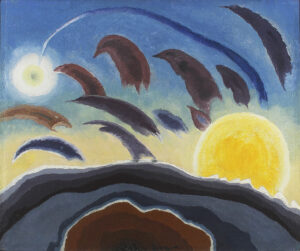
Sun and Moon, 1932, oil on canvas, 18 1⁄4 x 22 in.
Private Collection, Courtesy Alexandre Gallery, New York
The 10 pastels in the show, known as the “Ten Commandments,” were inspired by nature, and in fact were titled Nature Symbolized by the artist. While small in scale, they were large in impact, and if one is playing the game of “who came first,” they have a strong claim to be the first abstract paintings made by an American; the Synchromists Stanton Macdonald-Wright and Morgan Russell made their breakthrough about a year later. In any case, the critics were mainly baffled or disdainful, while Stieglitz was delighted to have discovered an artist who bolstered his assertion that America was just as innovative as Europe, if not more so. The show got a better critical reception when it traveled to the Thurber Gallery, in Chicago, where Dove soon picked up his first major collector, Arthur Jerome Eddy.
Strangely, instead of building on the momentum of this radical maiden exhibition, after 1912 Dove went into a sort of abeyance. He did not exhibit at the 1913 Armory Show and until 1921 worked mainly in charcoal and in a less abstract manner, while living in Westport, Conn., and trying to eke out a living from farming. In 1918 he gave up farming and went back to illustration to make money. He seems to have had second thoughts or a kind of reluctance about abstraction, and re-immersed himself in nature to seek inspiration and renewal. Maintaining his warm relationship with Stieglitz, he also associated with a group of creative people in Westport that included the writers Sherwood Anderson, Van Wyck Brooks, and Paul Rosenfeld and the artists John Marin and Paul Strand.
In 1921, Dove met a fellow artist in Westport, Helen Torr, known as “Reds” for the color of her hair, and fell in love with her. Florence had long been unsympathetic to Dove’s artistic experiments and lifestyle, and Torr was unhappily married to an illustrator, Clive Weed. She and Dove left their spouses for each other and left Westport to live on a houseboat moored in the Harlem River in New York, followed by seven years living on a sailboat that they sailed up and down the north shore of Long Island. Amid the acrimony following the split, Florence Dove refused to give her husband a divorce or to let him see his son, from whom he would remain separated for eight years. Energized and inspired by the new relationship, Dove began to paint in earnest again, and found a patron in the Washington, D.C., collector Duncan Phillips. However, financial troubles continued, and poverty and hardship would accompany him throughout the rest of his life.
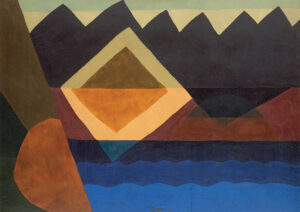
Square on the Pond, 1942, wax-based paint on canvas, 20 x 28 in.
Museum of Fine Arts, Boston, Gift of William H. and Saundra B. Lane and Henry H. and Zoe Oliver Sherman Fund, M. Theresa B. Hopkins Fund, Seth K. Sweetser Fund, Robert Jordan Fund and Museum purchase © Estate of Arthur G. Dove, Photograph © Museum of Fine Arts, Boston
The decade of the 1920s was a time of artistic byways and even meanderings for Dove. He explored different media, most notably assemblage or what he called his “things.” These were framed yet three-dimensional constructions made from everyday objects and had a narrative element—for example, a 1925 piece consisting of a blue denim shirt juxtaposed with pieces of a bamboo fishing rod and titled Goin’ Fishin’. These works owe something to Dada collage but without its subversive irony. The ’20s also saw Dove becoming passionately interested in music, especially jazz, and attempting to convey it in his paintings, some of which he titled with the names of musicians such as George Gershwin, Irving Berlin, and Louis Armstrong. In this endeavor he was in line with the efforts of other abstract artists, most notably Kandinsky and the Synchromists, to equate abstract art with music or at least to make them commensurate with each other.
With the death of Dove’s mother in 1933, a major change came about in his life. He moved back to Geneva with Torr to live, once again, in the family house. While he dreaded Geneva in certain ways due to family strains, he reconnected with his original art teacher and fishing companion Newton Weatherly, now 89 years old, and explored the landscape he had loved as a child. He and Torr stayed five years in Geneva, the last of which was spent living on the third floor of the Dove Block, the largest studio space the artist would ever have. In 1938, again feeling stifled by upstate New York, the couple returned to Long Island’s north shore, this time settling in a tiny cottage in the town of Centerport, where Dove spent the last decade of his life, a time marked by illness and debility as well as by a second great flowering of creativity.
The paintings that Dove made between 1938 and the year of his death, 1946, are an example of the phenomenon of “late work” among artists. Dove burst forth into a visionary level of achievement just as his physical powers were failing him. Still focused on nature as their source, his paintings from this period are a return to abstraction, suffused with a new luminescence as well as new formal experiments such as spirals and geometric shapes of greater regularity than the more biomorphic ones of his earlier work. These final works have a quality of triumphant simplicity and serenity, a completeness that bespeaks an artist who has fully realized himself. After a life of restlessly moving about and searching for direction, struggling against poverty and self-doubt, Dove emerged glowing as brightly as the suns that burst through so many of his late paintings. His life, truly lived out loud, reached fulfillment just before its end.

Subscribe to Art & Antiques for your Digital or Print copy