Subscribe to Our Newsletter
The Superb City
The Italian port city of Genoa, rich from trade and finance, played host to a century and half’s worth of Baroque art creativity.
By John Dorfman
The art of Genoa has been a well-kept secret. Many of the greatest works are in palazzi and villas, in the form of frescoes created for private enjoyment. Most of the scholarship about Genoese art has been carried out by local academics without worldwide reach, and there have been few exhibitions outside Genoa itself. So outsiders can’t exactly be blamed for failing to appreciate the fact that from around 1600 to 1750, this port city on Italy’s west coast was one of the creative powerhouses of the Italian Baroque, ranking with the far larger cities of Rome, Naples, and Bologna.
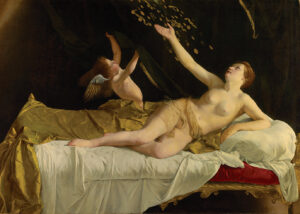
Orazio Gentileschi, Danaë and the Shower of Gold, oil on canvas, overall: 63 9⁄16 x 89 7⁄16 in., framed: 79 1⁄4 x 10⁴ 7⁄8 x 3 3⁄4 in.
The J. Paul Getty Museum, Los Angeles, Digital image courtesy of the Getty’s Open Content Program
Not since 1992 has there been a comprehensive museum exhibition dedicated to Genoese Baroque art, and in the U.S., never. However, American viewers are about to get an unprecedented opportunity to experience its glories. From September 26 through January 9, “A Superb Baroque: Art in Genoa, 1600–1750” will be on view at the National Gallery of Art in Washington, D.C. Organized by the National Gallery of Art and the Scuderie del Quirinale, Rome, with special cooperation from the City and Museums of Genoa, the exhibition is curated by Jonathan Bober, Andrew W. Mellon Senior Curator of Prints and Drawings, National Gallery of Art; Piero Boccardo, Superintendent of the City Collections of Genoa; and Franco Boggero, director, historic and artistic heritage section, Soprintendenza Archeologia, Belle Arti e Paesaggio, Genoa. After its run in Washington, “A Superb Baroque” will go on view in the Scuderie del Quirinale from March 4 through June 19, 2022.
On the principle that geography is destiny, it can be said that the unique qualities of Genoese art have a great deal to do with the unique nature of Genoa itself. On the land-facing side, the city is backed up against a range of mountains, which limited its level of intercourse with the rest of Italy. In the other direction, looking out to sea, Genoa has access to the rest of the world, which led to its becoming a major center for international trade and, eventually, international finance. An independent republic since 1528, when the admiral and soldier Andrea Doria drove out the French, Genoa developed a trading empire that spanned the Black Sea to the Netherlands, and its Casa di San Giorgio was the first public bank in Italy. As early as the 14th century, the poet Petrarch called Genoa “superb,” and the epithet “La Superba” has clung to it ever since—thus the title of the present exhibition. The city’s merchant and banking fortunes not only financed the patronage of art, but they also attracted a roster of foreign-born talent. Beginning with Peter Paul Rubens, who never lived in Genoa but executed commissions there and visited frequently between 1604 and 1607, Northern European artists were active and influential in Genoa, lending an international air to the art scene. In this cosmopolitan aspect of Genoese culture, the curators of the National Gallery exhibition see some parallels to the modern art of another great port city: “Incessant and reciprocal, their traffic in Genoa between 1600 and 1750 make the city’s culture resemble that of New York of the mid-twentieth century more than Renaissance Florence or even Paris of the eighteenth century. Though an extreme case relative to its time, the Genoese baroque encourages questioning of that presupposition of the canon: that artistic creativity, born of certain times and places, proceeds outward, ripples from a splash.”
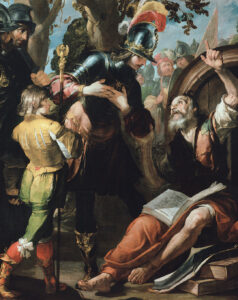
Gioacchino Assereto, Alexander and Diogenes, 1626/1628 oil on canvas; overall: 71 x 58 1⁄2 in., framed: 79 15⁄16 x 67 13⁄16 in.
Gemäldegalerie, Staatliche Museen zu Berlin bpk Bildagentur / Gemaldegalerie / Joerg P. Anders / Art Resource, NY
Ever since the late Middle Ages, the arts in Genoa had been strongly influenced by so-called forestieri (foreigners), a term that could be applied equally well to an Italian from outside the republic as to someone from outside Italy entirely. Local artists absorbed the styles of the forestieri and synthesized them over time into something recognizably Genoese. The greatest of the forestieri, at least as far as the Baroque era is concerned, was undoubtedly Rubens. Among his works in the National Gallery show is a magnificent equestrian portrait of Giovan Carlo Doria, son of the doge (ruler) of Genoa and a major collector and art patron in the city. The decision to represent Giovan Carlo on horseback was a bold one, considering that horseback portraiture was generally reserved for royalty and at the time the man did not even possess an official noble title, despite his family background. Nonetheless, Rubens went all the way with this concept, depicting both rider and horse looking directly at the viewer, seeming to leap out of the picture plane. In the dramatic chiaroscuro of this painting, the whiteness of the horse and of Doria’s face emerge glowing from the blackness of the background and of the rider’s clothing. The red sash and red sigil on Doria’s chest add a further note of contrast. Every detail of the painting has symbolic meaning, from the dog cavorting beneath the horse’s hooves (Doria’s loyalty to the king) to an oak tree (strength) to the eagle perched on a branch of the oak (the emblem of the Dorias).
Anthony van Dyck was another Flemish master who gravitated to Genoa for the patronage. His 1621 portrait of Agostino Pallavicino marks the beginning of his career in Italy, and it is a powerful announcement of a new talent. Van Dyck depicts the nobleman in the red robe he was entitled to as ambassador to the Vatican. The rich color pops against the brownish background, kept muted to accentuate the subject, and the artist lavished all his skill on the intricate folds of the drapery. Pallavicino’s face gazes out, reflecting intelligence, sobriety, and calm judgment befitting a diplomat.
An Italian “foreigner” whose work is on view in “Superb Baroque” is Orazio Gentileschi, the Tuscan-born Roman painter who today is as famous for being the father of Artemisia Gentileschi as for his own work. He was recruited to Genoa by the son of the doge Lorenzo Sauli and arrived in 1621 in Genoa, where he would spend four years before moving to France. A mythological canvas of his, Danaë and the Shower of Gold (1625), once adorned a Sauli palace in Genoa; recently, it was in the collection of the American art dealer Richard Feigen. In 2016, it was purchased at auction by the Getty Museum in Los Angeles, which loaned it to the present exhibition. Gentileschi renders this sensual story from Ovid’s Metamorphoses with a crisp classicism. The flesh of Danaë and the little cupid alike is cool and almost marmoreal, contrasting nicely with the yellow-gold of the drapery. This hue, meantime, harmonizes with the actual gold sailing through the air, a form taken by Zeus as he impregnates the princess. Gentileschi takes a rather literal approach to depicting the shower of gold; he shows us actual coins and shavings of gold leaf, which he perhaps supposed would be congenial to the banking and merchant elite of La Superba.
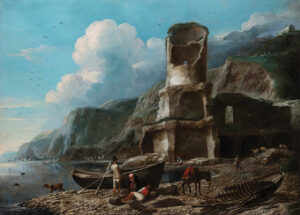
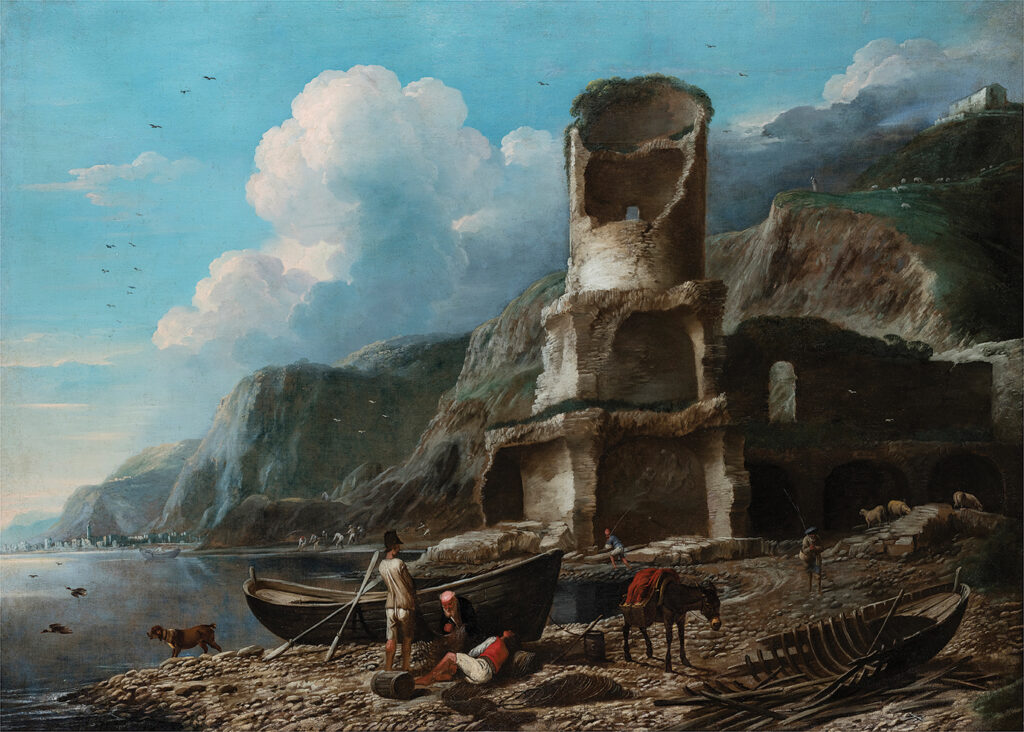
Antonio Travi, Shore with Fisherman and Ruined Tower, 1650/1655, oil on canvas, overall: 49 3⁄16 x 69 11⁄16 in., framed: 59 7⁄16 x 79 15⁄16 x 3 9⁄16 in.
Private collection
Another scene from Ovid is depicted in Sinibaldo Scorza’s Orpheus Charming the Animals (1621), a large pen and brown ink drawing that emulates the style of Northern printmaking. The inscription and date at the bottom indicate that this was not a preparatory drawing for a painting but an independent work. Its quality, finish, and rich detail justify that status: Orpheus, a serene expression on his face, sits on a rock playing the viola as a cat and a monkey look on, seated next to him. The whole picture frame is densely packed with various species of animals and birds, from the small to the very large—a huge draft horse and an even huger ostrich dominate the foreground toward the right. While Orpheus is at the center of the composition, he is seemingly overwhelmed by the profusion of nature, just as they are overwhelmed by the magical power of his melody.
A work closer to home is Antonio Travi’s Shore With Fishermen and Ruined Tower (1650/1655), which instead of imagined scenes from Classical myth shows us a scene from contemporary reality—specifically, a stretch of the Ligurian shore near Genoa. The ruined tower conforms to the fashion for picturesque decay, and the smallness of the figures serves to accentuate both the ruins and the natural elements of mountains and water. The effect is almost proto-Romantic, and Travi’s painting was certainly ahead of its time.
One of the greatest of the non-foreigners was the Genoese painter Bernardo Strozzi, who had been Travi’s teacher. Originally he was a Franciscan friar, and in 1625 he was put on trial for painting works that supposedly conflicted with the dignity and sanctity of his priestly office. One of those, most likely, was The Cook (circa 1625), which depicts a woman surrounded by dead birds, one of which she is plucking, a caldron boiling above a fire, and an elaborately decorated silver ewer. The incongruity of the ewer is a hint that the painting is in code. It can be read as a depiction of the four elements—fire (itself), water (in the ewer), air (the birds), and earth (the earthy cook, or rather serving-woman, herself). The mixture of humor, genre, and esoteric allegory was to the taste of Giovan Carlo Doria, Strozzi’s patron. The fact that Doria, Strozzi’s protector, died before the painting could be finished may have had something to do with the fact that the painter was hauled up on charges of indecency. The trial did not derail Strozzi’s career, and his bravura paint handling earned him many more commissions.
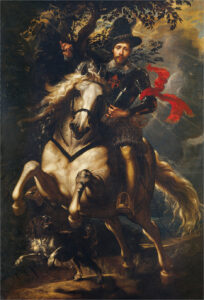
Peter Paul Rubens, Giovan Carlo Doria, 1606, oil on canvas, overall: 104 5/16 x 74 in., framed: 115 3/8 x 81 7/8 x 5 1⁄2 in.
Galleria Nazionale della Liguria a Palazzo Spinola, Genoa Scala / Ministero per i Beni e le Attività culturali / Art Resource, NY
The art of sculpture flowered somewhat later than that of painting in Genoa. Among the standouts in the exhibition is The Virgin of the Immaculate Conception (1669–70), by the French-born artist Pierre Puget. Commissioned for private devotion by Stefano Lomellini, it was designed to be mounted on an altar in Lomellini’s personal chapel. The Virgin, seemingly lost in contemplation, is borne aloft by angels, her billowing drapery conveying a sense of motion. The dramatic modeling, softness, and spiritual aura of this work make it one of the very greatest of Genoese Baroque sculptures.
The arts of metalwork were highly esteemed and fully developed in 17th-century Genoa. A notable example in “Superb Baroque” is a silver basin depicting the departure for America of Christopher Columbus, one of Genoa’s favorite sons. Made by the Flemish silversmith Matthias Melijn around 1630, it depicts Columbus leaving from the Andalusian port of Palos de la Frontera for his first voyage to the New World. It was commissioned by none other than Agostino Pallavicino, the ambassador, and was part of a series of ceremonial silver commissions. The intricate details of the pictorial decoration indicate that they were made from a drawing, and indeed, the design on the basin is very similar to a drawing made by the artist Lazzaro Tavarone for a fresco cycle depicting Columbus’ exploits, in the Palazzo Belimbau in Genoa.
“Superb Baroque” closes with a remarkable, elaborate landscape painting, Garden Party in Albaro (1745/1749), by Alessandro Magnasco. It depicts a walled terrace within a garden, with the city of Genoa visible in the distance. The figures are lively, but the celebration seems a bit shabby, the immediate surroundings somewhat decayed. The city of Genoa, however, endures. “Recognized as a masterpiece since shortly after it entered the city’s collections in the Palazzo Bianco,” the catalogue essay states, “ the painting rivals those of Watteau as an image of a passing age and as enduring poetry.”

Subscribe to Art & Antiques for your Digital or Print copy