Subscribe to Our Newsletter
The Haunted
The impact of ghosts and the spirit world on American art is explored in depth in a highly unusual museum exhibition
By John Dorfman
The United States has the reputation of being a hard-headedly rationalistic, materialistic nation, but in fact, Americans have been ghost-obsessed from colonial days down to the present time. The harsh conditions faced by the early settlers, the frequent violence of their lives, and the rugged landscapes that surrounded them combined to create of sense of being haunted. The Puritan religion, with its emphasis on sin and punishment, brought the other world shudderingly close to its adherents. In later times, the supernatural stream was more likely to run underground, but it was always there, bubbling beneath the surface. In the middle of the 19th century, America gave the world Spiritualism, a mass movement dedicated to making contact with the souls of the dead. In the 20th century, interest in Spiritualism persisted, bolstered by the tremendous grief of the world wars, joined by new otherworldly pursuits such as ESP research, astrology, the occult, and the New Age.
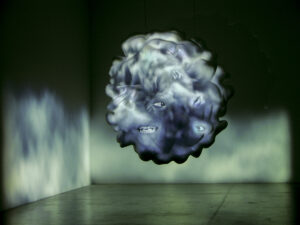
Tony Oursler, Dust, from Thought Forms, 2006, fiberglass sculpture, Haron Kardon HS100 5.1 sound system, Sony XGA VPL-PX41 projector, 2 Sanyo PLC-XU48 projectors, 3 DVD players, 6 DVDs, and 3 master tapes, 72 × 72 × 72 in.
The Broad Art Foundation, Los Angeles CA, F-Ours-1S06.05 Photo: Courtesy Tony Oursler, © Tony Oursler
That all these phenomena are present in American art should come as no surprise, even if their presence remains—perhaps appropriately—somewhat subliminal and often overlooked. It is the ambition of Robert Cozzolino, curator of paintings at the Minneapolis Institute of Art (Mia), to make sure that they are overlooked no longer, and to that end he has organized a large-scale exhibition that pulls the black velvet curtain aside to reveal the tendrils of ectoplasm that drift through our art history. “Supernatural America: The Paranormal in American Art” is touring the country and opens October 7—right in time for Halloween—at the Speed Art Museum in Louisville, Ky. (through January 2, 2022), after a run at the Toledo Museum of Art in the summer. Finally, it will be on view at Mia from February 19 through May 15, 2022.
Cozzolino has been dubbed “the curator of the dispossessed” because of his championing of artists from outside the mainstream, and his interests have led him far afield from the usual museum fare. In 2014, he organized a major exhibition dedicated to the visual art of David Lynch—himself a connoisseur, if ever there was, of the weird traces beneath the surfaces of American life. In “Supernatural America,” Cozzolino makes no distinction between outsider and insider art; what concerns him is the artist’s sensitivity to spiritual influences. As he puts it in an essay in the exhibition catalogue, “Nearly all the objects selected for ‘Supernatural America’ are either by artists who described their supernatural encounters, were mediums and practitioners, or made images based on the anomalous experiences of intimates. Historical archives and interviews confirmed their relationship to this material; living artists discussed it with me. Ghosts, interplanetary visitors, and interdimensional worlds are rarely metaphors in this work—although they can be both real and representative of larger ideas. They are based on the artists’ personal relationship to Spiritualism, haunting, visitation, clairvoyance, trance states, and magic.” Visitors to the Speed, or to Mia later on, should, therefore, be aware that this is no ordinary museum show. Here we are dealing with artists who believed themselves to be in actual contact with the other world and brought back what they believed to be testimony of such encounters. On the walls of “Supernatural America,” one can see artworks credited to “Frances Haines McVey and William Blake (Spirit)” and “Agatha Wojciechowsky and Spirits.”
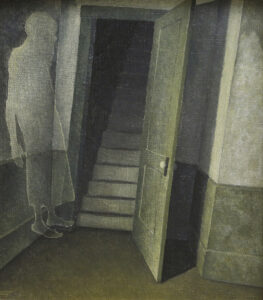
Marvin Cone, Anniversary, 1938, oil on canvas, 18 x 16 in.
Museum purchase, Art Advancement Fund with gift of Winnifred Cone, 82.10.3 Cedar Rapids Museum of Art, Cedar Rapids, IA
Cozzolino has really made a deep study of these spiritualist-medium artists, and his catalogue essay on the subject contains a wealth of detail about the lives of these little-known artists and the worlds they moved in. Frances McVey, whose “life has yet to be fully reconstructed,” “may have studied” at the school of the Art Institute of Chicago in the 1920s. A self-portrait from around 1950 depicts her as a confident, modern woman in a red beret, holding a paintbrush in one hand. By this time she was living at Camp Chesterfield, a Spiritualist settlement in Indiana (which has been the frequent target of investigative debunkers over the years), making automatic paintings that she believed to be guided by spirits—in particular, great creative spirits of the past. Edouard Manet made appearances, but the poet and artist William Blake was McVey’s most frequent contact. The works she made “with” him are generally black and white drawings that depict the journey of a soul to heaven in the form of an undulating line, on which are written words that purport to be Blake’s, heard by the artist in a trance state. McVey, writes Cozzolino, “had one foot in the art world and another on the astral plane.”
Wojciechowsky, on the other hand, was a simple German immigrant who worked as a house cleaner and never had any intention of belonging to the art world but ended up in it anyway. She had been a medium for a long time before discovering her ability at automatic writing and then automatic painting. Starting in the 1960s, she produced works in a styles as numerous as the spirits who guided her. An untitled work from 1963, on view in “Supernatural America,” covers the canvas with waving electric colors in abstract patterns, out of which human faces peer; these are supposedly portrayals of spirits in the afterlife. In the 1960s, the artist Richard Lindner became intrigued by Wojciechowsky and introduced her to the gallerist Daniel Cordier, who showed her work in his gallery on several occasions. Despite this recognition, Wojciechowsky claimed no personal credit for her work, insisting that it was the spirits who made the art using her hands.
While these were basically outsider artists, many of the artists featured in “Supernatural America” are bona fide members of the mainstream. Ivan Albright, an American modernist, is well known for his intricately eerie and dark works of figurative art. In the 1930s, he speculated about ghosts, asking himself in a diary entry, “Are there bodies you can’t see and yet feel?” Albright’s daughter recalled that he channeled spirits and spoke with his twin brother via mental telepathy. In the Albright family, she said, “the paranormal was considered normal.” Other artists in the show are associated with Surrealism, a movement that was a major nexus for the importation of occult ideas and practices into the modernist art world. Like McVey and Wojciechowsky, the Surrealists in both Europe and America practiced automatic writing and drawing, but even when they weren’t, their art frequently depicted otherworldly scenes, or scenes of this world as seen by eyes more accustomed to the other. Gertrude Abercrombie was a bohemian Chicago artist and jazz enthusiast who painted eerie Surreal works in an extremely precise, hard-edged style. She conceived of herself as a witch and often depicted herself in that guise, usually in the company of cats and owls, in eerie settings. Her Strange Shadows (Shadow and Substance), from 1950, deals in many of the classic Surrealist tropes—the uncanny double, the foreboding clock, flesh depicted in a deathly color, the cramped and geometrically ambiguous stage set. In Search for Rest (1951), the Abercrombie-witch figure strides across a blasted landscape in which distant trees seems to become ghostly human figures, as the moon sheds its silver light on a lone tree. Is the female protagonist haunted by these entities, or is she the one doing the haunting?
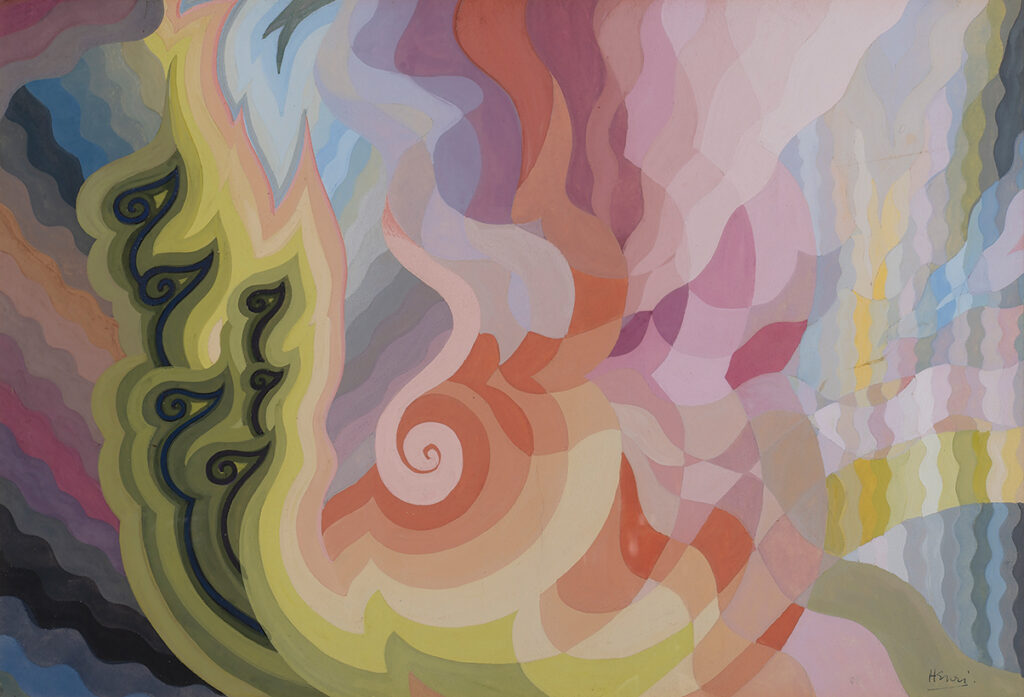
Henriette Reiss, Poem Symphonique: redemption Tone Poem, César Franck, ‘Temptation,’ 1937, tempera on paper mounted on board, 13 1⁄4 x 19 3⁄8 in.
Private Collection © The Reiss Partnership, Photo: © 2020 Georgia Landmann
Henriette Reiss was an English-born artist, textile and rug designer, and book and advertising designer who also had a career as an art teacher for teachers in the New York City public school system. She died in 1992 at the age of 103. Several paintings of hers are in “Supernatural America,” and they are striking abstractions of the “non-objective” school, titled after pieces of music by composers such as Frédéric Chopin and César Franck. Reiss’ works are right in line with the early-20th-century modernist project, spearheaded by Kandinsky, the Synchromists, and others, of exploring the regions where visual art and music overlap and resonate with each other. Her spirit communications, if such they were, were not dictations from dead people but transpersonal messages from the realm where pure color, form, and sound originate.
Some other work in the exhibition also come from established artists who were quite far from being mediums. John Quidor’s 1858 painting The Headless Horseman Pursuing Ichabod Crane gives vivid plastic expression to Washington Irving’s Halloween classic, The Legend of Sleepy Hollow. While obviously a piece of entertainment rather than an earnest dispatch from the mediumistic universe, Quidor’s composition manages to convey the shock and fear of a supernatural encounter, much as Irving does despite the humorous intention of his story. His effort is aided by his late-Romantic approach to the landscape, complete with “sublime” effects in the rugged mountains and forest and the bold use of light and shadow. Hiram Powers, the neoclassical sculptor, gives us Loulie’s Hand, an eerie rendering in marble of his little daughter Louisa’s hand, disembodied and laid on a lotus blossom. While she was very much alive at the time, the sculpture has a decidedly uncanny quality, as if it were of the hand of a ghost, and the whiteness of the marble strengthens that impression.
Ghosts can be interpreted as memories, hauntings from the past, and the American landscape and cityscape are full of uneasy memories. The artist Morris Kantor channeled some of these in his painting Haunted House (1930), based on an actual house in the ancient town of Marblehead, Mass. The cramped interior space with its odd angles and 18th-century decor would do plenty on their own to convey the presence of visitants from the past and the spirit world, but in from the window streams a dark cloud containing a cluster of miniature New England houses with lighted windows resembling eyes. During his visit to Marblehead (right near Salem of witch-trial fame), Kantor wrote, “The humble interior of the American farmhouse, old and quaint, with its peculiar moldy smell, the fading beauty of old plaster discolored by time . . . layers upon layers of wall paper, all turned my imagination to the past, to the people who had lived there and gone.”
As Cozzolino makes clear, many of the ghosts in America are spirits whose unrest is due to the fact that they died under unjust circumstances. For African American and Native American artists, the past is ever-present, imbued with a horror that will not die. For white America, the ghosts bring guilt, and memories of crimes committed in the name of slavery and westward expansion continue to haunt the nation. Contemporary artist John Jota Leaños made a digital animation and installation work titled Destinies Manifest (2017), in which he took a 19th-century popular image, a woman who personifies Manifest Destiny gliding over the American landscape, and transformed it into something both satirical and terrifying. The women is now a ghost-skeleton, her blond hair streaming from a skull face, and she walks across a desecrated landscape of malls and freeways.
One does not have to believe literally in hauntings and spirit guides to understand and appreciate the works on view in “Supernatural America.” The truth is, artists have always been sensitive to perceptions beyond those of the ordinary person, whatever one chooses to call them, so it is difficult to draw a line between “spiritualist” or “psychic” artists and artists full stop. Not only that, but avant-garde modernism of the early 20th century was very preoccupied with the spiritual quest, and its pioneering practitioners were just as eager as the mediums to access realms of experience beyond the norm. Some of them were even mediums themselves. In a way, art without ghosts is no art at all.

Subscribe to Art & Antiques for your Digital or Print copy