Subscribe to Our Newsletter
Portrait of the Artist as a CEO
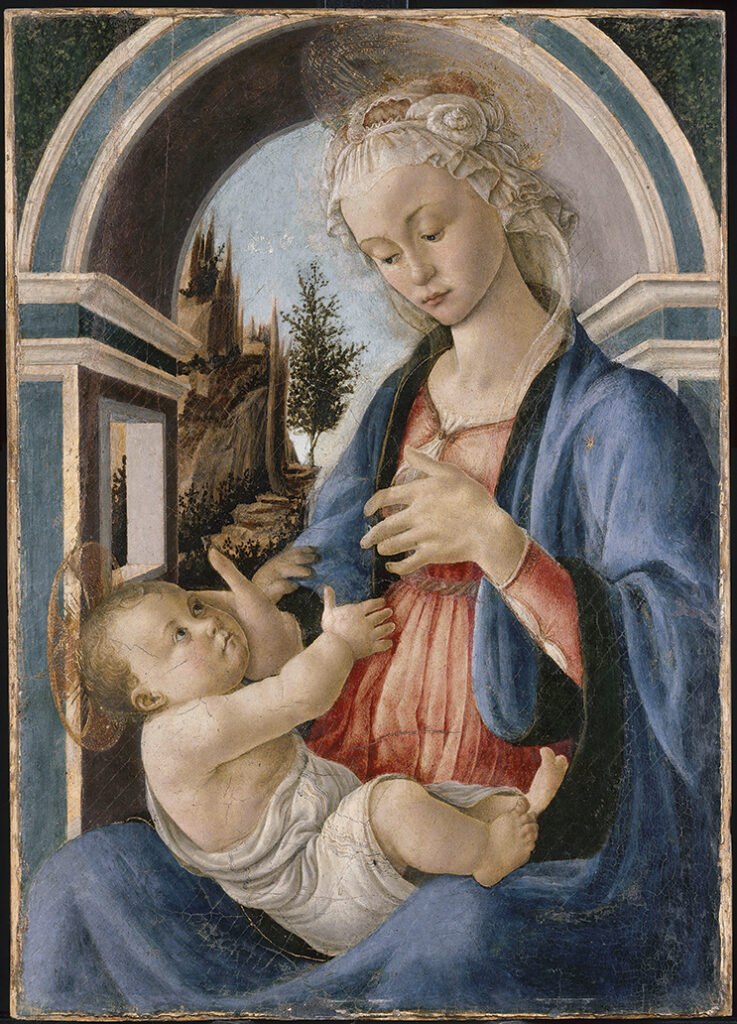
An exhibition in Paris puts a large number of Botticelli paintings on view and delves deeply into the Quattrocento artist’s role as master of a workshop.
By Sarah E. Fensom
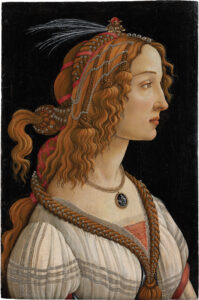
Allegorical figure, also known as La Bella Simonetta, circa 1485, tempera and oil on poplar wood, 81.8 x 54 cm.
Städel Museum, Frankfurt am Main, CC BY-SA 4.0; Musée du Petit Palais, Avignon, on permanent loan from the Musée du Louvre, 1976 Photo © RMN-Grand Palais/René-Gabriel Ojéda
Sandro Botticelli, a Florentine painter known for his fluidity of line and profound sense of elegant beauty, was also an enterprise. The latter role is the focus of “Botticelli: Artist and Designer,” an exhibition currently on view at the Musée Jacquemart-André in Paris. The ambitious exhibition gathers 40 works by the Renaissance master, as well as several paintings by Florentine contemporaries who influenced him or were influenced by him. Focusing not just on Botticelli as a creative artist but also as an entrepreneur and teacher, the presentation sheds light on the Renaissance workshop, with its many assistants and numerous projects, and on the way in which Botticelli managed and manifested new ideas in his own studio.
Botticelli was born Alessandro di Mariano di Vanni Filipepi in 1445 to a Florentine tanner. The last of eight children, he was given the nickname “Botticelli” by his older brother Giovanni. Why Botticelli, which translates to “little barrel,” was applicable to the young Alessandro remains unknown. He grew up in a house on via della Gora (now known as via Montebello), which later became the site of his workshop (some reports say he died there, too, in May 1510).
Though he didn’t come from an artistic family, Botticelli’s family’s skills and network helped him establish himself in Florence. For instance, his older brother Giovanni, nearly 25 years the painter’s senior, worked as a marriage broker, or sensale e faccendiere, at the Monte delli doti (doti, means dowry; the agency, which was founded in 1425 by the Republic of Florence’s government arranged suitable dowries for Florentine brides). Ana Debenedetti, the co-curator of the Paris exhibition, notes in her book, also titled Botticelli: Artist and Designer (Reaktion books, 2021) that Giovanni’s position was advantageous for Botticelli, because weddings and births were the most typical occasions for painting commissions. It’s likely, Debenedetti argues, that Giovanni was able to heartily recommend his brother to his network of clients.
In his entry on Botticelli in The Lives of the Most Excellent Painters, Sculptors, and Architects, Giorgio Vasari writes that Botticelli, a restless youth, was initially put under the tutelage of a goldsmith. Vasari names this goldsmith as Botticello, apparently an odd appellative coincidence. It was through this apprenticeship, apparently, that Botticelli discovered drawing and painting (goldsmiths, it should be noted, were rather adept draftsmen, and were sometimes called maestri di disegno). Scholars now generally identify this goldsmith figure as Botticelli’s older brother Antonio, who was a battiloro (a type of artisan who worked with precious metals, hammering them into very fine layers that were then used to decorate textiles or paintings). Debenedetti also alleges that Botticelli trained for a time in the workshop of the goldsmith Maso Finiguerra, a relation to his family by marriage, and acknowledges that perhaps Andrea del Verrochio, who had a multidisciplinary workshop nearby, was also an early influence on the artist.
Central to the Paris exhibition is the relationship between master and apprentice in the Renaissance workshop. Every great artist of Quattrocento Florence would have inhabited both roles at different points in his career. Inherent to the workshop, or bottega, was a strict hierarchy, in which the master, or capobottega, was the head. He would have been registered with the guild, notes Debenedetti. Below him, the art historian writes, were “in descending order, a number of collaborators (fully trained artists who decided not to open their own shops: Lorenzo di Credi (1459–1537), for instance, remained Verrocchio’s life-long collaborator until he inherited the shop in 1488), together with more or less advanced apprentices (garzoni and younger fanciulli di bottega, whose training and salaries were regulated by the guild) as well as other mere handymen.” The number of people employed by the workshop, which functioned as a “polyvalent hub,” was, of course, subject to its success.
The painter’s guild, the Arte dei Medici e Speziali, specified that an apprenticeship should last nine years, with three years paid for by the pupil (or, more specifically, his family) and six by the master. An apprenticeship included room and board, meaning that the pupil lived with his teacher and could be summoned to work at any time, Debenedetti points out. This agreement was not taken lightly, and as such required the keeping of strict contracts—irregularities and delinquencies were severely punished, on occasion by imprisonment and torture.
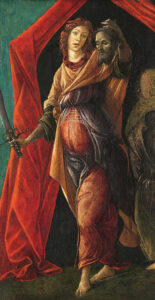
Alessandro Filipepi, commonly called Botticelli, Judith With the Head of Holofernes, end of the 1490s, tempera on wood, 36.5 x 20 cm
Rijksmuseum, Amsterdam, bequeathed by J. W. E. vom Rath, Photo: Rijksmuseum, Amsterdam
Works in “Artist and Designer” highlight Botticelli as both apprentice and master. His early studies in goldsmithing are not specifically represented here (though they certainly helped his drawing skill), but rather his apprenticeship with Fra Filippo Lippi, the great Florentine painter and Medici favorite. Botticelli joined the Carmelite friar’s workshop around 1459 or 1460, when the master would have just been finishing a masterpiece: the altarpiece representing The Adoration in the Wilderness (now at the Gemäldegalerie in Berlin) for the Medici chapel in the Palazzo Medici in via Larga (today via Cavour).
Not much is known about the specific terms of Botticelli’s apprenticeship to Fra Filippo, but Debenedetti cites Cennino Cennini’s Craftsman’s Handbook (Líbro dell’arte), written around 1400, which indicates two phases in apprenticeship: the first, in which pupils begin handling raw materials, and the second, during which they are permitted to aid in the execution of actual artworks, and learn to draw and paint. It was necessary for the garzone to acquaint himself with the style of the capobottego. Debenedetti writes, “The imitation of the master’s style was fundamental to the success of the workshop, the production of which was by nature collaborative, in order to maintain a recognizable, reliable and consistent output….Each work, whether produced by the capobottega, his assistants or in collaboration, was considered the master’s work and purchased as such.” The art historian continues, “Unevenness in the production was therefore inevitable, a trend which important patrons attempted to avoid by stipulating in contracts that specific aspects were to be executed exclusively by the master.” These stipulations were not always honored, however.
But Debenedetti notes that for the most gifted apprentices, like Botticelli and Fra Filippo’s son Filippino, who later apprenticed under Botticelli, imitation of the master was not the sole goal. “[The training was] aimed at appropriating [the master’s] technique, sensibility and vision so that his artistic legacy could pass to new generations.” The Paris exhibition supplies poetic evidence of the passing of Fra Filippo’s style on to Botticelli, as a parent might pass the shape of a nose or eyes on to a child. On view in the first gallery is Fra Filippo’s Virgin and Child, a circa-1460–65 tempera on poplar wood from the Bayerische Staatsgemäldesammlungen–Alte Pinakothek, Munich. Fra Filippo excelled at the subject of the mother and child (look no further than “The Uffizi Madonna”), which was a theme typically intended for private worship. In this first gallery, too, is Botticelli’s Virgin and Child, a circa-1467–70 tempera on wood, also known as the Campana Madonna—a version of the subject, when viewed next to the master’s, is like watching a foal finding his legs under him. Though awkward in its anatomical elements, it takes much from Fra Filippo’s work—in particular the facial features and position of the child.
Madonna With Child or Madonna of the Book (circa 1482–83), a tempera on wood Botticelli executed more than 10 years later, squares more closely with what we know of Botticelli. The face of the Madonna is smooth and elegant, as if carved of marble, and her hair is in rich sinuous waves, the color of spun gold. Her skin and that of the child possess a flaxen brilliance that makes the figures pulse with life and pop off the canvas, not unlike those in Fra Filippo’s works like the Mystical Nativity (circa 1459) in the Palazzo Medici and its partial replica, the so-called Camaldoli Adoration (circa 1463). The richness of Botticelli’s palette in this work speaks not only to the pupil’s progression from the master but also the continued evolution of the Quattrocento.
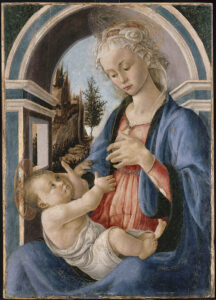
Virgin and Child, also known as the Campana Madonna, circa 1467–1470, tempera on poplar wood, 72 x 51 cm.
Botticelli debuted as an independent master in 1469, the same year as the death of Florence’s leader Piero il Gottoso, and Lorenzo de Medici’s rise to power. Tommaso Soderini, an uncle by marriage to the Medici family, gave him his first commission. It was a panel of Fortitude (now in the Uffizi), needed to complete a set of all Seven Virtues commissioned one year earlier from Piero del Pollaiuolo—his first documented commission, as well, and one he was struggling to execute in a timely manner. The panel, which was in some ways in keeping with Pollaiuolo’s designs, was also a breakthrough—he incorporated the significant use of three-dimensional projection and used layers of translucent glazes to create depth of color, a technique that did not have precedence in his master’s oeuvre.
Botticelli’s creativity was on display, and things moved quickly. Commissions from the Medici and their circle came pouring in, culminating in 1481–82 with his execution of the Sistine Chapel frescoes for Pope Sixtus IV in the Vatican in Rome. In the early 1470s, he took on Filippino Lippi, as his pupil following his father’s death. Not surprisingly, the pupil collaborated with the master on a number of Madonna and Child paintings, as well as the panels for a dismantled pair of cassoni (the panels are now divided between the Louvre, the Musée Condé in Chantilly, the Galleria Pallavicini in Rome, and the National Gallery of Canada.)
As the production of his workshop ramped up, Botticelli employed the practice of keeping an archive of repertory drawings which depicted pre-established figures set in a variety of poses and expressing a variety of emotions. Debenedetti suggests that it is not impossible that Botticelli could have inherited some of Fra Filippo’s studies, especially after Filippino came into the workshop. These drawings, a significant resource, helped Botticelli develop new compositions and helped his assistants and collaborators complete compositions—especially those that included well-known motifs like the Virgin and Child—that he had started. They allowed Botticelli more time for experimentation, while quickening the pace of workshop production.
Experimentation took many forms, including textiles. Botticelli designed Peaceful Minerva, a circa 1491–1500 wool and silk tapestry for a French patron. The work, which is still in a private collection, was created in a French manufactory. Botticelli excelled in the interpretation of Classical mythology for the Florentine audience. This piece features his depiction of Minerva, a familiar figure from his painting oeuvre and one he also represented on a marquetry door in the ducal palazzo of Urbino.
Venus, the goddess most closely associated with Botticelli, is represented in the exhibition by his Venus Pudica (“Modest Venus”), in the collection of the Gemäldegalerie, Staatliche Museen zu Berlin, Berlin. The figure in the circa-1485–90 oil on canvas is based on the main figure in the famous Birth of Venus (circa 1485–86) in the Uffizi. His repeated use of Venus rendered the figure iconic and also promoted a theme that was a favorite of the Medicis.
Botticelli’s repeated execution of tondi was likely inspired in part by Fra Filippo’s so-called Barolini tondo (mid- to late 1460s), Debenedetti speculates, which represented the Virgin and Child with scenes from the life of St. Anne. This form of circular devotional painting became a mainstay in Botticelli’s repertoire and a popular format in Florence in the second half of the century. The exhibition features examples of these works like Madonna of the Magnificent (1490s), a tempera on wood made by a very adept follower of the artist.
Assembling 40 works by any Old Master painter, as “Botticelli: Artist and Designer” does, is impressive. This show does so with the help of several major international institutions, borrowing from the Musée du Louvre, the National Gallery in London, the Rijksmuseum in Amsterdam, the Vatican museums and libraries, the Uffizi in Florence, and the Gemäldegalerie in Berlin. It runs through January 24.

Subscribe to Art & Antiques for your Digital or Print copy