Subscribe to Our Newsletter
The Sage of Red Wing

Charles Biederman, influential in the abstract art world of 1930s New York, spent the last 60 years of his career in rural Minnesota, relentlessly pursuing his own direction and artistic philosophy.
By John Dorfman
It’s hard to imagine in these days of constant marketing and hype, but there used to be artists who resigned from the art scene to consecrate themselves to actually making art. Leaving an art-market center in search of solitude is hard enough, but even harder is abandoning a style that has brought success, in order to avoid creative stagnation and self-repetition. One of those who had the self-assurance and resolve to do these things was the American modernist Charles Biederman (1906–2004), and the fact that his name is not better known has a fair amount to do with his choice to leave New York City for Red Wing, Minn., in 1941 and spend the rest of his long life there. In doing so, he acquired the reputation of a recluse, but that reputation was undeserved.
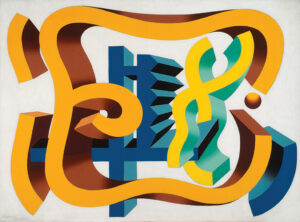
Untitled, Paris, April 10, 1937, 1937, oil on canvas.
Collection of the McNay Art Museum, Museum purchase with the Helen and Everett H. Jones Purchase Fund © Frederick R. Weisman Art Museum, University of Minnesota, Minneapolis
Through extensive correspondence, Biederman kept in touch with a wide range of creative and influential people, from fellow artists to curators and critics and even a world-famous quantum physicist. In addition, he developed theories about art that he propagated through a series of books that, although little-known to the general public, acquired a devoted following among a select group of artists. Most important, though, Biederman, both before and after his move to Red Wing, was an innovator in modern art who bridged some of the gaps between the European and American abstract movements and continued to develop the ideas of rigorous geometric art regardless of trends.
While he is perhaps best known for his paintings and constructions from the 1930s and early ’40s, Biederman evolved some distinctive modes of expression and uses of media that make all seven decades of his career extremely interesting and worth getting better acquainted with. Recent museum and gallery exhibitions as well as the efforts of a few dedicated dealers are bringing some much-deserved attention to the work of this highly intelligent and rigorous American modernist.
Much of what is known about Biederman’s life and work is due to the efforts of Neil Juhl Larsen, a young art student (and later a design engineer) who befriended Biederman in the early 1990s and visited with him twice a month every month for the last decade of his life. Out of these extensive and in-depth conversations grew the agreement that Larsen would write a biography and art study, but unfortunately, he came down with an aggressive cancer and outlived his subject by just two years, leaving the work unfinished at his death. The writer Susan C. Larsen (no relation) was assigned the task of completing the book, titled simply Charles Biederman, which was published by Hudson Hills Press in 2011.
The life chronicled in this volume was one that began in hardship, and it was on rocky soil indeed that Biederman’s artistic inclinations took root and grew. He was born in Cleveland, Ohio, to Czech immigrant parents, his name at birth being Karel Josef Biederman. The family was completely immersed in the Czech community in Cleveland and discouraged their son from making any contacts outside it. The Biedermans were poor and totally absorbed by the need to earn a living; furthermore, according to the Larsens, “theirs was a family in which displays of emotion were utterly foreign. Biederman recalled that his parents did not embrace him or show any outward signs of affection throughout his childhood.” Not only that, but Biederman suffered from an eye ailment that persisted throughout his life, so that all his achievements as a visual artist were made in spite of it.
Biederman always had an adamant will to realize his visions and ideas, and in all things, he had to find his own way. At the age of 14, he won a national drawing contest (a fellow winner was the cartoonist Charles M. Schulz), which led to the offer of a job as a detailer in an auto repair shop—his first encounter with commercial art. At 16, his father demanded that he quit school to help support the family, and he got a better job, as an office boy at an advertising agency where he began to learn about graphic design and paste-up layout. While they had no appreciation for fine art, the Biederman family accepted design as a valid field, but when the 18-year-old Charles had saved up enough money and expressed his desire to attend the school at the Art Institute of Chicago, they were at first reluctant to grant permission. Eventually, however, his father relented, saying to his mother, “Why not let him go? Why shouldn’t he get out of this mess? Why should he stay around here and end up like us?”
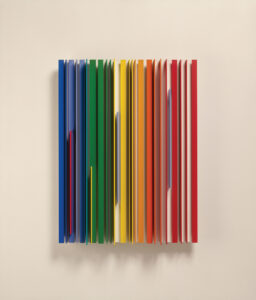
#27, Giverny, designed 1952, fabricated 1971, painted aluminum, 39 3⁄8 x 33 3⁄4 x 4 in.
Collection of the Frederick R. Weisman Art Museum at the University of Minnesota, Minneapolis. Biederman Archive, Weisman Art Museum, Gift of Charles J. Biederman 2015.28.26
At Chicago, Biederman’s teachers immersed him in trends—chiefly French Impressionism, japonisme, and Whistlerian tonalism—that were already retrograde by the mid-1920s. All around him, though, the energies of modernism were pulsing, taking visible form in the architecture of the Chicago skyscrapers that were shooting up everywhere. Biederman grew impatient at he restrictions of the Art Institute’s curriculum, and by 1929 he was told to get in line or get out. He chose the latter, leaving without a diploma just as the stock market crashed and ushered in the Great Depression. He was scraping by with some commercial jobs and public art commissions when in 1931 he made a life-changing acquaintance, the art collector, amateur artist, and patron John Anderson, who lived in Chicago but who had a family farm in Red Wing, Minn. Anderson, the heir to a puffed-wheat fortune, paid for Biederman to take a trip to his ancestral home of Czechoslovakia, where the young artist visited Prague for a brief time in 1932. Feeling alienated from the culture there, however, he soon returned to the U.S., where he continued making art influenced by Cézanne, Cubism, and social realism. In September 1934, frustrated with Chicago’s lack of a vibrant, progressive art world, he moved to New York, where Anderson and his wife had an apartment on the Upper East Side.
In New York, Biederman made a creative breakthrough and his career took off. He rented a studio in Washington Square, where Edward Hopper was one of his neighbors, and it so happened that right around the corner was Albert E. Gallatin’s Museum of Living Art. Gallatin, an abstract artist as well as a wealthy collector and art patron, established his own museum to showcase works by avant-garde artists including Picasso, Gris, Léger, Miró, and Mondrian. All of these, but especially Mondrian, made a deep impression on Biederman. Gallatin’s museum proved to be a seminal influence on many other budding artists, as well, such as de Kooning, Arshile Gorky, Philip Guston, and Mark Rothko. In 1936, Gallatin co-founded a group called American Abstract Artists, with the intention of giving exposure to work that had been studiously ignored by the Museum of Modern Art in its recent exhibition “Cubism and Abstract Art.”
Biederman, never a joiner, did not become an AAA member, although at first his work followed closely the pattern being set by the young American abstractionists in the group. He was now painting in a fully abstract way, with a combination of biomorphic and geometric elements, in bold colors and with hard edges. Even then, though, he imparted to his forms a certain three-dimensionality, conveyed by a sort of shading that suggested contour or topology. Paradoxically, while the space they occupy is devoid of depth, consisting simply of a monochromatic background, the figures, so to speak, have thickness, and they curve and bend into the third dimension. It is these bold and spiky compositions, chiefly oil on canvas, that today represent the lion’s share of Biederman’s work available on the art market.
He himself, however, was not satisfied with these works and was determined to push farther. He was already experimenting with making the third dimension more palpable by making layered constructions out of painted wood, so that the picture plane becomes a sort of geometrical diorama, wall art that is not flat. Biederman was inspired by the Constructivism of the artists Mondrian and Vantongerloo, as well as by Léger’s industrial style of painting. In 1936, Charles Green Shaw, an AAA member and close friend of Gallatin’s who also made constructions as well as geometrical abstract paintings, co-organized an exhibition at Reinhardt Gallery in New York of five abstract artists—himself, George L.K. Morris, John Ferren, Alexander Calder, and Biederman—whom he dubbed the “Concretionists” because he felt that their works were indeed concrete and that the word “abstract” gave the wrong idea by suggesting that the art lacked physical reality.
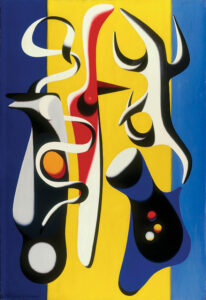
Untitled, New York, June 1936, 1936, oil on canvas, 77 x 53 in.
Collection of the Frederick R. Weisman Art Museum at the University of Minnesota, Minneapolis. Biederman Archive, Weisman Art Museum, Gift of Charles J. Biederman 2015.28.15
In 1937, increasingly interested in the developments of modernism going on in Europe, Biederman traveled to Paris, where he met Kandinsky, Brancusi, and Léger. Of the latter, he wrote, despite his admiration, “What I am looking for in a painting must have more than what Léger has found. Really, when you look at it that whole generation of painters never quite threw off cubism….In exactly five more days, I shall remove myself from Paris, the city with its embalmed culture.” Returning to New York, he declared that America “is the place that the future is possible now,” but his path into that future would have to be a fairly solitary one, since he had repudiated the AAA and now found himself a kind of pariah. He pronounced painting dead and focused his efforts on making constructions in painted wood as well as from increasingly industrial materials including wire, glass, aluminum, and even electric lights (in 1940 he became the first artist to use fluorescent tubes). While he made a few sculptures that were fully realized in the round, most of his new works were relief-like, intended to be mounted on the wall. Gone was the illusionistic shading, and the diversity of hues in the paintings was replaced by an emphasis on primary colors—a trait, of course, that he shared with the artists of de Stijl. His forms were no longer biomorphic but chiefly circles, triangles, trapezoids, as well as balls and sticks. He withdrew his works from the Pierre Matisse Gallery, which had been selling them, and began to imagine a future in which art works were mass produced, fabricated according the specifications of the artist rather than being unique works of hand craft. He spoke excitedly of “a revolution that will make the days of the cubists like a Sunday School…removal of dealers and collectors in the capitalistic sense. One day it will be like ancient times when all things would be created by people into aesthetic constructions.”
It was in such a frame of mind that in 1941 Biederman made the decision to leave New York and all it stood for. The charting of his future course was accomplished in partnership with Anderson and his family, for Biederman married Anderson’s sister-in-law, Mary Moore, and together with her relocated to a farmhouse in Anderson’s hometown of Red Wing. There he could experiment, make art, elaborate his new theories and write about them, and live cheaply. In this perhaps paradoxical environment combining the rural and the industrial, Biederman settled in to the rest of his life. Thanks, in part, to Anderson, he supported himself with commissions for public art and design projects and occasional private sales of his work. Mary, a schoolteacher, sometimes had to step in and single-handedly support the family during lean times for art commissions.
In the course of his theoretical endeavors, Biederman had become very interested in Alfred Korzybski’s General Semantics. Although Korzybski is not held in very high regard today, the eccentric émigré Polish nobleman made quite a splash in midcentury America with his writings and lectures on language, meaning, and the transmission of knowledge, and Biederman incorporated many of these insights into his own magnum opus, Art as the Evolution of Visual Knowledge (1948). While rather scathingly reviewed by critics, the book went on to become a sort of secret bible for artists, along the lines of John Graham’s System and Dialectics of Art (1939). It was especially warmly received in the Netherlands, not surprisingly. In the early 1950s, Biederman also became quite influential on a young generation of British artists working in constructionist modes, including Victor Pasmore and Anthony Hill.
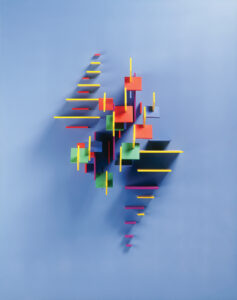
Charles Biederman, #24, Constable, 1977–79, painted aluminum, 41 1⁄2 x 33 1⁄8 x 12 in.
Collection of the Frederick R. Weisman Art Museum at the University of Minnesota, Minneapolis. Biederman Archive, Weisman Art Museum, Gift of Charles J. Biederman 2015.28.29
At this point, Biederman was referring to his general approach to art as “structurism.” By this term, he meant a designed and fabricated, fundamentally democratic art based on straight lines and right angles, squares and rectangles, and primary colors. It was an art of reality, simplicity, and elegance, and unlike many early and mid-century abstractionists (Mondrian, for example), Biederman had little patience for mysticism or otherworldly aspirations. His art, even if it can look rarefied, is fundamentally down to earth, at home in the rural world of Red Wing. In fact, in his later years Biederman painted the sides of his farmhouse in the three primary colors championed by de Stijl.
Biederman’s painted aluminum structures became more and more minimal during the 1960s through ’90s, influencing, among others, Donald Judd, although Biederman certainly did not identify with Minimalism in any way. He was thinking way beyond any categories of formalism, absorbed by questions of nature in its relation to art and knowledge. Inevitably, he was attracted to science and as a result entered into one of the most extraordinary of his many correspondences—with the great American-born theoretical physicist David Bohm, then living in England. In 1960, after having read Bohm’s 1957 book Causality and Change, Biederman wrote him the first of what would eventually total some 4,000 letters. Although they never met in person, the two men spent the better part of 10 years exploring and comparing each other’s disciplines. Bohm’s biographer, David Peat, wrote that Biederman introduced Bohm to the idea that any visual element in an artwork is absolutely dependent on context, and that “this context-dependence struck Bohm as similar to context-dependence within quantum theory—the way a quantum system is defined by the context of a measurement or observation.” Due to its great interdisciplinary interest and its contribution to the breaking down of barriers between the so-called “two cultures” (the sciences and the arts), the Bohm-Biederman correspondence has been edited and excerpted in a book published by Routledge in 1999.
Biederman kept working right up until the time of his death in 2004 at 98. By the end of his long life, he had become fairly well accepted within the art establishment, treated on occasion as an elder statesman or even a sage. The Walker Art Center in Minneapolis held a retrospective of his work in 1965, and the Minneapolis Institute of Arts followed in 1976–77. In 1991 Biederman bequeathed the artistic and archival portions of his estate to the Frederick R. Weisman Art Museum in Minneapolis, which now holds the most important collection of the artist’s work as well as all his writings and correspondence. Recently, Biederman’s works have been on view at several galleries in New York, bringing an awareness of his art and the rigor of his aesthetic philosophy to the city that he so decisively spurned some 80 years ago.

Subscribe to Art & Antiques for your Digital or Print copy