Subscribe to Our Newsletter
Modern Man – Turner and Modernity

Far from being a Romantic dreamer, J.M.W. Turner had a lively interest in technology and politics that profoundly informed his work.
By John Dorfman
J.M.W. Turner is often spoken of as “modern” before the fact, because he seemed to flirt with abstraction, especially in his late works. But there’s another reason why the early-19th-century English painter could be considered modern, one which has little or nothing to do with the stylistic innovations he made: Turner was actively engaged with the politics and technology of his time. Far from being a dreamy Romantic immersed in a timeless landscape, he was fascinated by the rapid changes that were occurring in British society, changes that presaged the industrial and sociopolitical revolutions that shaped the world we now live in.
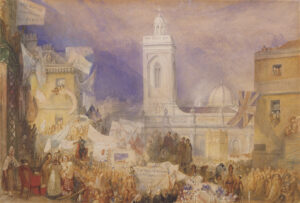
The Northampton Election, 6 December 1830, circa 1830–31, watercolor, gouache, and ink on paper 11 1⁄2 x 17 1⁄4 in.
Tate Britain, London, accepted by the nation as part of the Turner Bequest 1856, T12321 Photo: © Tate, London, 2020
We’ve always known that Turner was a savvy businessman who was acutely conscious of current market forces. Now we are being made aware of the degree of Turner’s interest in current affairs and how it affected his art, thanks to an extremely thought-provoking exhibition organized by Tate Britain in London and currently at the Kimbell Art Museum in Fort Worth, Texas. “Turner’s Modern World,” on view through February 6, brings together more than 100 works by the artist, loaned by Tate Britain, the Museum of Fine Arts, Boston, the Metropolitan Museum of Art, the Cleveland Museum of Art, the Yale Center for British Art and other institutions on both sides of the Atlantic, to make its case that Turner was very much a modern artist, if not quite a modernist artist. It should be noted that some of the works from American collections were not included in the Tate’s presentation of the show, which took place from October 2020 through September 2021, due to concerns on the part of the curators that these works should not travel during the Covid-19 pandemic. They are integrated into the installation for the first time at the Kimbell.
Turner was born in 1775 and died in 1851, so his life spanned the American Revolution, the Napoleonic Wars, the Industrial Revolution (which started in Great Britain and spread over the world), the expansion of the British Empire, and the beginning of the socialist revolutionary movements. These dramatic events shaped the world we now inhabit, for good and for ill. Still, as Tate Britain director Alex Farquharson writes in his preface to the exhibition’s catalogue, “This exhibition is calibrated to his modern world, not ours. Connections between them can be overdone. Nothing stays modern for long and certainly did not during his lifetime of dizzying change.”
It is natural to want to see the present reflected in the past. That is exactly what many 20th-century art critics did with Turner’s late style, which they viewed through the prism of Abstract Expressionism. Turner’s wild use of paint, which broke boundaries set up by previous art canons, seemed to them almost, if not actually, “gestural,” while the way he let the effects of light and atmosphere overwhelm the nominal subject of a painting came across, perhaps inevitably, as “abstract.” And while it’s fashionable to hail creative geniuses as being “ahead of their time,” it is better to say that they transcend their time while still being very much of it. The current exhibition, writes Farquharson, “can be seen as a sequel to ‘Late Turner: Painting Set Free’ first shown at Tate Britain in 2014 and curated by David Blayney Brown, Amy Concannon and Sam Smiles, who are also the present exhibition’s curators.” “Late Turner” (which was reviewed in this magazine’s Winter 2014–15 issue) highlighted the unique and revolutionary qualities of the artist’s abstract-like style while carefully situating it in the context of the painting practices of the 19th century and of Turner’s own studio practice and personality. Similarly, in “Turner’s Modern World,” Blayney et al. keep the focus on Turner’s own extra-artistic interests and how they made their way into his paintings.
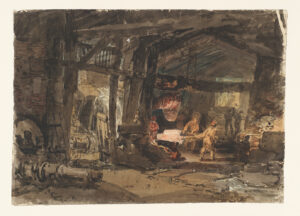
The Interior of a Cannon Foundry, 1797–98, graphite and watercolor on paper, 9 3⁄4 x 13 3⁄5 in. Tate Britain, London, accepted by the nation as part of the Turner Bequest 1856, D00873 Photo: © Tate, London, 2020
As the Industrial Revolution was ramping up in Britain, some artists reacted by withdrawing their gaze from the scene and redirecting it inward or backward into a real or imagined past. The Pre-Raphaelite Brotherhood, which was founded just a few years before Turner’s death, chose for their subject the worlds of medievalism and myth. William Blake, who famously denounced technology as “dark Satanic Mills,” retreated into a visionary, symbolic cosmos which he depicted as vividly as if it could be seen by the physical eye. And the “Shoreham Ancients,” followers of Blake such as Samuel Palmer and George Calvert, painted the rural scene in such a way that grimy modernity never seemed to enter into the picture. Turner took a very different approach. Even his purest landscapes, which revel in the natural beauty of earth, sea, and sky, embody modernity. The dramatic sunsets he favored owed their amazing colors to the effects of air pollution, then a new phenomenon, and the catalogue’s authors suggest that Turner was well aware that he owed these appealing light shows, at least in part, to the burgeoning industry that was ravaging England’s landscape.
Turner was interested in science and technology and belonged to several circles of intellectuals and experimentalists who exposed him to cutting-edge developments, and his professional interest in color theory, optics, and paint materials dovetailed with this broader orientation toward science. Scientific and technological subjects appear fairly frequently in his work; in fact, not since Joseph Wright of Derby had a British artist so delighted in the depiction of the achievements—even the gadgetry—of human ingenuity. Two early works, Interior of a Cannon Foundry (1797–98) and Interior of a Tilt Forge (circa 1798) take us deep inside the bowels of the new industrial manufacturing system, and the artist’s eye seems illuminated by a sense of wonder; the huge wheels of the forge loom as large as celestial orbs. Of course commerce was not far away from the motivation, either. Turner painted Whalers (Boiling Blubber) (exhibited 1845) for a client, Elhanan Bicknell, who was in the spermaceti oil trade. Apparently Bicknell did not appreciate Turner’s near-abstract style on this one, and returned it to the artist.
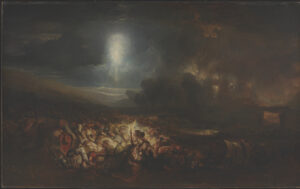
The Field of Waterloo, exhibited 1818, oil on canvas, 58 x 94 in.
Tate Britain, London, accepted by the nation as part of the Turner Bequest 1856, N00500 Photo: © Tate, London, 2020
Ships at sea, one of Turner’s favorite subjects (in fact he can easily be counted in the ranks of the marine painters), gave him an opportunity to depict the new technology of steam. In Staffa, Fingal’s Cave (1832), the steamship struggles in a storm, a column of smoke from the stack rising into and blending with the black clouds. A tiny solar disk glows red near the horizon in the corner of the composition. The ship seems dwarfed, and the smoke seems like a lonely standard raised amid nature’s attack. In Snow Storm—Steam Boat Off a Harbor’s Mouth, the vessel and its vapor are merging with the vapor from the sea, with an effect that is dramatic but less fraught with danger than in Staffa. Ships of war were another of Turner’s favorite subjects, and one in which military technology coincides with political concerns. The iron works that the artist painted with such evident delight were making metal for battle, to be used mainly in Britain’s ongoing struggles with the French under Napoleon. In The Battle of Trafalgar (1806–08), the artist renders the ships pressed up against each other in an improbable-looking scrum, an approach that heightens the drama and gives the viewer a “you-are-there” sense of journalistic immediacy. Of course, this is before the age of steam, so not much modern technology here, but the sense of war journalism certainly presages modernity in several ways. At this stage, Turner was still glorifying British might, but by the time he painted The Field of Waterloo in 1818, his vision was tempered by compassion for the suffering of the masses of soldiers. There is no distinction made between the two sides, both huddled in pain and exhaustion and illuminated by the flash of silvery light from a flare. That reporter’s eye, compassionate and unblinking, is also very modern; it was possessed also by another pioneer artist of Turner’s era, Goya.
Turner’s political consciousness developed over the course of his life. His Slave Ship (1840) depicts African captives being thrown overboard in order for the ship’s captain and crew to avoid detection by a British anti-slavery patrol vessel (slavery had been banned throughout the British Empire in 1838), and it may, according to the exhibition’s curators, refer also to a notorious incident in 1781 when the slaver Zong threw 133 Africans into the water to facilitate an insurance claim. By 1840 Turner had come a fair distance in his thinking on the subject, given that he had been an investor in a Jamaican sugar plantation in 1805. Around five years earlier, he had painted A Disaster at Sea, a depiction not of a slave ship but of a convict ship, the Amphitrite, bound for Australia. It did not get far but foundered in a storm off the coast of France, and the captain refused offers of aid for fear that the convicts would escape. In the end, all the women and children, as well as most of the crew, drowned. Turner’s sympathy for the marginalized is on full view in this chaotic scene, but unfortunately he deemed it too controversial to be displayed to the public.
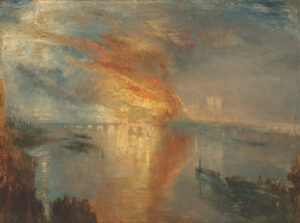
J.M.W. Turner, The Burning of the Houses of Lords and Commons, 16 October, 1834, circa 1834–35, oil on canvas, 36 1⁄4 x 48 1⁄2 in.
Photo: © Tate, London, 2020; Tate Britain, London, accepted by the nation as part of the Turner Bequest 1856, N00530
Turner’s politics leaned liberal, and he occasionally made literal depictions of the political process. He celebrated the Greek independence movement, an early example of the struggle for national self-determination against multi-national empires, in paintings that portrayed freedom fighters and folk dances. At home, he was a keen observer of the struggle for workers’ rights and political freedoms. In the watercolor Northampton Election, 6 December 1830, Turner shows Lord Althorpe, a reform-minded member of Parliament, being borne aloft on the shoulders of supporters parading through the streets. Off to the side, a man dressed in old-fashioned clothes, representing reaction, is chided by the symbolic figure of Marianne, the personification of France, where the “Second French Revolution,” deposing the reactionary King Charles X, had just occurred. A banner unfurled by the Whig supporters reads, “The Purity of Elections and Triumph of Law”—a sentiment eerily germane to the present moment in the U.S.!
Last but not least, Turner was indeed modern in his methods as well as in his subjects. New times called for new techniques of representation and a new independence from long-held conventions. Turner, especially in old age, was willing to part with old ways. As Sam Smiles writes in an essay in the catalogue, Turner “can be characterised as a modern painter not because some of his paintings have modern subjects, nor because his late works look, to some, as though they foreshadow modernism in their ‘impressionistic’ or even ‘abstract’ qualities, but becausehe showed resolutely and consistently how painting might accommodate itself to an innovative age.”

Subscribe to Art & Antiques for your Digital or Print copy