Subscribe to Our Newsletter
Symphonies of Color
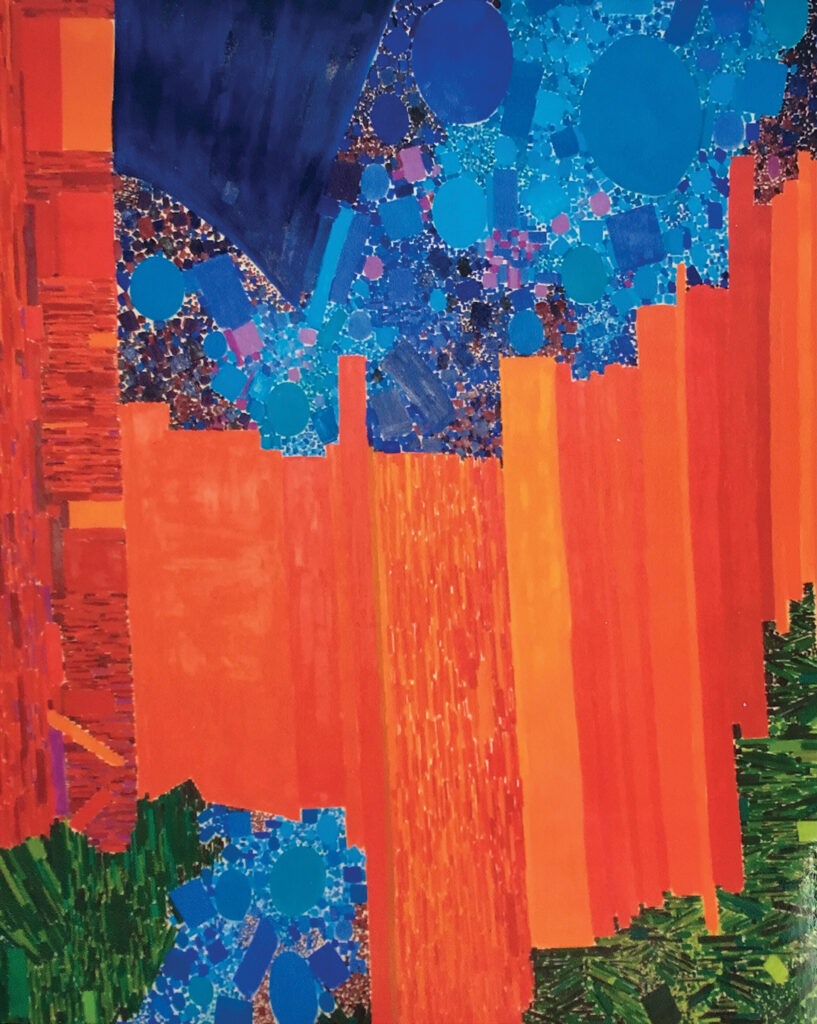
From New York to Monhegan Island, Lynne Drexler stayed true to her artistic inspirations—abstraction, music, and nature.
By John Dorfman
Many modern artists have perceived deep connections between visual art and music and have even tried to express these in their work. But how many actually brought a portable lap-sized desk to the opera or concert hall and drew in their seats while the music played? Lynne Drexler did. A lifelong passionate devotee of classical music, Drexler (1928–99) would often go to the opera three times a week, and she kept notes on specific performances. Wagner was her favorite composer; others she prized include Mahler, Richard Strauss, Tchaikovsky, Mussorgsky, and Borodin. When she drew “from music,” so to speak, it was no literal depiction of performers or scenes that went down on the paper; it was almost always abstract forms that the artist felt expressed the way the sounds affected her. And when she worked the monochrome drawings up into finished paintings, she added color.
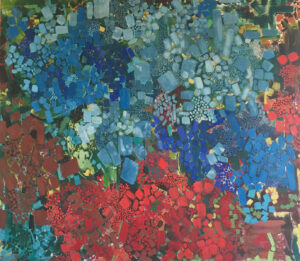
Lynne Mapp Drexler, Omar Hundred, 1959–60, oil on canvas, 70 x 80 in.
Private Collection. © The Estate of Lynne Mapp Drexler
Whether abstract, figurative, or a combination of both, Drexler’s art was first and foremost about color. As a student of Hans Hofmann, she always let the color be the driving force, with form following its lead. In her love of bright, warm, and powerful hues, she was a faithful follower of great colorists such as Cézanne, Matisse, Bonnard, and van Gogh. Originally a member of the second generation of Abstract Expressionists of the New York School, Drexler settled permanently in the rural isolation of Monhegan Island off the coast of Maine, where she let nature into her work more than ever before. Drexler became a beloved figure among the year-round inhabitants of Monhegan.
The rugged island has attracted artists ever since the early 20th century when Robert Henri encouraged students such as George Bellows and Edward Hopper to paint there. In later generations, Rockwell Kent and the Wyeths made it a major part of their artistic lives. However, as Tralice Bracy, former curator of the Monhegan Museum, notes in the catalogue for a 2008 Drexler retrospective held there and at the Portland Museum of Art, “Of the thousands that have painted on Monhegan, only two have lived year-round and died on Monhegan, S.P.R. Triscott (1846–1925) and Lynne Drexler.” Both artists retreated to Monhegan when they felt their individual styles being eclipsed by changing tastes in the art world. For Triscott, a 19th-century watercolorist noted for landscapes, the threat was modernism; for Drexler, it was Pop Art and the end of the Ab-Ex era. “Monhegan seems to have acted as a time capsule of sorts for both Triscott and Drexler,” Bracy writes, “providing enough of a remove for the two to paint without the trends and pressures of the urban world.”
Drexler was born and raised in Newport News, Va. On her mother’s side, she came from Southern aristocracy, descended from Robert E. Lee and the first royal governor of Virginia. Later in life, when her reputation as a rough-edged, bohemian eccentric was well established, Drexler still carried this heritage with her. “Under all the unkemptness and disdain for order,” recalled a friend from Monhegan, “there was a very proper southern woman. She could curse like a pirate, but she judged people by their manners.” Drexler’s parents encouraged her interests in art and music with lessons, though the desire to become an artist did not crystallize until she was in her late 20s. At Colonial Williamsburg, she happened to meet an architect named Howard Bernstein, who encouraged her to move to New York and get involved with the contemporary art world. Also, an artist who was teaching at the Hampton Institute in Virginia, Peter Kahn, suggested that she get in touch with his brother, the painter Wolf Kahn, and with Hans Hofmann, which she did. In 1956, Drexler moved to New York and enrolled in Hofmann’s school; two years later, she studied with Robert Motherwell at Hunter College.
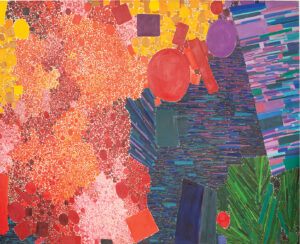
Floral Water, 1964, oil on canvas, 72 x 88 in.
© The Estate of Lynne Mapp Drexler
Both of these artist-teachers had a major influence on Drexler’s direction. Hofmann made her a modernist, taught her to understand painting in terms of space, form, and color. She thoroughly absorbed his idea of “push and pull,” the dynamic interrelationship of formal elements, and made it a keynote in her own work. Motherwell taught her a process-oriented approach to art, in which the artist discovers his or her path through working, rather than through establishing a pre-conceived direction or set of criteria to fulfill. Drexler had gone to Hunter with the idea of getting a degree so she could take up a teaching position herself. Motherwell thought she should instead devote herself to her art. “I’ll flunk you out of here before I see you go teach,” she recalled him saying to her. “You’re too good a painter.” He also told her that socially, she was “the most impossible person he had ever met,” to which she replied, “Takes one to know one, doesn’t it?”
Drexler’s earliest body of work is purely abstract, with the paint applied in dense clusters of short brushstrokes, in rich but not bright hues. The overall effect allows color, rather than geometric form, to prevail. Sometimes she would use crayon first and then apply an ink wash over that to achieve a complex, layered, shimmering effect. These works got Drexler noticed, and in 1961 she showed her work, solo, at the Tanager Gallery on Tenth Street in New York, an influential artists’ cooperative whose members included Alex Katz and Philip Pearlstein. A price list from Tanager has Drexler’s paintings priced as high as $1,200—a lot of money at that time. In 1962 she married a fellow abstract painter, John Hultberg, who was represented by the dealer Martha Jackson. It was through Hultberg that the connection to Monhegan Island was made; Jackson had bought a house there for him, and the newlywed couple used it as a summer getaway from the city.
During the mid-’60s, Drexler accompanied Hultberg on a series of artistically motivated travels, including to Mexico, Hawaii, and California. In Los Angeles, she engaged in printmaking at the legendary Tamarind Print Studios and showed work at the Esther Robles Gallery, an important venue for contemporary art. When they returned to New York in 1967, Drexler and Hultberg moved into the Chelsea Hotel on West 23rd Street, famous for its literary and artistic denizens. One of Drexler’s paintings was hung in the lobby, alongside works by Jackson Pollock and Larry Rivers. The time she spent in the Chelsea coincided with her peak years of concert and opera attendance, but by the ’70s, rock and punk were far more likely to be heard in the hotel than classical. Drexler was starting to feel alienated from New York and its art scene, and her career was no longer prospering, since fashions had shifted away from her sort of painting. Hultberg, by contrast, was doing better and better. Meanwhile, Drexler experienced some eye trouble that got in the way of her work. At a low point, she tried to kill herself. Shortly after she recovered, in 1971, she and Hultberg purchased the Monhegan house from Martha Jackson and started spending a lot more time there. In 1983, Drexler started spending the whole year on the island and never left.
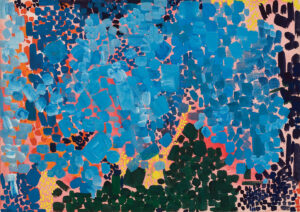
Untitled (Blue Series), gouache on wove paper, 14 1⁄16 x 19 7⁄8 in.
Portland Museum of Art, Maine, museum purchase with an anonymous gift in memory of Stephen J. Jenteel, M.S.W., 1985.234 © The Estate of Lynne Mapp Drexler
It was on Monhegan Island that Drexler, without abandoning her abstract art practice, began to incorporate representational elements—from nature, never the human figure. She also started doing plein air painting, as well as taking photographs outdoors that she used in the studio for reference. Her abstractions from the 1970s have a denser texture than her earlier ones, almost like wood grain, and tend to gravitate toward one color. By the end of the decade, though, her style opens out into a much airier feel, with figurative elements like tree branches appearing, shown against an abstracted, textured sky. During the ’80s, as Drexler immersed herself in Monhegan’s landscape and seascape, her paintings become brighter—even Fauvist in palette—and more explicitly representational, while still remaining loyal to the formalist Hofmann tradition of push-pull. The rocky coastline, fallen tree trunks, wooden houses, and laundry billowing on clotheslines that she saw around her all furnished opportunities for playing positive and negative spatial elements against each other, juxtaposing complementary colors, and contrasting figure with ground. On the other hand, sometimes Drexler would paint a grassy meadow in such a way that all notions of three-dimensional space are flattened away and we are left looking at a pure pattern of subtle tonal variations.
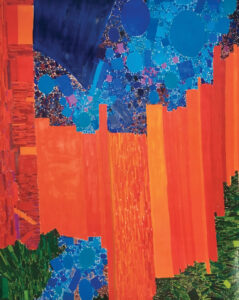
Deciduous Empire, 1964, oil on canvas, 88 x 72 in.
Private Collection © The Estate of Lynne Mapp Drexler
In the ’80s and ’90s, Drexler’s career flourished again, with sales to Maine collectors and the Portland Museum of Art. She was happy living in relatively remote surroundings, where she found it easier to concentrate on art without the distractions and demoralizations of the New York art world. “There is no isolation in a place like this—impossible to find—but solitude is respected,” she remarked of Monhegan Island. Her needs were simple: “I am not rich…but I have what I want. I mean as long as I have food, heat, roof over my head, food for the cat, and paint I am happy. Oh, and Jack Daniels.” She was known for welcoming spontaneous guests and pouring them tea or bourbon on the rocks, depending on the time of day.
When Drexler learned that she was terminally ill, she forbid her island friends to show any gloom, and when they threw her a 70th birthday party—it was to be her last birthday—she was in high spirits and delighted being the center of attention. She had one last solo show, at the Lupine Gallery on Monhegan Island. She died on December 30, 1999, while listening to Mozart’s Don Giovanni.

Subscribe to Art & Antiques for your Digital or Print copy