Subscribe to Our Newsletter
A Millennial Modernist
California artist Danny Heller grew up well after MID-CENTURY MODERNISM prevailed in America, but he has recaptured and reinterpreted the era by painting its architecture, automobiles, and its very mood
By David Masello
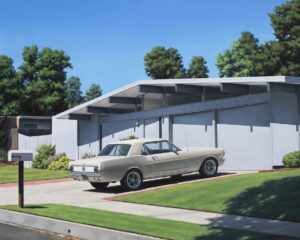
Mustang in the Driveway (2025);
It took many years for Danny Heller to realize that the unremarkable place in which he grew up was actually so remarkable that it would become his painterly subject. As a boy growing up in the 1980s and ’90s in Los Angeles’s San Fernando Valley, Heller considered his family’s suburban setting to be “blank and bland and vanilla,” as he says now from his studio and home in Desert Hot Springs, California. “My childhood was a nice one, but for excitement, for cultural outings and sites, we would drive over the mountains into L.A. It wasn’t until I returned to the Valley after going to college up the coast that I really started to realize that there was a lot to look at. I started painting what I knew and what I grew up with. I wanted a subject matter to paint and I had found it.”
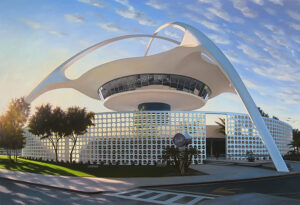
LAX Theme Building–Ground Level (2020)
Given the post-War era in which the vast San Fernando Valley came into being as a suburban adjunct to the city of Los Angeles, some of its areas came to be defined—and still are—by exemplary mid-century Modern houses. These dwellings, most of them built in the 1950s and ‘60s, were made for their sunny California climes—with strong rectilinear lines, large expanses of glass, overhanging and butterfly roofs, swimming pools, terraces and interior courtyards, carports, and novel architectural forms akin to landed alien craft.
“As I started painting more and more, I eventually started to catch wind of higher examples of mid-century Modern design,” he says. “The Valley is often thought of as the ugly stepchild of L.A., but if you look closely at some of the architecture there you start to realize that there is something exceptional to it all.”
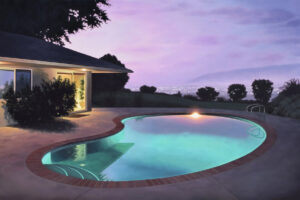
vThe California-based artist Danny Heller paints the elements that define mid-century Modernism. Evening Swim (2025) depicts a Los Angeles swimming pool.
Though born in 1982, well after mid-century Modernism had flourished and waned, Heller came of age at a time when the aesthetic was rediscovered. “It was around 2005 when it all came back in vogue, with things like Palm Springs’s hugely popular Modernism Week, which launched in 2006,” he says referring to the annual celebration of the period domestic architecture of the region. He points to popular culture, too, as fostering a reawakening, such as the TV series “Madmen,” which was set during the mid-century era. “I was riding the wave at the right time,” Heller acknowledges.
Another subject of the era that Heller celebrates in his oils on canvas (typically measuring 30 x 40 in.) is the cars of the time, an era when automobiles could be thought of as kinetic sculptures, given their exuberant forms and details—fins and headlights that assume the look of faces, geometrically articulated taillights, and elegant fender skirts. It’s as if the houses of the time and the cars were meant for one another; there was no aesthetic disconnect. The cars parked in the driveways of the houses Heller depict assume a presence as strong as the dwellings and the palm trees that bespeak California.
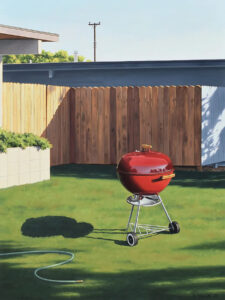
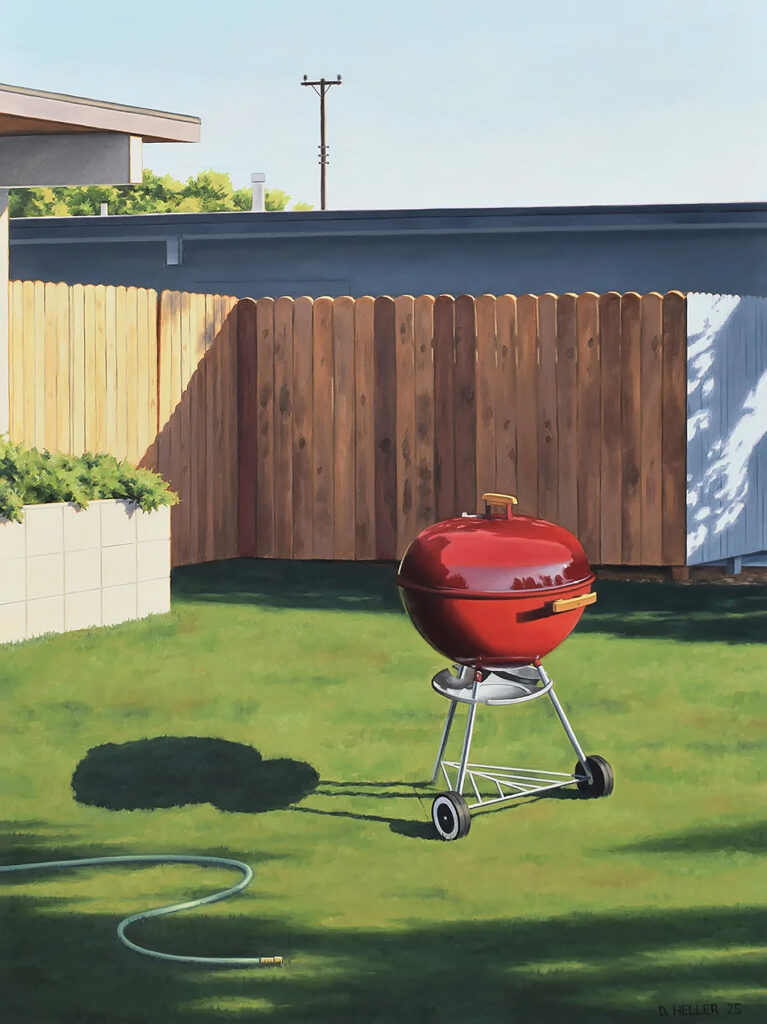
Afternoon BBQ (2025)
While the automobiles Heller features are expertly rendered, people are absent from his canvases. Heller claims that human figures don’t appear in his scenes, even in decidedly urban ones like New York’s Park Avenue, “simply because I can’t paint them.” That’s actually a misstatement, for to look at some of the few paintings of his that include store mannequins or the hint of a driver at the wheel of a car, is to discern figures that do appear lifelike. Of that fact, however, he says, with humor, “If the people are as stiff and lifeless as mannequins, I can paint them.”
Rather, Heller keeps his scenes peopleless because he wants the subject matter to be the setting he has chosen to celebrate and the light that illuminates it. “I like clearing the scene of people because it allows viewers to place themselves in the scene better,” he emphasizes. “People can insert themselves.”
Having grown up near the major TV and movie studios, notably Disney and Warner Brothers, Heller imagined himself, while a boy, someday working on movies and shows doing storyboards or set designs. “I approach my paintings almost as a set designer. I design a scene.” And while he paints actual houses and period cars in real locations in and around Los Angeles, and in the Palm Springs area, he is not completely faithful to what results on his canvases. He admits to photoshopping images of cars from one location and repainting them in front of houses in another. “Every now and then, I’m lucky and I strike gold and I find one of these mid-century cars actually in front of the homes or on the street. But since that isn’t the case often, who’s to say that this particular house wouldn’t have a car like this parked in its driveway originally? If I make it all up or if I find it that way, I’m still being true to life.”
For the full story click on the link below for your Digital subscription:

Subscribe to Art & Antiques for your Digital or Print copy