Subscribe to Our Newsletter
A Multimedia Master
The extremely diverse art practice of Sophie Taeuber-Arp is at long last getting the serious consideration it deserves, in a retrospective exhibition at the Tate Modern in London.
By Sarah E. Fensom
For the Swiss polymath Sophie Taeuber-Arp, abstraction was square one. Unlike most of her colleagues in Europe’s early 20th-century avant-garde, Taeuber-Arp didn’t begin with the object and then progress into non-objectivity from there. Instead, the multi-disciplinary artist adapted the grid structure she used in her textile practice into drawings, creating abstract works on paper, dubbed Vertical-horizontal compositions, as early as 1915.
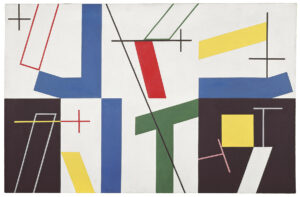
Six Spaces with Four Small Crosses, 1932, oil paint and graphite on canvas, 25 9⁄16 x 39 3⁄8 in.
Kunstmuseum Bern. Gift of Marguerite Arp-Hagenbach; Stiftung Arp e.V., Berlin
Active within Zurich dada, Taeuber-Arp implemented everyday materials like wool and wood for the variety of works she created. Her drawings were no different; she drew in crayon and used watercolor, tempera, and gouache (she didn’t begin using oil on canvas until the late 1920s). The abstract drawings she created during the late 1910s were strikingly ahead of their time—rectangular planes of color are stacked in Tetris-like configurations, separated not by lines but by precise hatching; curved forms sit within rectangular blocks of contrasting color, giving the appearance of twisting, squeezing movement; and nondescript figures, circles, and crosses interrupt the artist’s exacting grids, creating the impressions of flags or symbols or buildings.
Taeuber-Arp’s seemingly preternatural inclination for abstraction—and the virtuoso facility with line, shape, and color that she used to express it—formed simultaneously with the artist’s skill across the media of design, architecture, and dance. She designed furniture and interiors; created costumes, jewelry, rugs, embroidery, and textiles; developed marionettes for the theater; performed as a modern dancer; realized architectural projects; and produced a robust studio output of graphic design, drawings, paintings, and sculptures—among them, turned-wood “Dada Heads” that remain some of the most iconic artworks of the Dada movement. She also taught the applied arts for more than a dozen years, published pedagogical texts, and edited an art magazine.
“Sophie Taeuber-Arp,” an exhibition on view at London’s Tate Modern through October 17, explores the far-reaching career of the artist. The show brings together more than 200 objects culled from collections across the United States and Europe. Reflective of the many artistic hats Taeuber-Arp wore, the exhibition boasts an exciting mix of artworks and objects, like intricately beaded evening bags, abstract reliefs on turned-wood, designs for the Aubette, a modernist entertainment complex in Strasbourg, and all 17 of the original marionettes that the artist created for an avant-garde interpretation of the play King Stag in 1918. “Sophie Taeuber-Arp” comes to London after a stint at the Kunstmuseum Basel earlier this year and will head stateside to MoMA in November (both institutions are co-organizers of the show with the Tate).
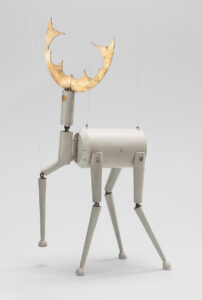
Sophie Taeuber-Arp, Stag (marionette for “King Stag”), 1918, oil paint on wood. brass sheet, metallic paint on metallic paper, metal hardware, 19 11⁄16 x 7 x 7 1⁄16 in.
Museum für Gestaltung, Zürcher Hochschule der Künste, Zurich. Decorative Arts Collection
The exhibition grapples with the question of Taeuber-Arp’s legacy—why isn’t an artist of her breadth and caliber a titan of the 20th century art historical canon? In the catalogue MoMA is publishing alongside the show, Ann Umland and Walburga Krupp address this question, pointing first to the artist’s marriage to Jean (Hans) Arp, another luminary of the early 20th-century European avant-garde. The two artists met in November 1915 at the “Modern Tapestries, Embroideries, Paintings, Drawings” exhibition at Galerie Tanner in Zurich and married on October 22, 1922, in Pura, Ticino. After her marriage, Taeuber-Arp took a hyphenated surname in accordance with Swiss custom. “Her new husband’s name,” the scholars write, “remained simply ‘Arp.’” They continue: “Married or not, [Jean] Arp retained his independent identity. By contrast, to introduce the former Sophie Taeuber, from her wedding day on, is always also to introduce her artist husband. This basic fact is symptomatic of the difficulties faced by women of Taeuber-Arp’s generation, in particular those with well-known spouses, to be considered artists in their own right—as individuals first, rather than as partners.”
But gender discrimination wasn’t the only circumstance that negatively influenced Taeuber-Arp’s renown. The scholars point to the “varied nature of her artistic practice.” Taeuber-Arp’s “polymathic activities,” they write, “are one of the things that make her feel exceptionally contemporary. Yet much of her work was historically deemed ‘minor’ or proved ephemeral—live dance performances went undocumented; beaded bags and pillowcases were not preserved with the same care as ‘major’ paintings and sculptures; architectural interiors and wall paintings were subject to dismantling or being painted over; and activities such as editing or layout took place behind the scenes.” The artist also died in an accident in 1943 at just 53 years of age. Jean Arp published a posthumous catalogue raisonné of his wife’s work in 1948, which Umland and Krupp describe as a “well-intentioned attempt to consolidate [Taeuber-Arp’s] reputation as an abstract painter-sculptor.” But, they note, “in the process by and large [the catalogue raisonné] occluded the vibrant, cross-disciplinary versatility that is at the heart of her singular life’s work.”
Born in Davos in 1889, Taeuber-Arp moved to Munich in 1910 to study at the Teaching and Experimental Ateliers for Applied and Fine Arts. The school, founded in 1902 by Hermann Obrist and Wilhelm von Debschitz, took cues from the Arts and Crafts movement, fusing the principles of fine art, design, and craftsmanship. Taeuber-Arp excelled at working with textiles, and after the conclusion of her studies, she began a successful career in the medium. She designed batik lampshades for the company Baumann-Kölliker & Co., and several years later created cushions in brightly colored wool embroidery, oval rugs, and of course, made standalone embroideries. Standouts of the Tate show are works like Embroidery, a circa-1920 wool on canvas textile that is on loan from a private collection. The piece, made during Taueber-Arp’s time in Zurich, is executed in a rainbow of hues. Its composition of bold geometric shapes—a veritable city of gridded forms—is as avant-garde and seminal as any painting. It’s strikingly similar to the artist’s drawings of the period, which she sometimes used, if not directly, as the basis for woven pieces.
During this period, Taeuber-Arp also created luxury accessories—bags, necklaces, and bracelets in intricate beadwork. These pieces were knitted or crocheted with colored metal or glass beads, and they followed the same sense of rigorous color theory and abstraction that the rest of Taeuber-Arp’s work did. Geometric Forms (beaded bag), made in 1917, is another standout of the Tate’s show. The lovely pouch-style bag features a long silk strap and tassel. It is covered in deep violet beads, with squares of blue beading bisected by yellow triangles. The tubular Geometric Forms (necklace), also in the show, was made around 1918. It features an intricate sequence of interlocking squares and triangles in both warm and cool colors.
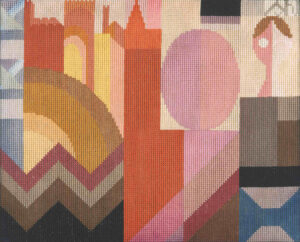
Embroidery, c. 1920, wool on canvas, 12 5⁄8 x 15 3⁄4 in.
Private collection, on loan to the Fondation Arp, Clamart, France
In 1914, Taeuber-Arp also began teaching design and embroidery privately at the Zurich Vocational School and the School for Needlework Teachers. She was a passionate educator who foregrounded her methodology in deeply exploratory and highly modern techniques. A former student, Elsi Giauque-Kleinpeter, said of Taeuber-Arp’s style, “Independently, we were supposed to discover, invent and create something that no one else had ever come up with before.”
Taeuber-Arp’s sense of modernism extended to kinetic practices, as well. As a student, she attended gymnastics classes that followed Bess M. Mensendieck’s methodology, which reflected new anatomical and physiological studies. From 1915 to 1918, she took classes at Rudolf von Laban’s international school of dance. Dance became a principal way in which Taeuber-Arp participated in the Zurich Dada scene. She was a founding member of the Cabaret Voltaire, the haunt central to the anarchic movement’s social goings on, and she’s pictured dancing in one of the three surviving photographs of the dada parties held in Zurich. At Galerie Dada in 1917, she performed abstract dances to Hugo Ball’s cycle of phonetic poems, Gadji Beri Bimba (one of the first Dada poems recited at Cabaret Voltaire). In the late 1910s, she also took dance courses led by Carl Jung’s circle at the Psychology Club in Zurich (Taeuber-Arp’s sister underwent psychoanalysis by Jung, and the artist read his writings).
Taeuber-Arp’s experiments with wood are among her most significant contributions to Dada. The Swiss Marionette Theater, founded in Zurich in 1918 at the Swiss Werkbund exhibition, approached the artist about its production of Carlo Gozzi’s fairy-tale play King Stag. Taeuber-Arp designed the sets and the marionettes for the play, which had been rewritten by René Morax and Werner Wolff to playfully poke fun at psychoanalysis. Taeuber-Arp created creatures made of geometric wood elements. She painted them in monochromatic colors with their ring bolts and fastenings exposed, as can be seen at the Tate in pieces like the light gray Stag (Marionette for King Stag), which features gleaming bronze antlers. The results were highly modern puppets that were loose of joint and able to produce free and unexpected movements. Simultaneously, the artist created her dada heads, which were hat stands and artworks in one. In 1920, she commissioned Nicolai Aluf to take her portrait with the heads, and the Tate has Aluf’s Sophie Taeuber with her Dada head (gelatin silver print on card) on view. Both the marionettes and the dada heads were celebrated in their own time and immortalized in 1919 in the final journal of the Zurich dada movement, Der Zeltweg.
Taeuber-Arp began a lucrative interior design career in 1926. She was granted French citizenship alongside her husband, and she began taking on projects in Arp’s hometown of Strasbourg. She created interiors, murals, and stained glass windows for private homes in the area, designed the restaurant, dance floor, and bar for the Hotel Hannong, and, as previously mentioned, helped develop the Aubette, a large, modern entertainment complex in the center of the city. Taeuber-Arp also designed the live-in studio the couple had built in Clamart in the suburbs of Paris in 1929. The three-floor modern home was constructed of local burnstone, with balconies and entrances cast from concrete. Throughout the 1930s in Paris, Taeuber-Arp continued to design interiors and take architectural commissions. Among them was the studio and apartment she created for fellow artists Theodor and Woty Wener in 1931. Later, she designed a chrome-plated steel facade for the Belgian surrealist Camille Goemans. Taeuber-Arp’s interiors for the gallery included modern lighting, tubular steel chairs, and a lacquered mahogany desk. The architect Hans von der Mühll built the Basel home of collectors Annie and Oskar Müller to Taueber-Arp’s designs in 1933, and Ludwig Hilberseimer built the Berlin home of Ingeborg and Wilhelm Bitter to the artist’s specifications in 1935.
While in Paris, Taeuber-Arp had more time to dedicate to her studio practice, as well. This meant she was able to create paintings, drawings, and sculptures with renewed zeal. But in typical Taeuber-Arp fashion, this didn’t always mean straightforward work. The artist made a series of wood reliefs in 1936 and 1938 that present almost as flat art, but maintain a fascinating sculptural element. The Tate features Flight: Round Relief in Three Heights, a 1937 oil paint on plywood work that looks strikingly contemporary. Its curvaceous, abstract forms cavort in shades of yellow, gray, white, and blue. But Taeuber-Arp did create fabulous oils on canvas, as well, and pieces like Coloured Gradation (1939), which comes to the Tate from Kunstmuseum Bern, highlight the artist’s incredible command of bold color, form, and movement.
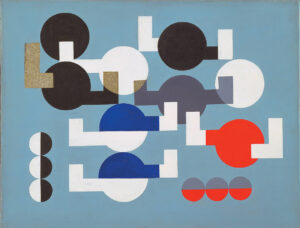
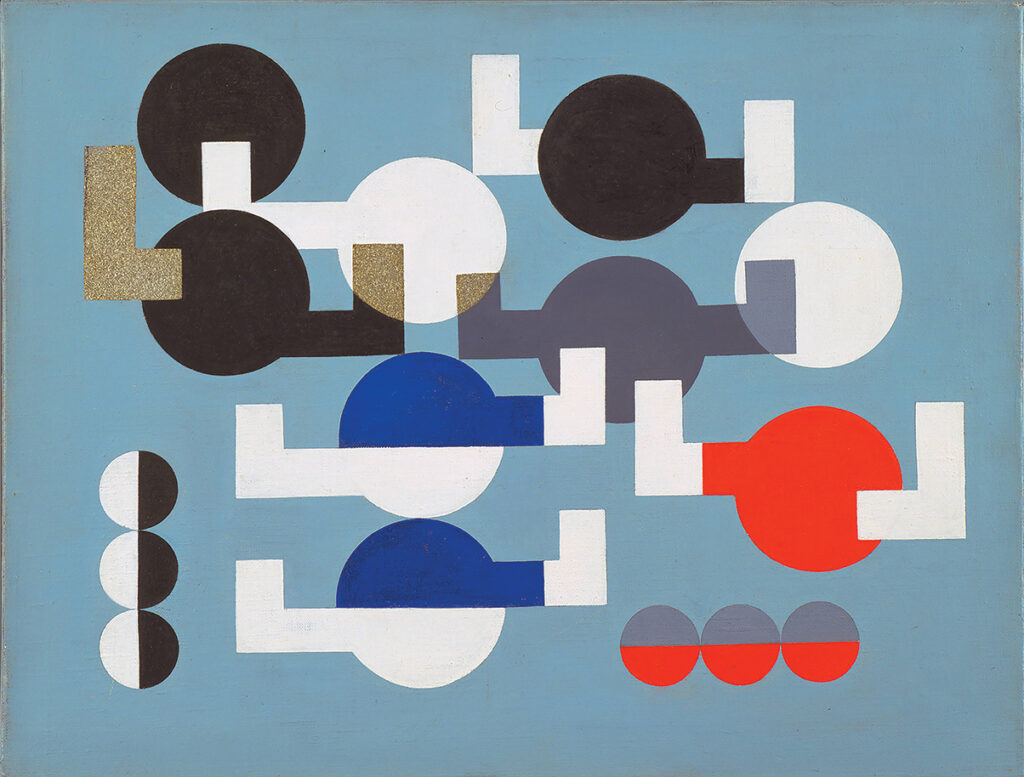
Composition of Circles and Overlapping Angles, 1930, oil and metallic flakes on canvas, 19 1⁄2 x 25 1⁄4 in.
The Museum of Modern Art, New York. The Riklis Collection of McCrory Corporation. Photo: The Museum of Modern Art, Department of Imaging and Visual Resources. © 2019 Artists Rights Society (ARS), New York / VG Bild-Kunst, Bonn
The Tate’s presentation of “Sophie Taeuber-Arp” marks the first major exhibition of the artist in the U.K. Surprisingly, Taeuber-Arp never had a solo exhibition or retrospective during her lifetime. This is not to say her work wasn’t showcased publicly—she took part in numerous group exhibitions and juried shows, both in her native Switzerland—and more specifically Zurich, where she began her career in 1914—and in Paris, where she relocated in 1929. Her marionettes for King Stag, for instance, were included in the “12th National Exhibition of Art,” an arm of the Swiss National Exhibition in Bern in 1914. Her work was featured in a seminal series of exhibitions at the Kunsthalle Basel, Kunsthaus Zürich and Kunsthalle Bern in 1918–20 titled “The New Life” and in the First National Exhibition of Applied Art in Lausanne in 1922 and the International Exhibition of Modern Decorative and Industrial Arts in Paris in 1925. Taeuber-Arp’s textiles were frequently shown at the Museum of Applied Arts in Zurich, Winterthur, and Basel, and in exhibitions organized by the Swiss Werkbund, with the museums also purchasing her pieces for their collections.
After her move to Paris, Taeuber-Arp joined a succession of groups, often alongside Arp, and exhibited among constructivists, concrete artists, and surrealists. In 1930, she joined Michel Seuphor and Joaquín Torres-Garcia’s group, Cercle et Carré, alongside artists like Robert and Sonia Delaunay, Walter Gropius, Wassily Kandinsky, Le Corbusier, László Moholy-Nagy, Fernand Léger, and Piet Mondrian. At the group’s exhibition at Galerie 23 in the spring of 1930, she exhibited three paintings. She was part of Abstraction-Création from 1932–34, and the Allianz, a group of modern Swiss artists, in 1937. She took part in the latter’s 1942 exhibition at the Kunsthaus Zürich. She also showed with the Association Artistique Les Surindépendants, a group that exhibited constructivists and surrealists together, and a.r., an avant-garde Polish group. (The involvement with a.r. led to Taeuber-Arp’s donation of pieces to Europe’s first modern art museum in Lódz, Poland.) In 1938, she was in the “International Exhibition of Surrealism” at the Galeries Beaux-Arts in Paris, Surrealism’s last deep breath in the city. Taeuber-Arp was in the 1929 show “Modern Art from Spain and Abroad” at the important Barcelona venue, Galeries Dalmau, and in the 1935 exhibition “Thesis, Antithesis, Synthesis” at the Kunstmuseum Luzern (a condition of Arp’s participation). Her dada heads made their way to MoMA in 1936 for the watershed “Fantastic Art, Dada, Surrealism” exhibition. Taeuber-Arp herself curated “International Contemporary Art: Constructivism, Neoplasticism, Abstract Art” at the Kunstnerforbundet in Oslo with Arp and Vilhelm Bjerke-Petersen in 1938.
Taeuber-Arp’s first retrospective was posthumous, being held at the Kunstmuseum Bern in 1954. It was organized in part by her husband, and thus through the lens Umland and Krupp describe, with her applied art and design works deemphasized. In 1977, as second-wave feminism was putting a spotlight on the “feminine” forms of craft that historically had been denied fine-art status, a major Taeuber-Arp exhibition in Winterthur, Switzerland, and Strasbourg, France, included a critical number of the artist’s applied artworks and architectural designs. In 1981, MoMA held a small exhibition of Taeuber-Arp’s work that also featured designs and applied-artworks, but Umland and Krupp write that they were “decontextualized within a deliberately formal presentation.”
The current exhibition in London, and surely its iteration later this year in New York, is designed to showcase all of Taeuber-Arp’s work in context. The idea is to make room for every aspect of the artist’s practice, and achieve the sense of balance and understanding that institutions and the art-historical canon seemed to have struggled with in the past. The artist fittingly wrote in 1922, “Only when we go into ourselves and attempt to be entirely true to ourselves will we succeed in making things of value, living things, and in this way help to develop a new style that is fitting for us.”

Subscribe to Art & Antiques for your Digital or Print copy