Subscribe to Our Newsletter
Moving Designs: Art Deco Cars and Motorcycles

Cars from the Art Deco era park themselves at the MFA Houston.
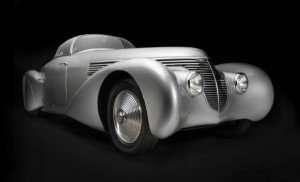
Andre Dubonnet, Jean Andreau, Hispano-Suiza, H6B Dubonnet “Xenia” Coupe, 1938;
Featured Images: (Click to Enlarge)
-
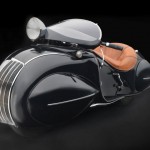
- O. Ray Courtney, Henderson Motorcycle Co., KJ Streamline Motorcycle, 1930.
-
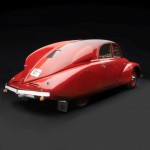
- Hans Ledwinka, Tatra, T97, 1938.
-
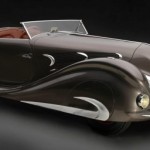
- Bodywork designed by Figoni & Falaschi, Delahaye, 135MS Roadster, 1937;
-
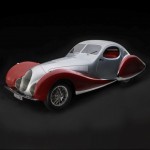
- Bodywork by Figoni & Falaschi, Talbot-Lago, T150CSS Teardrop Coupe, 1938.
-
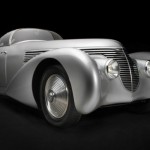
- Andre Dubonnet, Jean Andreau, Hispano-Suiza, H6B Dubonnet “Xenia” Coupe, 1938;
Art Deco, which appeared before World War I in France and flourished internationally throughout the first half of the 20th century, was heavily influenced by new technological developments and industrialization. This thoroughly modern style—which favored symmetry and sharp, straight lines—lent itself fittingly to the design of automobiles. “Sculpted in Steel: Art Deco Automobiles and Motorcycles, 1929–1940,” a new exhibition at the Museum of Fine Arts, Houston (February 21–May 30), puts 14 cars and 3 motorcycles from the height of the Art Deco era on view. The show also includes historical images and videos, which will help position the cars and bikes within a greater art historical context.
The show is organized by Cindi Strauss, the MFA Houston’s curator of modern and contemporary decorative arts, and Ken Gross, an automobile expert and former director of the recently reopened Petersen Automotive Museum in Los Angeles. Gross was the brains behind the exhibition “Sensuous Steel,” which was held at the Frist Center for the Visual Arts in Nashville in 2013. The show, which Strauss describes as a “huge hit,” was larger, putting 18 vehicles on view. “Our show,” says Strauss, “is a more focused view of the period. It conveys the same kinds of themes, in terms of thinking about Art Deco, luxury, glamour, and exceedingly rare automobiles—some one of a kind—but we are focusing all our interpretive materials very specifically on the design.” The vehicles in the show abound with elegant touches and stylish details, from interiors and upholstery to instrument panels and steering wheels. “These choices,” says Strauss, “relate to the larger themes one sees in furniture design, fashion, and metalwork.”
Art Deco was introduced internationally at the 1925 Paris World’s Fair and promptly became an influential style outside of Paris. “Sculpted in Steel,” which boasts vehicles of French, American, Czech, Italian, and German make, will juxtapose international conceptions of Deco design. Says Strauss, “The show places the vehicles within the style of each country.” She also notes that although the earliest car in the show—a one-of-a-kind Bugatti Type 46 Semi-profile Coupe—dates to 1929, the Deco influence can be seen in vehicles from before then.
During the Deco period, bodywork became incredibly important, and design firms were called in to collaborate with car companies on body design. For instance, the Italo-French coachbuilder, Figoni et Falaschi designed some of the most elegant automobile body shapes between the 1930s and the 1950s. (Designer Giuseppe Figoni was Italian by birth but moved to Paris in his youth and started his firm, and Ovidio Falaschi, an Italian businessman, became his business partner in 1935.) The firm is responsible for the bodywork of three of the cars in the exhibition—the 1938 Talbot-Lago T150C-SS Teardrop Coupe, the 1936 Delahaye 135M Competition Coupe, and the 1937 Delahaye 135MS Roadster.
At the time, there was also a major crossover between the aerospace industry and the car industry. The H68 Dubonnet “Xenia” Coupe, a 1938 model so sleek it seems to be cutting through the air even when parked, was manufactured by Hispano-Suiza, a Spanish automotive and engineering firm that not only produced cars but also aviation engines in Europe before World War II. The aircraft influence on the coupe’s design is evident. Says Strauss, “So many of the features on that car resemble airplane engines.”
Museum-goers may notice that the vehicles in the show are largely monochromatic. Manufacturers at the time favored either black or silver, to show off the clean lines and emphasize the chrome detailing. Says Strauss, the color choices “evoke the glamour of the age.”
The Cord Corporation, Auburn Model 810 “Armchair Sedan” in the exhibition, designed by Gordon Miller Buehrig, is a model from 1936. Buehrig, a prominent car designer from Illinois, joined the Auburn, Ind.-based Auburn Automobile Company in 1934, after having become the chief body designer for Duesenberg at the age of 25. Buehrig, who worked in the industry well into the ’60s, designed the Armchair Sedan, which has what Strauss describes as having a “complete unification of details, interior and exterior.” Another American model, Ford’s Model 40 Special Speedster, was designed specifically for Edsel Ford by Ford Motor Company styling chief E. T. “Bob” Gregorie and the Ford Aircraft Division fabricators. Incorporating both racing and aeronautical elements, it is the only one of its kind ever produced.
Another one-of-a-kind vehicle, the 1930 Henderson KJ Streamline, was designed by O. Ray Courtney for Henderson, a division of Excelsior Motor Mfg. & Supply Co., a competitor of Harley-Davidson. A nearly Platonic example of streamlining, the motorcycle has tire covers that resemble airplane engines, a teardrop-shaped body, a slightly bucketed seat, and a chrome grill, all designed to look fast as hell. The 1940 Indian Chief, another motorcycle in the exhibition, was more affordable, with a body style that seems more like those of today’s motorcycles. White with green accents and a tan seat, the bike seems perfect for a cross-country trip.
The 1936 Stout Scarab put the suburban minivan to shame. Designed and manufactured by William Stout for his own self-started Stout Motor Car Company, the example in the show is one of 6 to 10 ever produced. Says Strauss, “It’s innovative for its rear engine, styling, and the fact that it operates as a precursor to the minivan. It has a back bench for three people, interior chairs that are moveable, a front passenger seat that can move around, and an option for a table. And it was fast—you could really move along.”
The 1938 Tatra T97 was designed in Czechoslovakia by Hans Ledwinka. For this model, the concepts developed by Zeppelin designer Paul Jaray were licensed. This automobile, which can be seen in the show in bright red, has a rear dorsal fin and integrated fenders, giving it a unique look that is a precursor to the space-age designs of the ’50s and ’60s. Not surprisingly, Strauss says, “it was featured widely in films.”
“Sculpted in Steel” runs at the MFA Houston alongside a sister show, “Deco Nights: Evenings in the Jazz Age” (December 12–June 5). The exhibition puts Art Deco objects from the museum’s permanent collection on view, including costumes, furniture, glass, metalwork, and accessories and should give viewers an immersive Deco experience.
—
By Sarah E. Fensom

Subscribe to Art & Antiques for your Digital or Print copy