Subscribe to Our Newsletter
Art Deco Sculptures: The Dance of Deco
Art Deco sculptures, exuberantly celebrating life and freedom in bronze, limestone, ivory, and other media, have long since recovered from past critical disdain and are leaping to new heights on the market.
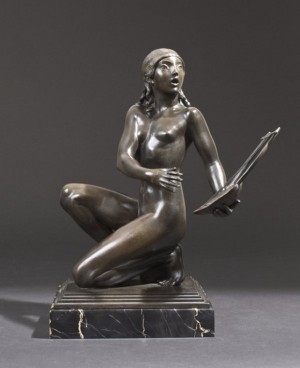
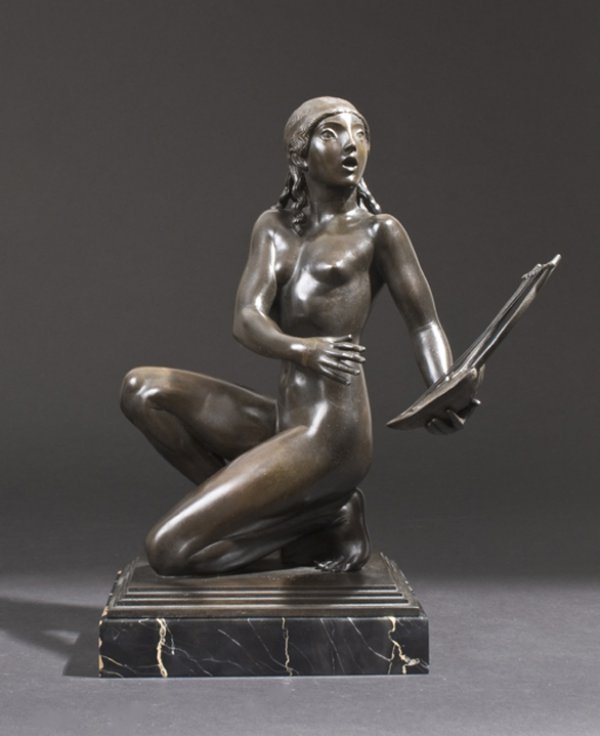
Paul Manship, Lyric Muse, 1912.
Featured Images: (Click to Enlarge)
-
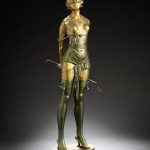
- Bruno Zach, Riding Crop, circa 1930.
-
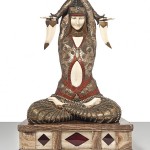
- Demétre Chiparus, Shiva;
-

- Paul Manship, Lyric Muse, 1912.
-
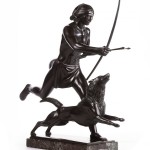
- Paul Manship, Indian Hunter and His Dog, 1926.
-
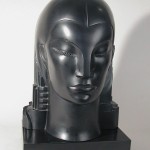
- Boris Lovet-Lorski, Head of a Woman, 1935.
Alice Duncan insists that Paul Manship, he of the gilded Prometheus that seemingly floats over the skating rink at Rockefeller Center in midtown Manhattan, is not an Art Deco sculptor. The only way she’d be comfortable seeing her name, Manship’s name, and the phrase “Art Deco” in the same sentence is if that sentence contains a carefully placed negative or two. “If you look at his work, it’s not that Deco. It’s streamlined,” says Duncan, a director at the Gerald Peters Gallery of New York and Santa Fe, who has handled Manship’s work since the late 1970s. “He takes antiquity and defines it through modern eyes. It’s very unique and very American.”
She has a point. The term “Art Deco” wasn’t in use when Manship was in his pre-World War II prime; according to the Victoria and Albert Museum, which mounted a seminal exhibit on Art Deco in 2003, the phrase didn’t gain currency until the 1960s. “Art Deco” covers different types of art that just happened to come into being around the same time, all animated by the forward-looking spirit of the age. Putting a circa-1925 small Manship bronze next to a circa 1925 bronze-and-ivory sculpture by the Romanian-born artist Demétre Chiparus brings this fact out even more starkly. Collectors of Manship and Chiparus don’t tend to overlap, but works by both, as well as other Art Deco-era sculptors, draw strong sums at auction and are only growing in esteem.
Of course, this wasn’t always the case. After bursting onto the art-world scene like gangbusters in 1912, selling all 96 bronzes in his first New York show, Manship enjoyed decades of dominance. The end of World War II and the rise of abstractionism inaugurated his decline, and while he continued to win commissions, he had thoroughly faded by the time he died in 1966. “He went from being extraordinarily popular and successful during his early and mid-career to almost forgotten,” says Joel Rosenkranz, founding partner of Conner Rosenkranz, a sculpture-focused gallery in Manhattan. “Collectors and tastes had changed. I think he just ran the course.”
Manship’s climb back to prominence was aided by dealers such as Duncan and Rosenkranz, as well as by new generations of curators who were ready and willing to view him through fresh eyes. Rosenkranz mentions co-authoring a 1989 book titled Rediscoveries in American Sculpture, which included Manship among its 20 artist-subjects. “At that time, I think the title was accurate. He was not in favor in the market. Curators didn’t take him seriously,” he says. “In the decades since the book has been published, Manship has been rediscovered.” Manship’s return was also aided by the high quality of his smaller pieces, which generally range in size from 12 inches up to four feet. “He viewed them almost like jewelry,” Rosenkranz says. “All the surfaces were refined, and I think people respond to that.”
Manship reproduced several, but not all, of his public commissions on a smaller scale in limited numbers. “A lot of his monumental works were extremely successful in reduction and translated well into reduction,” says Duncan. One notable example is his 1926 bronze Indian Hunter and His Dog. The original graces a pool in Cochran Park in Manship’s hometown of St. Paul, Minn.; a 21-inch version that had belonged to the sister of the man who commissioned the original sold at Sotheby’s New York in December 2013 for $1.5 million, a record for the sculptor. Sadly, there are no petite Prometheuses to be had. It appears that the Rockefeller family did not give Manship the rights to reproduce the now-iconic sculpture at a size that would suit a home setting.
Just as iconic as Prometheus is French sculptor François Pompon’s Ours Blanc, or White Bear, unveiled to great acclaim in 1922. Though Émile-Jacques Ruhlmann placed smaller versions of White Bear in two interiors he designed for the 1925 Paris Exposition, which was later recognized as the event where the Art Deco style flowered, Edward Horswell of Sladmore Gallery in London does not believe Pompon should be described in that way. “I don’t think Pompon was an Art Deco sculptor. I think he influenced the movement that followed,” he says, noting that the artist had abandoned his previous academic style in favor of something markedly more streamlined around 1910 or so. Pompon, a former assistant to Auguste Rodin, waited a long time for success. He was 67 when he showed his eight-foot-long polar bear at the Salon d’Automne. He had never created anything so large before, and it was his first depiction of an exotic animal. Financial constraints forced Pompon to make the bear from plaster, but the cheaper material didn’t blunt the sculpture’s impact in the slightest. “He pulled it off,” Horswell says. “His other pieces are good, but he just hit the mark. Also, people were surprised to see a modern sculpture of an animal in that size. The newness of it would really have surprised people and made them warm to it.” Pompon reproduced the White Bear in several materials in limited numbers. A limestone example dating to 1931 was offered at Sotheby’s London in June and fetched £329,000 ($516,266). The auction record for Pompon is not a White Bear but a circa-1925 bronze of a striding tigress. The big cat sold for €607,500 ($754,437) at Christie’s Paris last November.
Still other Art Deco-era sculptors deserve more attention than they have received. Chief among these is Boris Lovet-Lorski, a Lithuanian-born artist who emigrated to the U.S. in 1920. “Lovet-Lorski was different from Manship in that he loved exotic stone, he loved unusual material,” Rosenkranz says. “He wasn’t shy about distorting anatomy and proportions to get a streamlined effect, something that Manship would not have done. He broke the rules to get the effect he wanted.”
Manship and Pompon sculpted for clients, galleries, public commissions, and high-profile events such as salons and world’s fairs; Chiparus and his contemporaries often showed their wares in department stores, and they catered more explicitly to a range of price points. The multi-figure creations of Chiparus represented his top-of-the-line models. They were expensive when they were ordered, and they drive auction and world records today. The apparent world record for Chiparus belongs to a three-figure version of The Finale, a circa-1925 trio in which two female dancers flank a male dancer who wears a body suit. Offered in November 2013 at Bonhams London, it garnered £290,500 ($454,188). In the three-figure version, the fingertips of the dancers’ hands meet, but in the single-figure versions, the fingertips flare outward, wing-like. “If someone just wanted a single, or could only afford a single, [Chiparus] would accommodate that,” says Mark Oliver, a specialist at Bonhams. Also worth mention is a stunning five-figure 12 7/8 inch-high circa-1928 version of his Les Girls, a showstopper that depicts a line of five dancers in elaborately decorated turquoise body suits, which commanded $434,500 in December 2012 at Sotheby’s New York. As with The Finale, Chiparus made Les Girls in several versions: a single dancer, a trio, and a version rendered in a larger size. Chiparus was also open to producing all-bronze or all-ivory renditions of his figures.
As with Manship, sculptures by Chiparus and his contemporaries fell out of fashion after World War II. But Chiparuses and the like often suffered worse fates than Manships. “Many were destroyed in the bombings and also damaged by the upheaval and moving about of the time,” says Janice Kehoe, owner of Solo Antiques in Preston, Lancashire, in the U.K. “On some occasions, people were left to sort things out after deaths, and they would come across these figures and throw them out, as they had no idea what they were.” Oliver reports that some were deliberately destroyed. “Several were broken up in the 1950s when they were considered to be kitsch and vulgar,” he says. “Those in more responsible and appreciative [hands] have survived.”
Chiparus’ style of Art Deco sculpture has been popular since it enjoyed a revival of interest in the 1970s, but prices exploded in the mid-2000s when Russian collectors made their presence known. “There was a huge increase in interest in the Russian market,” says Jeremy Morrison, a senior director in the 20th-Century Decorative Art & Design department at Christie’s London. “They amassed huge numbers of figures in a relatively short period of time. They bought across the market, propelling it up. From the heights of 2007 and 2008 it started to diminish, partly because of the blip and partly because they got everything,” he says, laughing. Prices are softer now, but they are still strong, and collectors can expect to pay low six figures for the best of the best. Motifs that reference the Ballets Russes—a company that bewitched Chiparus—are especially popular and are beloved by Russian collectors. The Finale immortalizes a curtain call at the Ballet Russes, and the central male figure is believed to be based on Vaslav Nijinsky. Oliver attributes its strong auction performance to its scarcity, its condition, and “just being the right piece at the right time,” more than enough to fuel a spirited fight among determined bidders. Another circa-1925 sculpture that Chiparus actually named Ballets Russes sold for £192,500 ($377,878) at Christie’s London in April 2008. Its identically dressed female figures are shown mid-stride in flowing, flaring skirts.
In this field of Art Deco sculpture, bigger does seem to be better in the eyes of collectors. “Chiparus is the most valuable sculptor,” says Morrison. “He makes higher prices than anyone else. Though [Ferdinand] Preiss is considered the better carver, he does not produce on the same scale.” Chiparus didn’t shy away from creating sculptures in the two-foot-high range. Contrast this with Preiss’ lauded Torch Dancer, a vibrant figure of a young woman balancing on one foot, arching her back, and holding a flaming ivory torch in each hand. A circa-1925 example sold at Christie’s London for £18,500 ($36,316) in April 2008. It stood just over 16 inches high, and a goodly portion of its height is provided by its onyx base. The Christie’s house record for Preiss was set in the same sale by The Archer, a circa-1925 sculpture that is unusually large for the artist, at 18 ½ inches high on a relatively low and flat green onyx base. Its hammer price was £48,500 ($95,206).
Chiparus and Preiss had many competitors, but the most interesting and curious of the bunch has to be Bruno Zach, a Ukrainian-Austrian known for his erotically charged sculptures of women. One of the enduring appeals—perhaps the chief appeal—of Art Deco sculptures of this type is the depiction of women. Self-assured and glowing with life, they shed their corsets and their constraints, dancing in body-hugging leotards, playing sports, and generally delighting in their newfound freedoms. Zach’s women are self-assured in a different fashion; suffice it to say that his sculptures were not sold in department stores. “Not all Zachs are raunchy, but the ones that make the big money are the raunchier studies,” says Oliver. Bonhams sold a 32-inch version of Riding Crop, a circa 1930 sculpture of a topless woman in high heels holding a riding crop behind her back, for £97,250 ($151,931) in November 2011. Christie’s London squeaked past Bonhams for a new auction record with another Riding Crop of the same size, dated about five years earlier, sold for £97,875 ($152,098) in May 2013.
Art Deco sculptures that combine bronze and ivory are often described as being chryselephantine, a portmanteau that combines the Greek words that refer to gold (chrysos) and ivory (elephantinos). Chiparus, Preiss, and their compatriots were drawn to ivory in part because the Belgian government of the time subsidized imports from its African colony, making the material relatively cheap. Ivory is also a dream to carve and nicely approximates Caucasian flesh tones, and chryselephantine sculptures certainly revel in the flesh: Cut-outs in bronze cold-painted costumes reveal ivory navels, thighs, and shins. But new laws passed in the U.S. that govern the sale of ivory are having an effect on sales of chryselephantine sculptures. The laws make most imports of African elephant ivory into the U.S. illegal, even if no one doubts that the ivory predates the year 1970.
Kehoe, for her part, is seeing a surge in interest. “Bronze and ivory figures are making exceptionally high prices. There are lots coming onto the market as people are concerned they may not be able to sell them if the law changes,” she says. “Buyers are paying high prices as they think that once the law changes they will not be able to buy them again. It is an artificial market at this time.” Oliver and Morrison, who are both based in the U.K., report having lost their American clientele since the U.S. law took effect, but they also say they aren’t experiencing a spike of interest in all-bronze figures, nor have sales of
chryselephantine taken an obvious or dramatic hit. Morrison’s May auction saw “all sold, and all sold quite well—we were delighted by that.” He and his Christie’s London colleagues will test the market again on November 3 at the King Street location with an auction that will include more than half a dozen Chiparuses, including a rare large-scale Shiva on an alabaster base. Bonhams London takes its turn on November 17 with an auction that will include sculptures by Chiparus, Preiss, and other notable names.
While there have been major museum shows devoted to Art Deco, Manship, and Pompon, not much has been done on Chiparus and his competitors. Even still, Oliver, Kehoe, and Morrison continue to welcome a healthy mix of collectors who learn about these sculptures and want one of their own. “Hand on heart, I think it’s just the charm of the pieces themselves,” says Morrison. “They resonate.”
—
By Sheila Gibson Stoodley

Subscribe to Art & Antiques for your Digital or Print copy