Subscribe to Our Newsletter
Between the Lines

Inspired by spiritual ideas, Piet Mondrian created a radical art that aimed to transform the world.
By Sarah E. Fensom
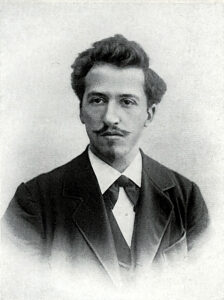
Piet Mondrian, 1899.
Piet Mondrian joined the Dutch arm of the Theosophical Society in 1909. His interest in a newly emerging spirituality had begun earlier, however. The artist, who was raised as a Calvinist, read Theosophical literature and attended lectures by the Austrian philosopher and esotericist Rudolf Steiner in Amsterdam in 1908. These curiosities were not unusual for the time. Theosophy, which was co-founded by Helena Petrovna Blavatsky in New York in 1875, quickly gained steam in Europe. It found a strong foothold among the avant-garde in the Netherlands, and in 1904, 40 Dutch artists took part in a show associated with the Theosophical Society’s International Convention in Amsterdam.
Theosophy was a sort of spiritual catch-all, in which bits and bobs of Eastern and Western religious, philosophical, and artistic ideas coalesced. It sought to exist between the poles of scientific progress and the church, in a sort of reconciliation of the divine universe resolved through evolution. Vasily Kandinsky, a student of Theosophy, tapped into its teachings that color could communicate with the soul. Hilma af Klint, the Swedish artist and Theosophical practitioner, is now widely credited as a pioneer of abstraction. She believed that abstract art was a “spiritual precursor of a utopian social harmony, a world of tomorrow.”
During what is sometimes referred to as Mondrian’s “Symbolist” period, he painted the triptych Evolution (1911). The work is perhaps his most clearly associated with Theosophy. Each section features a figure depicted in blue. The central panel was the realization of the titular evolution and it not only protruded more than an inch further into space, it was also installed by the artist higher than the side panels. In Isis Unveiled (1877), Blavatsky’s first major work, she wrote that three spirits live in man, but that all three are “only as the image and echo of one and the same all-constructing and uniting principle of production.” Of the three, the first is “the spirit of the elements (terrestrial body and vital force in its brute condition); the second, the spirit of the stars (sidereal or astral body—the soul); the third is the Divine spirit.” Taken as a more literal interpretation of Blavatsky’s writings, Evolution can be read as the transformation from matter to soul to spirit. But it can also be seen as the flow of the art-making process and a collapsing of a progressive transformation into a broader whole. The Mondrian specialist and curator Hans Janssen writes, “The three parts remained separated to emphasize the step-by-step development from one to the other, and the sum equaled more than the parts, the visual impact of the whole transcending the individual elements.”
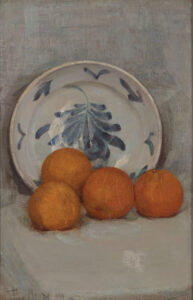
Still Life with Oranges, 1900, oil on canvas, 46 x 30 cm.
Myron Kunin Collection, Minneapolis © 2020 Mondrian/Holtzman Trust
Similarly, Janssen writes about this notion of evolution being central to an exhibition Mondrian presented at the Stedelijk Museum in 1909—a point of crucial understanding for the artist’s work to come. Mondrian’s work occupied three galleries. In the first, he presented early studies in simple pine frames. In the third, he presented a monumental evening landscape he had painted several years earlier. He placed all new work in the second and middle gallery, including Metamorphosis, a moody depiction of a dying chrysanthemum and a triptych of a haystack, showing it at sunset, after sunset, and in the dark in silhouette. Janssen speculates that Mondrian got the idea from a lecture he saw Steiner give in Amsterdam in March of 1908. Steiner had discussed the Hegelian system of the triadic development of ideas. Janssen relates this system to Mondrian’s curatorial technique as follows: Mondrian’s sketches in the first gallery represent the “idea in itself”; the landscapes in the final gallery represent the “idea out of itself, in nature”; and the “unconventional pictorial forms” in the central gallery represent the cumulation of the “idea in and for itself.”
This manner of presenting work outside the chronological order was an innovative artist statement regarding the idea of artistic development over time. All three galleries worked in collaboration, the way Blavatsky described the three spirits of man, but they also challenged one another. Janssen writes, “It was a model of the ideal of art, the ultimate artwork. That is, Mondrian took what normally occurs over time in a linear manner—the process of making art—and folded it in on itself, divided into three, making the linear suddenly appear cyclical. This implies a process of growth, decline, and progress and also suggests something about the function of art in society as a whole. It is an image, an example, of how society behaves and develops.”
The artist Édouard Schuré, a friend and colleague of Mondrian, wrote about the Dutch artist’s spiritual beliefs—also a tripartite development. Schuré said that Mondrian “went from Calvinism to Theosophy and from Theosophy to Neoplasticism.” Neoplasticism, which Mondrian made manifest in his most significant paintings but also wrote about extensively in the late 1910s and 1920s, is an exploration of Theosophical ideas. He called the neoplastic concept the most “objective and rational way possible to transmit” the Theosophical “Absolute” (the Society’s version of a supreme being). And in 1917, he shared several of the first articles from “The New Plastic in Painting,” his early, 11-part treatise on the subject, at a meeting of the Theosophical Society. Later, in 1921 he sent a copy of his book Le Néoplasticisme to Steiner with a note that called his concept the art of the “foreseeable future” for Theosophists.
He continued: “Art gives visual expression to the evolution of life: the evolution of the spirit and—in the reverse direction—that of matter. It was impossible to bring about an equilibrium of relationships other than by destroying the form, and replacing it by a new, universal expressive means.”
But as Schuré notes, Neoplasticism wasn’t just the way Mondrian expressed Theosophical beliefs, it was also Mondrian’s development of a sort of devotional doctrine—a pattern of artistic beliefs to be observed. The artist thought that Neoplasticism could eventually supplant religion and the artist could become a “priest of this religious art.”
The recent exhibition “Mondrian and De Stijl” organized by the Museo Reina Sofía in Madrid, Spain, and the Stichting Kunstmuseum den Haag, in the Netherlands, in collaboration with the Comunidad de Madrid (and curated by Janssen), doesn’t focus primarily on Mondrian’s spiritual side. However, it does conceive of Mondrian as a sort of utopian visionary. “Mondrian and De Stijl” was on view at the Reina Sofía through March 1, but the works are returning to the Kunstmuseum den Haag, where they form part of a permanent installation.
The show posits Mondrian not as a dreamer pursuing some far-flung state of perfection but rather as a holistic thinker who courted a heterogenous, relational practice. Through the dynamic evolution of his work, in relation to De Stijl as a group, and with the curation of his own exhibitions throughout his career, he pursued a broad program designed to reconstruct the visual atmosphere.
If Mondrian sounds a bit freaky, it’s important to remember that Modernism and its many tributaries had the goal of changing the world, as all artistic or philosophical movements should. At its best, the movements under the Modernist umbrella wanted to create a better, more equitable society through experimentation, subversion, abstraction, and progress—a sort of sublime newness. And of course, the world did change, but not because of the complete fulfillment of an absolute Futurist or Bolshevist or nudist (etc., etc.) vision. It’s the ripped-off pieces of these ways of thinking and creating that led to the monumental progress of the 20th century.
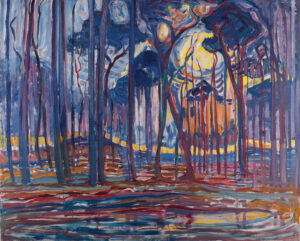
Woods Near Oele, 1908, oil on canvas, 128 x 158 cm.
Kunstmuseum Den Haag © 2020 Mondrian/Holtzman Trust
Mondrian began his career in 1892. He painted still lifes, like the elegant Still Life with Oranges (1900, oil on canvas) and landscapes like the Impressionist-inspired Evening at Weesperzijde (1901–02). Over the course of nearly 20 years, he honed his skills as a painter, exploring artistic movements like Pointillism, Fauvism, and Cubism. Landscapes right before and during his Symbolist period, like Large Landscape (1907–08) and Woods Near Oele (1908), show the artist working in a highly expressive style that began to flirt with abstraction. In Apple Tree, pointillist version (1908–09, oil on composition board), a depiction of a tree in staccato strokes, Mondrian simplifies his technique further into lines and basic forms.
Composition No. II (1913, oil on canvas) was the first painting that satisfied Mondrian on his quest for what he called “pure beauty,” based on the surface and on the structure and composition of color and lines. It’s also one of the first canvases a viewer might recognize as “a Mondrian.” The painting was based on a drawing of a river view near Amsterdam, Geinrust Farm, but one wouldn’t know that from looking at it. Instead, the canvas features a tight system of lines that form squares and rectangles. The palette is heavily muted shades of green, yellow, and red mixed with gray, and the painting’s edges are blurred with gray.
Mondrian had settled in Paris in 1913, but at the onset of World War I in 1914 he was visiting Amsterdam. Stuck in Holland during the war, he began to limit the use of color and geometric forms in his work. He met the painter and critic Theo van Doesburg during this period, and the two artists founded the magazine and movement De Stijl along with the Dutch artist Bart van der Leck and the Hungarian painter Vilmos Huszár. The group proposed a rejection of the natural referent and a complete reduction of pictorial language to its basic elements. These notions were epitomized not only in Mondrian’s work but also in works like van der Leck’s Composition 1917, No. 2 (Dog Cart) (1917, oil on canvas) and Huszár’s Composition in Gray (1918, oil on canvas).
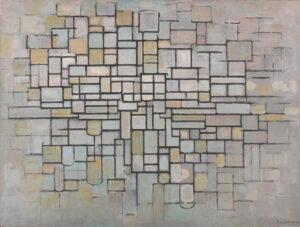
Composition No. II, 1913, oil on canvas, 88 x 115 cm.
Kröller-Müller Museum, Otterlo, The Netherlands © 2020 Mondrian/Holtzman Trust
Using the magazine as a sort of meeting place, De Stijl became a truly international movement that sought to abolish hierarchies within the arts and form a collaborative ideal. It extended beyond painting and sculpture and opened its arms to architecture, graphic and industrial design. The Dutch designer and architect Gerrit Thomas Rietveld, for instance, contributed his famed Red and blue chair (1917–23, painted beechwood and composition board), while van Doesburg collaborated with Cornelis van Eesteren on a Model for a private house (1923, wood, silk screen, Perspex, and Plexiglas).
Mondrian returned to Paris in 1919 and participated in De Stijl exhibitions there in 1923. Following disagreements with van Doesburg, Mondrian left the group in 1925. The movement and the publication continued through 1931, but compared to Mondrian fell into relative obscurity. In 1930, he began exhibiting with the Cercle et Carré movement and joined the Abstraction-Création group in 1931. With World War II looming, he left Paris for London, staying there from 1938–40. He emigrated to New York in 1940 and had his first solo exhibition there at the Valentine Dudensing Gallery in 1942. He died in 1944.
Mondrian was some 15 years older than his fellow De Stijl members and was a de facto patriarch of the movement. Through the publication’s first 11 issues, he published segments of his lengthy essay Neo-Plasticism in Pictorial Art, which outlined his aims. He wrote, “The new plastic idea cannot…take the form of a natural or concrete representation—this new plastic idea will ignore the particulars of appearance, that is to say, natural form and color. On the contrary it should find its expression in the abstraction of form and color, that is to say, in the straight line and the clearly defined primary color.” On canvas, this manifested itself as the use of only primary colors and non-colors, only straight, horizontal or vertical lines, and only squares and rectangles. In early works of this period like Tableau I (1921), which features red, blue, and yellow, Mondrian employs several color elements and clearly articulated rectangular forms. As time goes on, his lines become thicker and run more clearly to the edges of the canvas, as in Composition II in Red, Blue, and Yellow (1930) and Composition C (No. III) with Red, Yellow, and Blue (1935). In Composition B (No. II) with Red (1935), Mondrian’s use of white becomes the focus, with his vivid tomato red confined to the top left corner. In Picture II 1936–43, with Yellow, Red, and Blue (1936–43), as with a lot of the artist’s latest works, the thick black lines seem to take center stage, creating a heightened sense of drama.
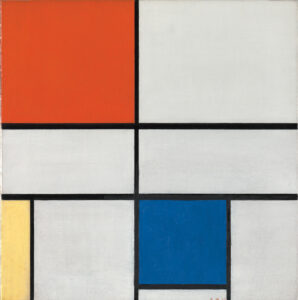
Piet Mondrian, Composition C (No. III) with Red, Yellow and Blue, 1935, oil on canvas, 56 x 55.2cm.
Tate, lent from a private collection, 1981 © 2020 Mondrian/Holtzman Trust
In his 1991 essay We Have Never Been Modern, Bruno Latour argues that the modernist project of separating nature and culture—a goal for which Mondrian was a thought-leader—never truly became functional. Hybrid objects or solutions, argues Latour, have been continually created that relate to both sides. Mondrian’s pre-Neoplastic period can be difficult to reconcile with what comes after it, like the Theosophical reconciliation of science and faith. But perhaps it’s possible to think of Mondrian’s Neoplasticism as the collapsing of landscape into something purely formal, again like Theosophy’s collapsing of world religions and philosophies into a broader belief system, rather than a denial of the existence of nature.
Between 1929 and 1938, Mondrian worked on a manuscript titled L’art Nouveau—la vie nouvelle, L’art de la vie, which was never published. In it he attempted to trace how art slowly evolved over centuries and then suddenly became abstract. Janssen writes, “Mondrian called this change a ‘mutation,’ an evolutionary concept denoting a sudden leap from an existing genus to a completely new one. He saw the sudden emergence of his own abstract art—from 1907/1908 to 1918, over a period ten years—as an example of such a mutation.”

Subscribe to Art & Antiques for your Digital or Print copy