Subscribe to Our Newsletter
Wayne Thiebaud – Borrowing From the Past
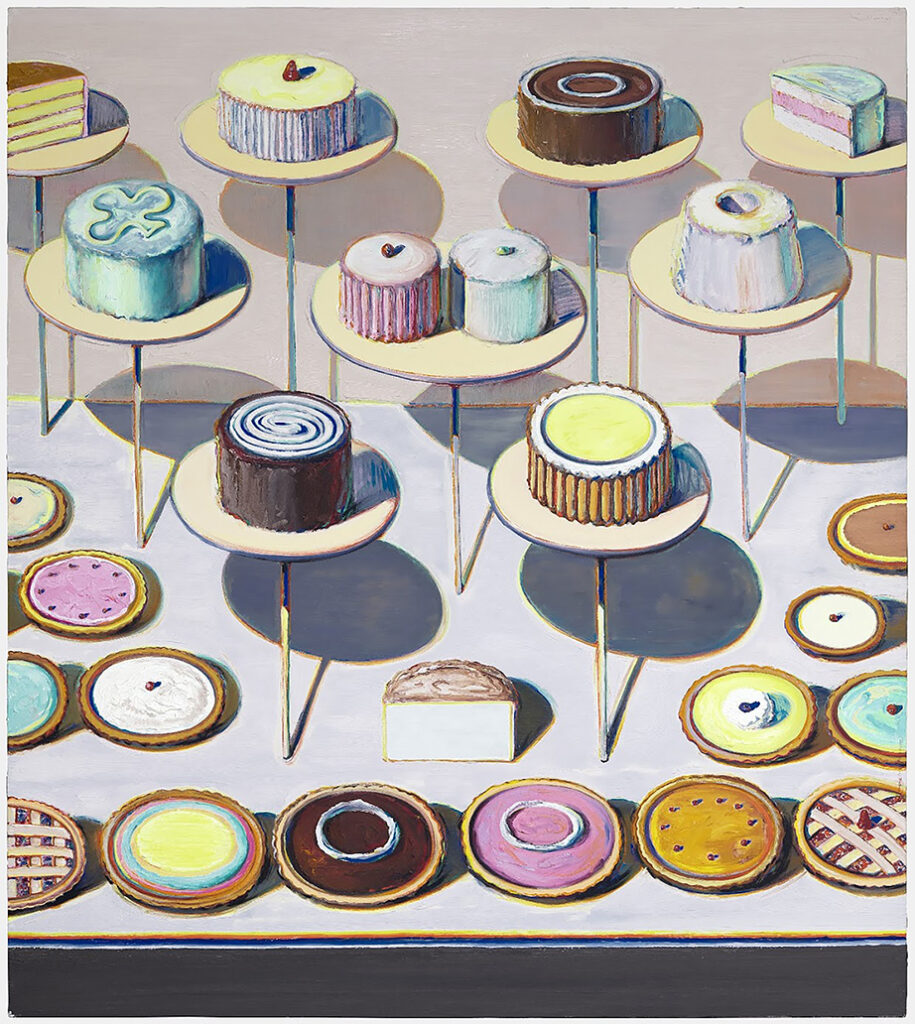
Cakes & Pies (1995)
Self-described “art thief” Wayne Thiebaud made a case for appropriating from masterworks and styles—as a way to forge his own iteration of art.
By Patti Zielinski

On a single canvas, 35 Cent Masterworks (1970–72), we see an assortment of Thiebaud’s favorite masterworks of the past.
“It’s hard for me to think of artists who weren’t influential on me because I’m such an obsessive thief,” Wayne Thiebaud once unapologetically told The New York Times. “One thing I’m cranky about is that people don’t realize painting is all one tradition. I hate dividing it.”
Thiebaud (1920–2021) was largely a self-taught painter who had a passionate engagement with art history; he regarded it as a continuum connecting artists of the past, present, and future. Such was the worldview he also imparted to the students he taught at Sacramento Junior College and the University of California, Davis, whose works, too, were ripe for Thiebaud’s appropriation.
“Wayne Thiebaud: Art Comes from Art,” organized by the Fine Arts Museums of San Francisco (FAMSF) and on display at San Francisco’s Legion of Honor (through August 17, 2025), is the first exhibition to highlight Thiebaud’s extensive reinterpretations of historical and contemporary masterworks—some on public view for the first time—alongside images of the original paintings that served as source material.
The staging of his paintings with images of masterworks is not unlike how Thiebaud as a young artist starting out in California and unable to travel was initially dependent on referencing reproductions of masterworks from museums throughout the United States and abroad rather than closely studying the real thing. But in these reproductions, Thiebaud had all of art history at his fingertips.
“Wayne Thiebaud’s engagement with art history’s ‘bureau of standards’ through the practice of appropriation and reinterpretation revealed his belief that the world of art transcended limiting definitions of time and place, as well as progress,” says Timothy Anglin Burgard, the exhibition’s curator. “Viewed from this perspective, the entire global history of art, encompassing every movement and style, was as accessible, relevant, and inspiring to Thiebaud as contemporary art.”

Day Streets (1996)
The cornucopia of art history available to Thiebaud is magnificently represented in his 35 Cent Masterworks, which depicts a display rack holding reproductions of 12 valuable paintings on sale for pennies apiece—Thomas Eakins’s The Biglin Brothers Turning the Stake; Velázquez’s Queen Mariana of Austria; Henri Rousseau’s The Snake Charmer; Honoré Daumier’s Lawyer Reading; Paul Cézanne’s Mont Sainte-Victoire; Piet Mondrian’s Tableau No. IV; Lozenge Composition with Red, Gray, Blue, Yellow, and Black; Claude Monet’s Water Lilies; Giorgio Morandi’s Still Life; Edgar Degas’s A Frieze of Dancers; Henri Matisse’s Male Model; Picasso’s Still Life with Guitar; and Giorgio de Chirico’s The Song of Love.
Other theft-worthy artists of influence included Johannes Vermeer, Jean-Siméon Chardin, Jean-Auguste-Dominique Ingres, Jean-Baptiste-Camille Corot, Édouard Manet, Vincent van Gogh, Joaquín Sorolla y Bastida, Pierre Bonnard, Walt Kuhn, George Herriman, Edward Hopper, Guy Pène du Bois, and Richard Diebenkorn. In addition, Thiebaud cited the importance of Japanese, Chinese, and Persian art, and especially their isometric perspective systems and vibrant palettes, as influences on his cityscapes and landscapes.
For the full story click on the link below for your Digital subscription:

Subscribe to Art & Antiques for your Digital or Print copy