Subscribe to Our Newsletter
Brought to Light
After 10 years in the making, San Francisco’s Legion of Honor now presents “The Etruscans: From the Heart of Ancient Italy,” a landmark show of hundreds of objects that reveals the ancient civilization.
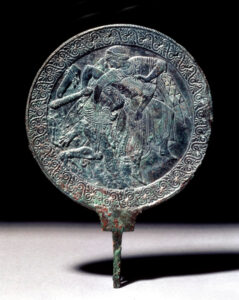
An Etruscan mirror depicting Hercle abducting Mlacuch (the Etruscan beauty goddess), 500–475 BC.
All photos courtesy of the Legion of Honor.
As the show’s curator, Renée Dreyfus, says, “This exhibition tells the story of this overlooked culture, featuring icons of Etruscan art surrounded by equally stunning and fascinating works that are little or unknown. Many of these works have never been in the United States before.” Art & Antiques is proud to feature here an excerpt from Dreyfus’s far longer essay that is included in the show’s comprehensive catalogue.
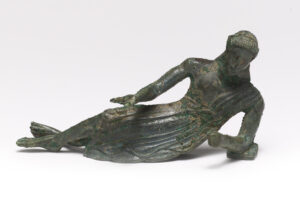
A statuette of a reclining banqueter, dating from the 6th-century BC, made of bronze.
All photos courtesy of the Legion of Honor.
This exhibition fulfills my long-held wish to introduce the complex and fascinating Etruscan culture, which significantly shaped the ancient Mediterranean world in the first millennium BC. Many people have limited knowledge of this ancient civilization, which has been overshadowed by the Greeks and Romans. This exhibition restores the Etruscans to their deserved place in pre-Roman history, presenting an array of objects stunning for their beauty, exquisite craftsmanship, and advanced technology. These works, ranging from remarkable bronze and terracotta vessels and sculptures to sumptuous grave goods and opulent gold jewelry, reveal a material legacy that continues to impress today.
However, the Etruscan legacy includes far more than glorious objects. Long before Rome dominated the Italian peninsula, it was populated by diverse ethnic groups. These populations, such as the Latins, Samnites, and Umbrians, are collectively known as the Italic people. However, the powerful Etruscan society was the principal contributor to culture and art in the first millennium BC. Recent discoveries and advances in scholarship have significantly enhanced our understanding of the richness and extent of Etruscan culture, which stands out as one of Italy’s most productive and innovative civilizations before the Roman conquest.
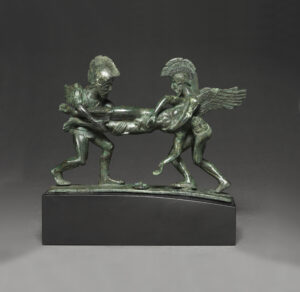
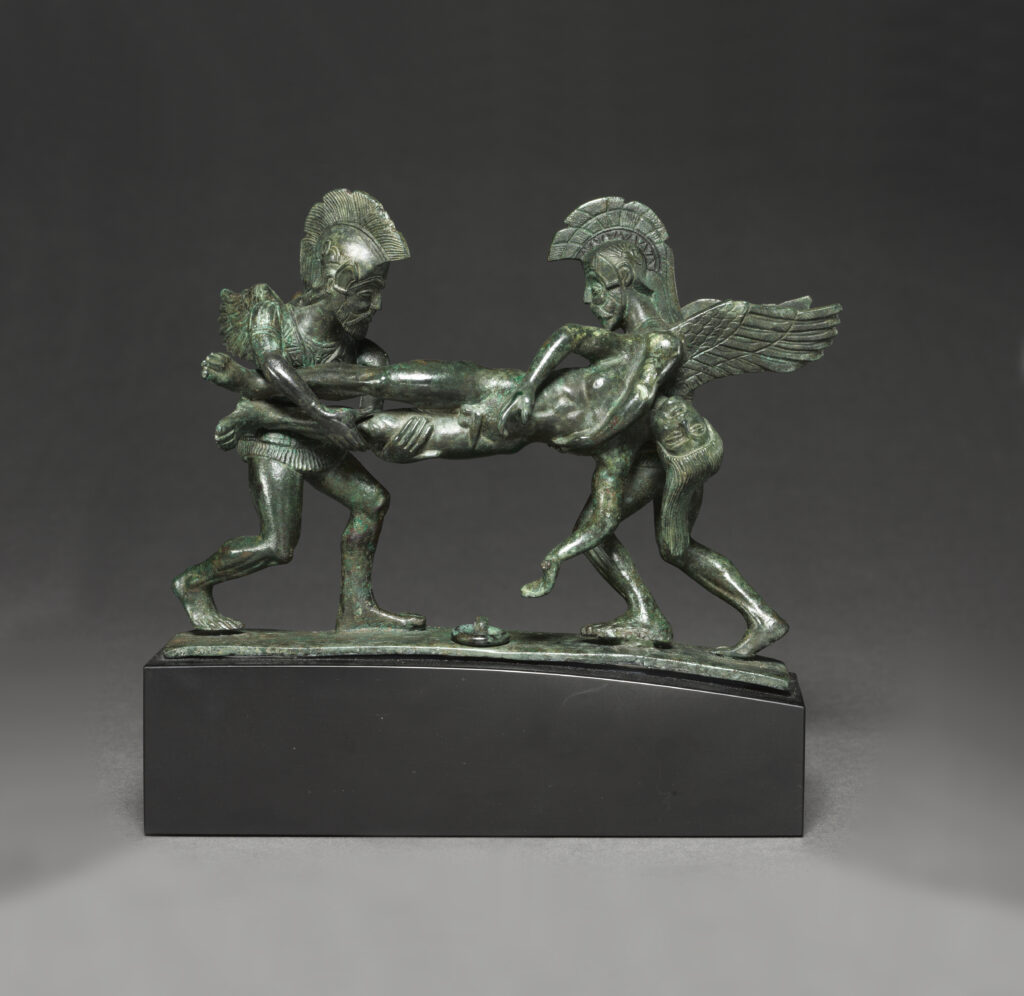
Sleep and Death fight it out in an early-fourth-century BC bronze work.
All photos courtesy of the Legion of Honor.
From the 9th to the 2nd centuries BC, Etruscan culture flourished between the Arno and Tiber rivers in present-day Tuscany and, through time, expanded into Umbria, Lazio, and other regions. The Etruscans were a sophisticated and affluent people who left behind a rich history with traditions vividly represented through the exquisite objects deposited in their tombs, temples, and sanctuaries. Renowned in their time for their wealth, religious observances, and the elevated status of women, they were major contributors to Western achievements in architecture, engineering, technology, and the arts. However, their remarkable culture remains largely unknown. Their unique, non-Indo-European tongue is a linguistic isolate with no known parent languages or modern descendants, making it challenging for scholars to decipher. These translation difficulties are further compounded by the lack of literature in the Etruscan language; almost no extensive written historical records or descriptions of the Etruscans’ daily lives and beliefs survive. Except for a few notable exceptions, the only extant examples are brief inscriptions on nonperishable materials.
The Etruscans were known in the ancient world for their profound spirituality. The Roman historian Livy (60/59 BC-AD 17) claimed that the Etruscans were antiquity’s most religious people: “The Etruscans above all other peoples by far were devoted to their religious practices because they were unsurpassed in the art of cultivating them.” Their daily lives were filled with divination, rituals, and strict religious rules set by a priestly class. Yet their sacred texts have been lost, with only one ritual calendar surviving. This extraordinary linen book, which is the longest extant Etruscan text, only exists thanks to the fortuitous reuse of its linen as wrappings for an Egyptian mummy.
The Etruscans were one of the three major powers of the ancient Mediterranean world in the early first millennium BC, alongside the Greeks and Phoenicians. Their expanded contacts with other societies via maritime trade led to a lively exchange of raw materials and finished goods, generating prosperity for the Etruscans. They also maintained trade relations with Greek colonies in southern Italy, particularly in the Bay of Naples region, where Euboean Greek merchants, among the first Greeks to venture to the West, settled. The Etruscans adopted and adapted the Euboean Greek alphabet for their written language around 725 to 700 BC out of necessity, as they began to engage in Mediterranean commerce.
For the full story click on the link below for your Digital subscription:

Subscribe to Art & Antiques for your Digital or Print copy