Subscribe to Our Newsletter
Gustave Caillebotte: The Eye of Paris
The National Gallery of Art in Washington, D.C., mounts a rare retrospective of French Impressionist Gustave Caillebotte.
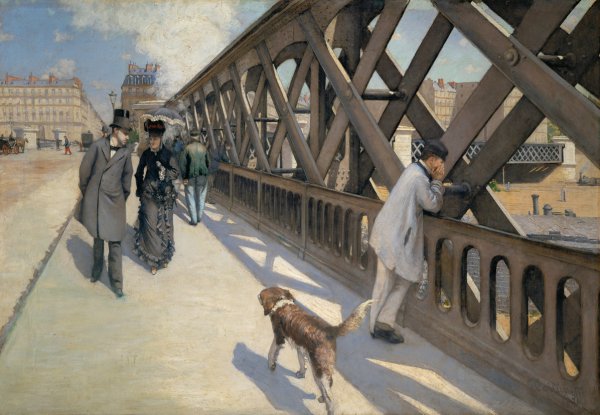
Gustave Caillebotte, The Pont de l’Europe, 1876, oil on canvas.
Featured Images: (Click to Enlarge)
-
- Gustave Caillebotte,
-
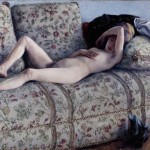
- Gustave Caillebotte, Nude on a Couch, 1880, oil on canvas;
-
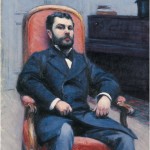
- Gustave Caillebotte, Portrait of Richard Gallo, 1878, oil on canvas.
-
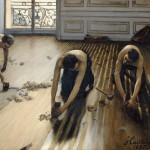
- Gustave Caillebotte, The Floor Scrapers, 1875, oil on canvas;
-
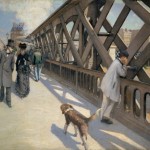
- Gustave Caillebotte, The Pont de l’Europe, 1876, oil on canvas.
-
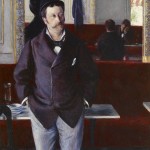
- Gustave Caillebotte,
Central to an understanding of Gustave Caillebotte’s work is the sense of place. This is not only because of the way his paintings capture Baron Georges Haussmann’s reconstruction of Paris’ urban landscape; or because he so often painted his immediate surroundings—his apartment, his neighborhood, his house at Petit Gennevilliers, his gardens, his father’s country house at Yerres, or scenes of river boating, his favorite sport. It is also because there is no single or central repository of his work. No collection stands out as the place to get a sense of his accomplishments as a great artist. The lion’s share of his paintings are in private collections, spangled across Europe and the United States. The Musée d’Orsay boasts four paintings, The Museum of Fine Arts, Boston has two (with no other major Northeastern museum having any), as do The Art Institute of Chicago and the Museum of Fine Arts, Houston. Single paintings by the artist dot the map of the Midwest in Minneapolis, Toledo, Cleveland, Kansas City, and Bloomington, Ind.
It is, then, almost miraculously that “Gustave Caillebotte: The Painter’s Eye,” a current exhibition (through October 4) at the National Gallery of Art in Washington, DC, brings 45 paintings by the artist together in its West Building. “Caillebotte’s paintings were inaccessible for almost a century, and they are still hard to come by in public institutions,” said Earl A. Powell III, director of the National Gallery of Art in a release. “For those interested in his work, there is no place to go to get a deep or broad sense of his achievement. We are thrilled to present this exhibition and accompanying publication to a new generation of art lovers and those hungry for another peek at his best works.”
The inaccessibility Powell speaks of is due to multiple factors. For one, Caillebotte died young, at 45 in 1894. He painted throughout his life, but with particular intensity between 1875 and the mid-1880s. After his death, his exhibition history is rather sparse, with one showing in 1921 at the Salon d’Automne. There, to put his reputation in context, he was ranked “an amateur with talent.” Mega-dealer Daniel Wildenstein spearheaded the market for Caillebotte 30 years later. Wildenstein—who had the rare opportunity of seeing a large portion of the artist’s oeuvre while it was still owned for the most part by his family—assembled Caillebotte’s catalogue raisonné and staged shows in Paris (1951), London (1966), and New York (1968) that posited the artist as a low-profile yet important Impressionist. He sold mostly to private collectors, particularly Americans in the Midwest and South, a group that had historically been early to accept and collect Impressionism at the turn of the century.
It wasn’t until the second half of the 20th century that Caillebotte’s work was introduced to the general public. The Art Institute of Chicago acquired the masterpiece Paris Street; Rainy Day (1876–77) in 1964, and Kirk Varnedoe, then a young art historian, put together “Gustave Caillebotte: A Retrospective,” which opened at the Museum of Fine Arts, Houston in October 1976 and moved to the Brooklyn Museum in early 1977. The National Gallery of Art’s 1986 exhibition “The New Painting: Impressionism, 1874–1886” included 15 paintings by Caillebotte, and found the artist both “rediscovered” and firmly added to art history’s starting line-up of Impressionists.
Caillebotte’s inaccessibility has also been due to the fact that he painted only around 500 paintings in his lifetime. This number is but a drop in the bucket compared to his fellow Impressionists, who sometimes shuffled off hundreds of paintings at a time to Paul Durand-Ruel, the primary dealer of Impressionist work. Caillebotte, who came from a wealthy family, used his free time and money to develop his various passions. Outside of painting, he compiled a world-class stamp collection with his brother, won awards as a sport-sailor and small boat designer, and cultivated a highly technical garden. Unlike contemporaries such as Monet, Renoir, or Degas, Caillebotte did not paint to sell, and in fact rarely sold paintings at all. The artist, who had a law degree and was a veteran of the Franco-Prussian War, was invited by Degas to take part in the first Impressionist exhibition in 1874 but officially joined the group two years later after an invitation from Renoir. He organized the group’s 1877 presentation and showed regularly in exhibitions through 1882. During this time, he amassed an important collection of his friends’ work. After his death, a bequest of 69 top Impressionist paintings was made to the French government, with 38 eventually finding a home at the Musée d’Orsay. Thus, for years, the paintings Caillebotte owned—including Manet’s Balcony, Renoir’s Ball at the Moulin de la Gallette, Monet’s Gare Saint-Lazare, Degas’ L’Etoile, and Cézanne’s Large Bathers—were seen more than the paintings he created.
For his landmark show, Varnedoe positioned Caillebotte’s work as revised realism focusing on the world of the elite urbanite, rather than strictly Impressionist. He also suggested that the fledgling art of photography may have influenced the unusual, snapshot-like perspectives Caillebotte often employed. Art historian Robert Rosenblum seconded this suggestion in his response to the retrospective, saying, “Caillebotte’s use of the distortions accessible to photography produces the kind of sinister expectations we know from the age of Hitchcock and Welles. It is almost as if we had to wait a century to perceive properly the mysteries of the humdrum recorded by Caillebotte.” In Paris Street; Rainy Day (which viewers will see in the show in D.C.), Caillebotte greatly enlarges the real-life intersection of the rue de Turin and the rue de Moscou, which, though part of Haussmann’s city overhaul, is in fact a small, rather average corner. The figures are life-sized, and the buildings are placed much further apart than they are in person—giving the scene a sense of artificial grandeur. The painting, with its seemingly mundane subject matter, is not simply a candid street view, but a complete manipulation of reality. Rosenblum, if he were making his observations about Caillebotte today, might mention as a comparison the angles at which a camera phone is often held to create a selfie: with both images (Paris Street and the selfie), the picture depicts something more striking than its subject.
“The Painter’s Eye” will reveal much of what Caillebotte saw. Exterior views of Haussmann’s Paris can be observed in The Rue Halévy, Seen from a Balcony (1878) and the celebrated street scene On the Pont de l’Europe (1876–77) while Interior, Woman at the Window (1880) shows the city calling from inside a shadowy apartment. Other interiors, such as A Game of Bezique (1881) and Young Man Playing the Piano (1876) show scenes of bourgeois entertainment. Meanwhile, The Floor Scrapers (1875), Caillebotte’s first important work, harkens back to the realism of Manet with its depiction of shirtless workers bathed in golden sunlight. The show includes portraits of Caillebotte’s friends, such as Portrait of Eugéne Daufresne (1878) and Portrait of Richard Gallo (1881), and two rarely viewed self-portraits from private collections are on view. Another rarity—a collection of Caillebotte’s still life paintings—will give viewers all the sumptuous lemons, pears, and berries they could desire, with a side of game birds and even a butchered calf. Peaceful landscapes, such as The Yerres, Effect of Rain (1875) and Sunflowers, Garden at Petit Gennevilliers (1885), which capture his and his father’s summer homes, show Caillebotte at his most Impressionist, while also hinting at what he was enjoying instead of painting.

Subscribe to Art & Antiques for your Digital or Print copy