Subscribe to Our Newsletter
Second City Surrealism
A new exhibition at the MCA Chicago chronicles the emergence of Surrealism and collections of Surrealist work in postwar Chicago.
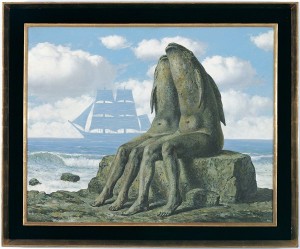
René Magritte, Les merveilles de la nature (The Wonders of Nature), 1953, oil on canvas, 30 1⁄2 x 39 inches;
Featured Images: (Click to Enlarge)
-
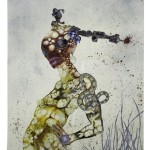
- Wangechi Mutu, That’s my death mask you’re wearing, 2004, ink, collage, and contact paper on mylar, sheet: 39 x 28 inches;
-
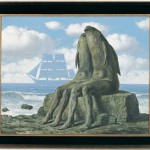
- René Magritte, Les merveilles de la nature (The Wonders of Nature), 1953, oil on canvas, 30 1⁄2 x 39 inches;
-
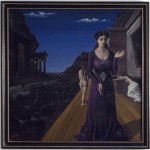
- Paul Delvaux, Penelope, 1945, oil on board, 48 x 47 1⁄2 inches.
-
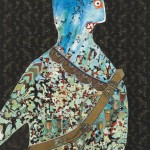
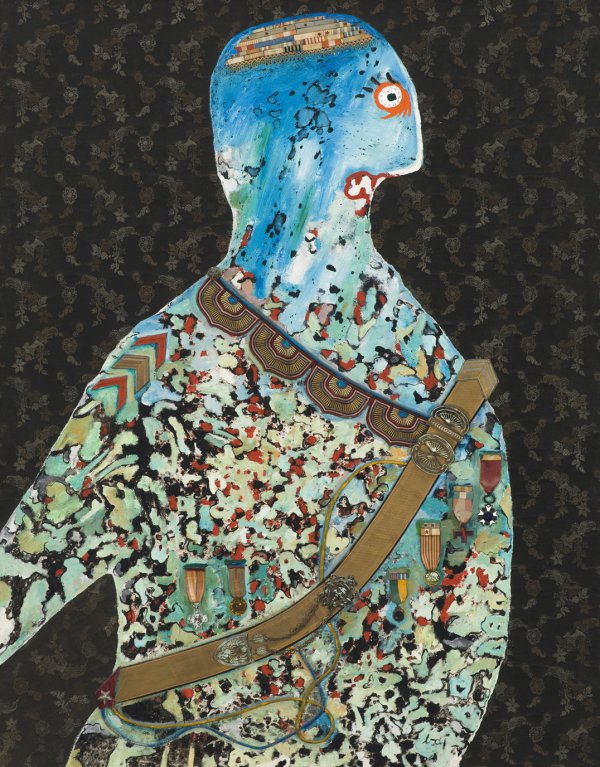
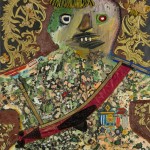
- Enrico Baj, Profile of a General, 1961, oil, fabric, medals, coin, and watch-face on canvas.
“Surrealism was, if not the first, then one of the first global art movements that emanated from Europe,” says Lynne Warren, the curator of the exhibition “Surrealism: The Conjured Life” at the MCA Chicago (November 21–June 5). “Then things reverted to national boundaries, like associating Abstract Expressionism with America, Arte Povera with Italy, and so on.” The art movement, which was formally described by André Breton in Paris with the penning of the Surrealist Manifesto in Paris in 1924, spread its seed stateside, as Warren notes, during the middle of the 20th century, not missing Chicago’s artists or collectors. However, the first major exhibition of American Surrealism did miss the Windy City.
The show “Abstract and Surrealist Art in the United States,” which was curated by collector and curator Sidney Janis, held court at the Cincinnati Art Museum and the San Francisco Art Museum in 1944. Three years later, Frederick A. Sweet and Katharine Kuh curated Chicago’s Fifty-Eighth Annual Exhibition of American Paintings and Sculpture (running November 6, 1947, through January 11, 1948). Its focus was “Abstract and Surrealist American Art,” and it put on view a broad conception of American artists working in a Surrealist and Abstract style. In his forward to the exhibition’s catalogue, the Art Institute of Chicago’s then-director Daniel Catton Rich wrote of the curators’ thirst for fresh blood. “No painting or sculpture previously shown in one of the large national exhibitions has been invited by [the curators] and all works have been produced in the last five years,” wrote Rich, “The result is an exhibit truly national in scope and strictly contemporary in spirit. Of the 252 artists exhibiting, some 85 are newcomers to museum annuals and 113 have never previously exhibited at the Art Institute.” That exhibition and the present exhibition at the MCA have a short list of artists in common—Alexander Calder, Roberto Matta, Kay Sage, Kurt Seligmann, Dorothea Tanning, and Yves Tanguy—but none of the same works return. William Baziotes’ Cyclops (1947) won the exhibition’s “Purchase Prize” and was priced at $950 according to the catalogue, while his Cat (1950), presumably of a much higher value today than Cyclops was then, will be shown at the MCA.
Rich’s forward points to the vanguard nature of abstraction in America, explaining that some don’t get it but that the avant-garde—particularly those under 30—see it as the prevailing art movement in the country. With works by Pollock, Hofmann, and Albers showing the movement’s roots in America, it seems that the exhibition’s organizers had an easy time explaining its emergence (the idea of national boundaries that Warren speaks of for Abstract Expressionism rings true here). “Surrealism, on the other hand,” wrote Rich, “has had no comparable development, though a number of painters and sculptors have not hesitated to blend its elements with abstraction, producing a style for which no adequate term has yet been coined.” This blending that Rich speaks of lead to the majority of the works on view in “Surrealism: The Conjured Life.”
Paying homage to the forefathers and mothers of Surrealism, the exhibition at the MCA, which is mined exclusively from its own collection, includes works by René Magritte, Balthus, Leonora Carrington, and Dorothea Tanning, among others. From there it splits into two groups: contemporary international artists such as Wangechi Mutu, Mark Grotjahn, Cindy Sherman, and Jeff Koons who consistently or on occasion flirt with Surrealism; and artists like Gertrude Abercrombie, Leon Golub, and Jim Nutt, who have a strong connections to both Chicago and Surrealism. The former echoes the global reach of Surrealism and the mixture of Surrealist notions with other styles that Rich spoke of. The latter—a deep, unshakable connection between the Windy City and Surrealism after 1950—is a testament to Chicago’s collectors as well as the artists based or educated there.
“Within that context, in our roots, our DNA, there is this Surrealist thing going on, and that influenced the subsequent art production in Chicago,” says Warren. “The Art Institute of Chicago taught the immediate postwar generation of artists, like Leon Golub. Th next generation is the Chicago Imagists—Jim Nutt, the Hairy Who artists—and they were very influenced by Surrealism. It seems, historically, like that’s a current that shapes what happened, which hasn’t been terribly well explored.” In the case of Nutt, who was educated at the School of the Art Institute of Chicago before it had amassed a healthy collection of Surrealist works, teachers like Whitney Halstead and Ray Yoshida were instrumental in introducing the movement. Though Nutt’s work is surely a cocktail of many influences (Pop Art, comics, and Psychedelic rock come to mind), his notions of perverted figuration, which come up repeatedly in his work, seem to have roots in Surrealism. Nutt and his Chicago cohorts—now known as the Hairy Who and the Chicago Imagists—shared this inclination. Says Warren, “If you’re interested in the figure, you’ll come up with some of the same ideas, and the Surrealists were mostly figurative artists. The distorted body was a characteristic of the Chicago Imagists.”
In a 1985 essay about the Chicago Imagists and Surrealism, Peter Selz writes that their connection lies somewhere between the refusal of the art world’s status quo and the acceptance of the unreal. “Aside from their attention to Expressionists like Ensor, Munch, and Nolde, who themselves gave form to demonic aspects of life, the young Chicago artists shared with the Surrealists an interest in tribal, primitive, and exotic art, as well as the art of children and the insane,” wrote Selz, “Both groups searched for art that embodied myth, magic, and psychic power and rejected the tradition of Western art, which seemed to have gone stale. It was the Surrealists’ glorification of the absurd and the irrational that seemed like a logical and rational response to a world-out-of-joint, the troubled and turbulent years between the World Wars.”
The Chicago Imagists, working in the mid-to-late ’60s and ’70s, were creating art in a turbulent, highly engaged social and political landscape, as well. According to Warren, Chicago at the time was also a pretty weird place. “It was a very strange city in the ’40s through ’70s,” says Warren. “Back then, there were strange manufacturing things going on, and a lot of merchandising—things were created to sell and market, and there were mannequins everywhere. A lot of the life of the city was about coming down on Christmas to see the windows at Marshall Fields; there were automatons in there. It was a very surreal place.” Warren notes that just as there were slaughterhouses and factories, there was also the University of Chicago and important intellectuals in town. “Real culture was going on as well,” she says.
Viewers of the show at the MCA will receive a primer on the Chicago Imagists and Hairy Who artists and their connections to Surrealism, with works like Giant Bird (1971) by Gladys Nilsson, Sunburn (1970) by Ed Paschke, Muscular Alternative (1979) by Christina Ramberg, and Summer Salt (1970) by Jim Nutt on view. These are a mix of highly refined technical skill and subversive underground sleaze—a true reflection of the city at the time.
Postwar Chicago also had its upper crust. There were a handful of pioneering art collectors in the Windy City at the time who had just as much of an eye for the surreal as the artists. According to Warren, Joseph Randall Shapiro, the founding board president of the MCA and Edwin and Lindy Bergman set the tone for collecting in Chicago in the ’50s and ’60s. Influenced by theories of psychoanalysis and Freudian symbolism, they turned to the Surrealists. Shapiro started by collecting prints and moved to oils in the ’50s. He liked “tough works,” as Warren put it, collecting Francis Bacon before he was hot. Shapiro was a fan of Hans Bellmer’s drawings, Kurt Seligmann’s paintings, H.C. Westermann’s pieces, and had an Enrico Baj Weeble-style sculpture titled Punching General (1969) that he would punch (an action the artist intended) upon welcoming guests into his home. This casual attitude mixed with a sharp collecting eye had an influence on Chicago’s younger artists. “Joe was so supportive of Chicago-based artists, which is one huge thread of the show,” says Warren. “Many of the artists, like Irving Petlin, got to get in and see these great collections of Surrealism. Joe’s apartment had normal furniture—it wasn’t decorated up. You put your drink on the Noguchi table; people smoked all the time back then, and there were smoke stains over the Dalí. That whole immersion in the material was very important to artists.”
The MCA owes its collection of works by Texas painter and visionary artist Forrest Bess to Mary and Earle Ludgin. After discovering his work at the Betty Parsons gallery in New York, the Chicago collectors became Bess’ main patrons. “They bought from him when they felt he needed some support,” says Warren. Bess, who corresponded with Carl Jung, met Parsons after writing her letters. The works in the MCA collection, which will be on view in “The Conjured Life,” are for the most part small landscapes from the late ’40s and early ’50s. Homage to Ryder, a 1951 driftwood-framed tribute to Albert Pinkham Ryder, captures the dreamlike quality of Ryder’s work (a proto-Surrealist one might argue).
“The Conjured Life” will be showing familiar artists in unfamiliar contexts. Cindy Sherman’s Untitled #188, a 1989 chromogenic development print, will be on view, reinterpreted amid Surrealist works. “Cindy Sherman is neither a Chicago artist nor a Surrealist. But the work in the show is very surrealist Cindy Sherman!” says Warren. “Mirrors, doll, lipstick smeared, abject human body, mannequin, automaton, dream state notions that we associate with the visual arts of Surrealism, are present in works like that. We’re not claiming she’s a Surrealist, but those works can be seen very productively in light of works that formed Surrealism.” Similarly Jeff Koons’ bronze Lifeboat (1985) finds a place in the show. Of Koons, Warren says, “He’s more open about this now—that he was influenced by Dali. One piece we have, of the lifeboat, is a realistic cast done in bronze—right there is a Surrealist idea. It has one appearance and a very different function, which is a Surrealist trope.” This shape-shifting interpretation of the Surrealist movement seems wholeheartedly in the Chicago tradition.
—
By Sarah E. Fensom

Subscribe to Art & Antiques for your Digital or Print copy