Subscribe to Our Newsletter
Illustrating a Point
Classic works of illustration art, created to be mass-reproduced, are now giving the greatest American painters a run for their money.
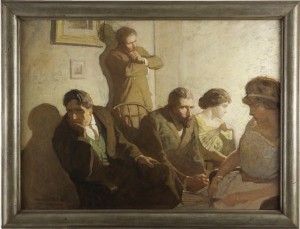
Newell Convers Wyeth, Mrs. Van Anden Sings: A Story of the North Country;
Featured Images: (Click to Enlarge)
-
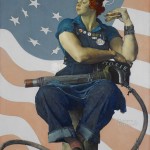
- Norman Rockwell, Rosie the Riveter, 1943.
-
- Newell Convers Wyeth, Mrs. Van Anden Sings: A Story of the North Country;
-
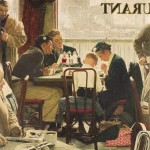
- Norman Rockwell, Saying Grace, 1951;
-
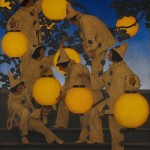
- Maxfield Parrish, The Lantern Bearers, 1908;
-
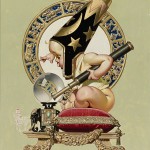
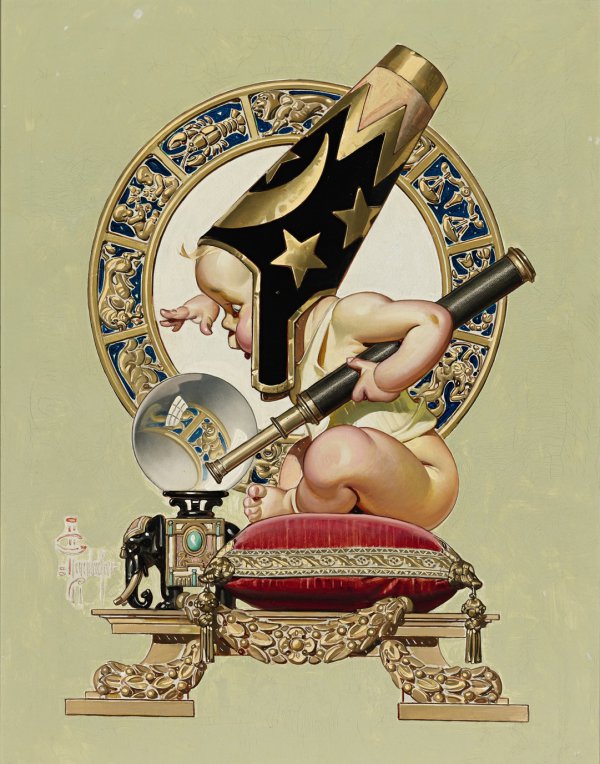
- Joseph Christian Leyendecker, New Year’s Baby, circa 1935.
In early October 2013 in Hong Kong, Sotheby’s displayed highlights from an upcoming December sale in New York. It included Andy Warhol’s Silver Car Crash (Double Disaster); a Picasso Tête de femme, a Giacometti Grande tête de Diego, and three original oils on canvas that American illustrator Norman Rockwell made for the cover of The Saturday Evening Post and owned by the late Ken Stuart, the magazine’s art director: Walking to Church (1953),The Gossips (1948), and Saying Grace (1951). “The Rockwells were what everyone was lined up to see,” says Elizabeth Goldberg, head of Sotheby’s American Art Department, recalling. “People were getting so close, we had to put up stanchions.”
Two months later, the Rockwells were offered in an American Art sale that also listed entries by Childe Hassam, Albert Bierstadt, Thomas Moran, Arthur Dove, Georgia O’Keeffe, Mary Cassatt, John Singer Sargent, Milton Avery, Thomas Hart Benton, and Edward Hopper. Two Stuart-owned Post cover illustrations landed within their seven-figure estimates, but Saying Grace, an image of an elderly woman and a small boy bowing in prayer over their modest diner meal, and considered by many to be Rockwell’s masterpiece, romped beyond its already-ample $15–20 million estimate to garner a jaw-dropping $46 million. Not only did Saying Grace set an auction record for Rockwell—who died in 1978 at age 84—it earned the highest price for any work in the American art category at auction. The implications were unmissable. Illustration art—often derided and dismissed by art historians and critics for its inherent commercialism and its aim to please the widest possible audience—triumphed over fine art, at least in the arena of the marketplace. This category-topping turn of events was hard to foresee in the mid-1990s, when bidders started to nudge Rockwell past the million-dollar threshold.
“If you’re putting together an American paintings collection, be it institutional or private, you need to have a representative work by Rockwell,” says Ed Jaster, senior vice president at Heritage Auctions in Dallas. The prize Rockwell at the Crystal Bridges Museum of American Art, opened in Bentonville, Ark., just over three years ago, is a 1943 oil on canvas for the Post depicting Rosie the Riveter on her lunch break, her rivet gun lying across her lap and her foot resting on a copy of Mein Kampf. “She has her own wall,” says Manuela Well-Off-Man, curator at Crystal Bridges. “We want to cover important American artists, and Norman Rockwell is definitely one of the more important American artists in terms of his success as an illustrator.” The Lucas Museum of Narrative Art, due to open in Chicago in 2018, will certainly feature major Rockwells; its founder, filmmaker George Lucas, is among the keenest of Rockwell collectors.
The sale of Saying Grace did have something of a halo effect on illustration art, but its glow is indirect. Goldberg says that a rise in demand for masterworks of American illustration art is largely indistinguishable from increased competition at auction for anything that qualifies as a masterpiece, no matter what it is, who made it, or when it was made. Works by two other elite illustrators appeared in that watershed December 2013 Sotheby’s auction: Maxfield Parrish and N.C. Wyeth. Their lots, all originally commissioned by clients, earned six- and seven-figure sums. Two oils on board from The Knave of Hearts, a 1925 book with what are regarded as Parrish’s finest group of book illustrations, exceeded their estimates: a “List of Characters” image made $437,000 against a $200,000–300,000 estimate, and The Six Little Ingredients, a scene of toque-clad boys presenting pots of baking ingredients on trays, sold for $1.9 million against a $250,000–350,000 estimate.
Crystal Bridges displays its Parrish, The Lantern Bearers, created in 1908 for Collier’s magazine, alongside paintings by Martin Johnson Heade and Fitz Henry Lane. “The artist really had great interest in and treatment of light,” says Well-Off-Man. “This painting really represents the peak of his career, with the glowing lanterns in contrast with the sky. It’s one of his major works, if not the best he did.”
Crystal Bridges’ founder, Alice Walton, pledged $4.2 million at Christie’s in 2006 for The Lantern Bearers, which almost equals the price paid at Sotheby’s in 1996 for Daybreak, Parrish’s best-known painting. (Daybreak subsequently sold twice more at Christie’s, tallying $7.6 million in 2006 and $5.2 million in 2010.) The impact of the vision of two beautiful nymphs luxuriating in an impossibly magnificent landscape is hard to fathom, even now. It’s estimated that during the 1920s, one in four American homes had a Parrish print on its walls, and most of those prints were Daybreak, which he painted in 1922 expressly for reproduction. Parrish was a brilliant technician and a hard and patient worker (he had to be, considering that his ethereal atmospheric effects required layer after layer of oils and glazes, and each had to dry before another could be applied), but he was an even better businessman. His contracts usually specified single-use rights that allowed him to retain ownership of the art that his clients commissioned from him.
Parrish ended his life with no regrets about his long and lucrative career. If he’s spinning in his grave now, it’s because he isn’t getting a cut of his secondary market. N.C. Wyeth was far more conflicted about his path than Parrish or Rockwell ever were. “He wanted to be an easel painter, and he did do easel paintings,” says Judy Cutler, director of the American Illustrators Gallery in New York and founder of the 14-year-old National Museum of American Illustration in Newport, R. I. “But he needed to make a living. He had five kids.”
Looking at his illustrations, it’s sad to think that Wyeth couldn’t enjoy them as much as generations of readers did. No small boy could resist Stand and Deliver, Wyeth’s 1921 Life magazine cover depicting a menacing band of pirates staring down the viewer as the Jolly Roger flies behind them. (It sold at Sotheby’s in 2006 for $2 million against a $1–1.5 million estimate.) And it’s difficult to deny the power of The Raft of Odysseus (Neptune Battles with Odysseus), an illustration for a 1929 edition of The Odyssey that shows the sea-god peering over a cresting wave at the Greek hero clinging to a raft, or The Homecoming, a 1945 Woman’s Day cover of a decommissioned soldier with his back to us, taking in the view of his homestead as his dog runs up the driveway to greet him. (Wyeth’s son, Andrew, served as the model for the returning soldier.) Each was consigned to a November 2014 sale at Christie’s with identical estimates of $600,000–800,000.
For all his agonized aspirations to fine art, N.C. Wyeth’s commercial art offers his surest claim to immortality (along with having established an American dynasty of painters that includes his youngest child, Andrew, and his grandson, Jamie). “Painting for the sake of painting, none of these guys did that except for Wyeth, and even then, it wasn’t a meaningful part of his career,” says Jaster.
Rockwell’s success at auction might help raise the profile of his idol, illustrator Joseph Christian (J.C.) Leyendecker. Despite a five-decade career that included 321 covers for the Post, as many as Rockwell delivered, he virtually disappeared from view when he died in 1951, after a decline that accelerated with the 1941 arrival of new leaders at the Post who wanted to break with the look of the past. The German-born immigrant made his artistic debut in 1896 by winning a magazine cover illustration contest (Maxfield Parrish took second place). Leyendecker then went to Paris to study at the Académie Julian under Adolphe Bouguereau, the man who put the capital A in Academy.
But the rigid formality of his artistic schooling imparted no snobbery when it came to assignments. Leyendecker’s most effective creation was the Arrow Collar Man, a Gatsbyesque fellow whose impeccable visage in advertisements for Arrow collars permeated popular culture for three decades, becoming the very image of masculine stylishness. Leyendecker also invented the notion of the baby as a symbol for the new year, and painted charming tots for the covers of more than two dozen January issues of the Post. “In terms of being a painter, he was one of the best,” says Jaster. “But he was a tragic figure. The fact that he was gay was too scandalous. He went from the greatest illustrator in America to a forgotten man by 1935 to 1940.”
Leyendecker is overdue for attention, and with Rockwells rising out of reach, he might finally receive it. “Now that Rockwells are routinely $1 million or more, people are looking for something comparable, and Leyendecker is a logical artist to look to,” says Sotheby’s Goldberg. Christie’s set the Leyendecker auction record with Football Scrimmage, an oil on canvas that realized $209,100 against an estimate of $12,000–18,000. The Norman Rockwell Museum will soon shine its spotlight on the illustrator, as well. J.C. Leyendecker and the Saturday Evening Post will open at the Stockbridge, Mass., museum on March 21, 2015 and will continue through June 14, 2015. It will be its second Leyendecker show; its first was in 1998.
Cutler has championed American illustration art longer than anyone, having founded her New York gallery in 1965. “I would always pay more than anybody to buy them. That’s how I could get them,” she says, recalling. In those early years, she priced Rockwells between $25,000 and $100,000; Leyendeckers were $1,500 to $15,000; Parrishes could be had for $15,000 to $75,000, and N.C. Wyeth illustrations ranged from $7,500 to $45,000. She regrets that she could not buy to hold for stock: “In order to keep getting them, I had to sell them to buy more.” Cutler’s clients didn’t have investment value in mind, but things might be changing. “They bought them for the reason that you should collect art—you like them,” she says. “But now it’s harder and harder to get these things. People don’t want to sell anymore. It’s interesting how the market has changed. There’s not much available, and when it’s available, it sells.”

Subscribe to Art & Antiques for your Digital or Print copy