Subscribe to Our Newsletter
David Ligare: Daring to Know
The astonishing life work of a “California Classicist” goes on view at the Crocker Art Museum.
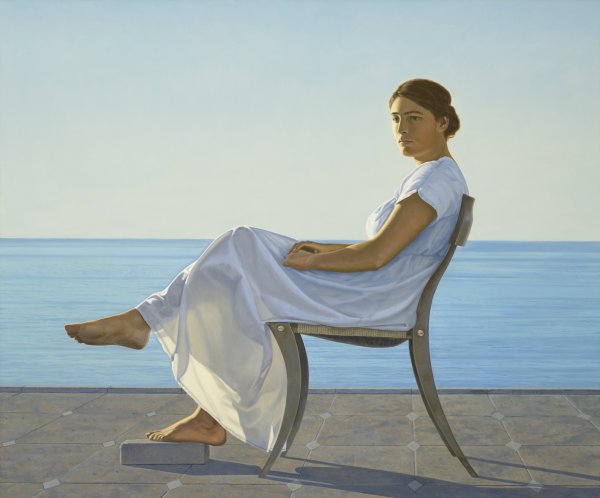
David Ligare, Penelope, 1980, oil on canvas, 40 x 48 inches.
Featured Images: (Click to Enlarge)
-
- David Ligare, Still Life with Polykleitan Head (Summa), 2002, oil on canvas, 40 x 48 inches.
-

- David Ligare, The Philosophy of Flowers II, 2006, oil on canvas, 20 x 24 inches;
-

- David Ligare, Penelope, 1980, oil on canvas, 40 x 48 inches.
-
- David Ligare, On Perspective
-

- David Ligare, Delos (Thrown Drapery), 1978, oil on canvas, 78 x 110 inches.
There is no artist in the world today quite like David Ligare. He paints scenes that evoke Classical antiquity or Renaissance Italy, yet his pictures are neither nostalgic fantasies nor manifestoes of cultural conservatism. His technique is intricate, wonderfully precise in its handling of perspective, texture, and light, yet he is no photorealist. He works in the three traditional genres of landscape, still life, and the figure, yet what he is really painting is thought itself. Now 70, Ligare found his artistic calling almost 40 years ago, and since the late 1970s has been producing a body of work that is remarkably consistent in its themes and style, though diverse in subject matter. Ligare has had many solo gallery shows (recent paintings were on view in April and May at Hirschl & Adler in New York) and been featured in group exhibitions at museums across the country, but many art aficionados are still unfamiliar with his work. However, starting on June 7, viewers can absorb the full breadth of Ligare’s art in a retrospective exhibition at the Crocker Art Museum in Sacramento, Calif., “David Ligare: California Classicist” (through September 20). The show is accompanied by an in-depth, scholarly catalogue including essays by Scott Shields, chief curator and associate director of the Crocker, and art critic Donald Kuspit.
Ligare is definitely a California artist, though not in the same way as, say, Richard Diebenkorn or Ed Ruscha. In his adherence to still life he has something in common with fellow Bay Area painter Wayne Thiebaud, though the resemblance pretty much ends there. Ligare lives on the Monterey Peninsula and sometimes paints en plein air, so in a sense he belongs to the artistic tradition, begun in the late 19th century, of celebrating the unique qualities of the region’s terrain and light. While Ligare’s neo-Neoclassical work, which inserts elements into the landscape that are not to be seen anywhere except in the mind’s eye, may not seem to have much in common with that of a Granville Redmond or a Guy Rose, there is a certain cultural continuity linking him with that pioneering era. In the early days of California’s settlement, arriving Easterners and Europeans frequently noted how closely akin the Golden State’s geography and climate were to those of the Mediterranean, especially Greece and Italy. Ligare likes to point out that the idea of reviving Classical ideas and forms was very much a part of the early self-conception of the state of California.
Passing through the frame of a Ligare painting, one could just as easily be on the grounds of a temple in ancient Greece as on the Monterey Peninsula. The same, strangely mellow yet sharply-defining light—a “light that never was on sea or land”—illuminates everything. The artist conjures a timeless world in which many eras and places converge and meet—or perhaps “interpenetrate” is the better word. In Penelope (1980), a beautiful, strong-looking, ageless woman sits in a chair on a patio by the ocean’s edge, her legs casually crossed, one foot resting on a mini-plinth. Her gaze, turned away from the water but not quite meeting that of the viewer, is impassive, patient, suggesting wisdom. She could be Odysseus’ wife, waiting for him to return from the Trojan War, knowing better than to look out to sea, but she could also be a woman of our own time. Her white garment suggests ancient styles, but it is more of a 20th-century sun dress than a chiton. The chair, as graceful and well-proportioned as its inhabitant, is Greek in inspiration, but a close look reveals that its perfectly proportioned parts are joined together with modern screws.
Che Soffre Speri (1990) causes four distinct eras to overlap. In the middle ground it depicts an imaginary Temple of Virtue, based on a design by the 18th-century English architect William Kent. In the foreground is a stone tablet inscribed with the words of the painting’s title (Italian for “he who suffers, hopes”), an allusion to a play by the 17th-century Italian prelate Cardinal Giulio Rospigliosi about the mythic hero Hercules’ choice between pleasure and virtue. And the landscape stretching off into the distance, while it could pass for Classical with its rocky soil and slim cedars, is absolutely Northern Californian.
Ancient and modern also meet in Still Life With Grape Juice (Xenia), a 1989 example of a genre that Ligare basically invented and is still exploring. In this series, the artist places a sort of box, open on two sides, by the seaside, where a sideways-raking light falls on an assortment of objects such as food, drink, and flowers, placed there as if in offering to a deity. In this painting, the plastic pitcher of grape juice and the stack of white bread slices situate the offering squarely in today’s world, but the sense of purity and serenity evoked by this contemporary version of bread and wine is timeless. Ligare has written that the ingredients “are typical of the meals prepared to feed the homeless here in Monterey County…at a nearby ‘community kitchen’ by a devoted group called The Franciscan Workers of Junipero Serra.” The incongruity of placing these humble mass-produced foodstuffs in a context far removed from a homeless shelter could be humorous—and in a way it is—but while Ligare has a well cultivated sense of fun, he is never satirical. What he doing here is redeeming and transforming, as well as making the ancient notion of religious offering relevant to today’s world.
Ligare’s work has been called Neoclassical; the artist himself prefers the term “recurrent classicism.” By that he means that the ancient Greek ideas that form the basis of Western art, literature, and philosophy need to be periodically rediscovered and revitalized. That has happened several times before, notably in the Italian Renaissance and the Neoclassical movement of the 18th century. Each time these ideas and aesthetics are revived, of course, they are different—or at least by virtue of being applied in a new context and in response to new needs, they are experienced differently. Ligare’s work is no slavish imitation of ancient Greece or Rome or quattrocento Italy but a contemporary reimagining and transformation.
Classicism itself is a reinvention; the word implies a return to sources from which one feels a sense of being removed in time. Ancient Greece wasn’t “Classical”; the word was first used by the 18th-century German archaeologist Johann Winckelmann. And as in Winckelmann’s notion of an unattainable but ever-to-be-strived-for perfection, symbolized by the white marble sculpture he loved, in Ligare’s work there is a sense of tension, an inner conflict between what we see in the painting and what we see in “real life.” Or put another way, the tension is between the artist’s and the viewer’s need for beauty and perfection and their joint realization—and acceptance—that it cannot exist except in art.
Ligare is not a conservative; while heavily indebted to Polykleitos and Poussin, he also sees himself as an heir of Picasso (also a Classicist in many ways) and Cézanne. He calls himself a postmodernist, and if he is a rebel in any sense it is against what he calls the “predictably quirky” quality of contemporary art. Ligare has recently written, “Contemporary art’s methods have become as conventionalized as the French Academic art of the 19th century was. It is now entirely formulaic even when it purports to be inventive… Many years ago I asked myself, if Duchamp were alive today what kind of art would he be making? I believe that that he would be making history paintings because, like his “Fountain,” history paintings are wholly unwelcome within the context of contemporary art.”
Ligare’s paintings, rooted in history and unafraid to adopt anachronistic elements without irony, are radical and provocative, but what he is really after is not provocation but a “radical pursuit of knowledge.” The mathematical precision of his use of perspective, his insights into ancient culture, his penetrating gaze at nature and the human body, are all in the service of this pursuit. The Latin inscription on one of his recent botanical still lifes says it all: Sapere Aude—“dare to know.”

Subscribe to Art & Antiques for your Digital or Print copy